Committee advances bill affirming CARB authority to regulate indirect sources amid debate over costs and guardrails
March 23, 2026 | California State Assembly, House, Legislative, California
This article was created by AI summarizing key points discussed. AI makes mistakes, so for full details and context, please refer to the video of the full meeting. Please report any errors so we can fix them. Report an error »
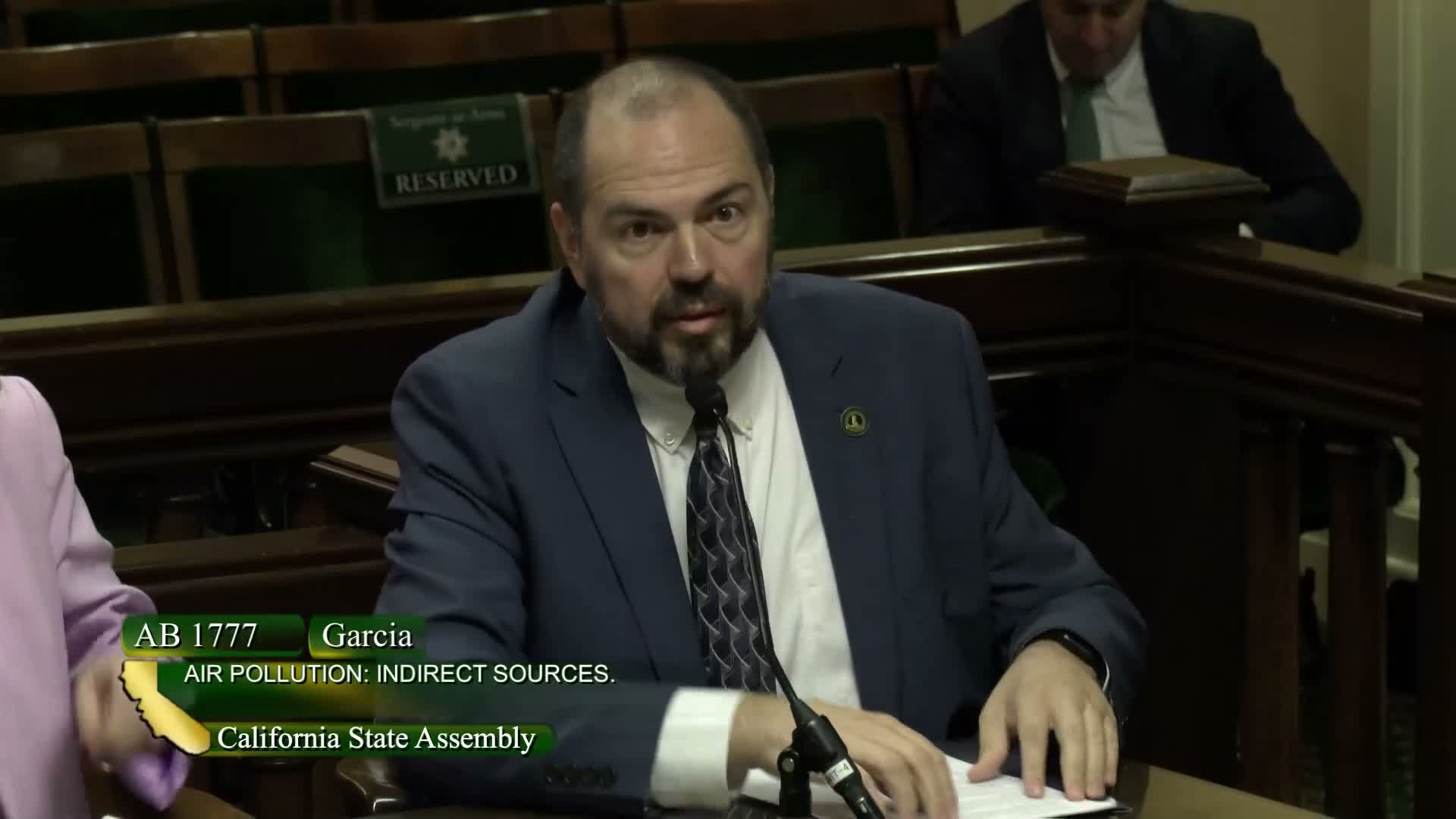
Assemblymember Garcia reintroduced AB 17 77 to explicitly affirm that the California Air Resources Board (CARB) may adopt indirect source rules (ISRs) for facilities that attract heavy vehicle activity and associated tailpipe pollution. "This bill will clarify and safeguard California's authority to clean up our air," the author said, framing the measure as a response to federal rollbacks and as a tool to protect children and other vulnerable Californians.
Environmental and health organizations provided strong backing. Ada Welder of Earthjustice, a cosponsor, said ISRs give regulators flexible compliance options and can address pollution hotspots. Dr. Benjamin Liu of the American Lung Association said diesel emissions remain concentrated in communities near ports, warehouses and freight corridors and urged the committee to preserve the state's regulatory toolbox.
Industry and business groups mounted broad opposition. Speakers for the Supply Chain Federation, California Trucking Association, California Chamber of Commerce, ports and warehouse, trucking and construction trade associations argued AB 17 77 would give CARB open-ended authority to impose costly, statewide ISR programs that could drive up prices and should remain a local air district function. "AB 17 77 gives CARB expansive new blank check authority to adopt ineffective and costly regulations known as indirect source rules," said a representative for the trucking industry.
Committee members pressed the author and witnesses about whether the bill affirms existing authority or creates new statewide rule-making power, and whether guardrails are needed to avoid imposing one-size-fits-all requirements across regions with different air quality challenges. Several members asked the author to work with labor and port stakeholders to address job and economic concerns.
The committee recorded a motion to refer AB 17 77 as due pass to the Appropriations Committee; the motion carried on a roll call vote. Next steps: fiscal review in Appropriations and likely stakeholder negotiations over potential guardrails or clarifying language.
Ending: The committee advanced AB 17 77 while signaling further negotiation is likely on scope and protections for workers and local economies before any final rulemaking authority is acted on by CARB.
Environmental and health organizations provided strong backing. Ada Welder of Earthjustice, a cosponsor, said ISRs give regulators flexible compliance options and can address pollution hotspots. Dr. Benjamin Liu of the American Lung Association said diesel emissions remain concentrated in communities near ports, warehouses and freight corridors and urged the committee to preserve the state's regulatory toolbox.
Industry and business groups mounted broad opposition. Speakers for the Supply Chain Federation, California Trucking Association, California Chamber of Commerce, ports and warehouse, trucking and construction trade associations argued AB 17 77 would give CARB open-ended authority to impose costly, statewide ISR programs that could drive up prices and should remain a local air district function. "AB 17 77 gives CARB expansive new blank check authority to adopt ineffective and costly regulations known as indirect source rules," said a representative for the trucking industry.
Committee members pressed the author and witnesses about whether the bill affirms existing authority or creates new statewide rule-making power, and whether guardrails are needed to avoid imposing one-size-fits-all requirements across regions with different air quality challenges. Several members asked the author to work with labor and port stakeholders to address job and economic concerns.
The committee recorded a motion to refer AB 17 77 as due pass to the Appropriations Committee; the motion carried on a roll call vote. Next steps: fiscal review in Appropriations and likely stakeholder negotiations over potential guardrails or clarifying language.
Ending: The committee advanced AB 17 77 while signaling further negotiation is likely on scope and protections for workers and local economies before any final rulemaking authority is acted on by CARB.
View the Full Meeting & All Its Details
This article offers just a summary. Unlock complete video, transcripts, and insights as a Founder Member.
✓
Watch full, unedited meeting videos
✓
Search every word spoken in unlimited transcripts
✓
AI summaries & real-time alerts (all government levels)
✓
Permanent access to expanding government content
30-day money-back guarantee
