Minn. bill to give subcontractors access to payment records clears Labor Committee
March 23, 2026 | 2026 Legislature MN, Minnesota
This article was created by AI summarizing key points discussed. AI makes mistakes, so for full details and context, please refer to the video of the full meeting. Please report any errors so we can fix them. Report an error »
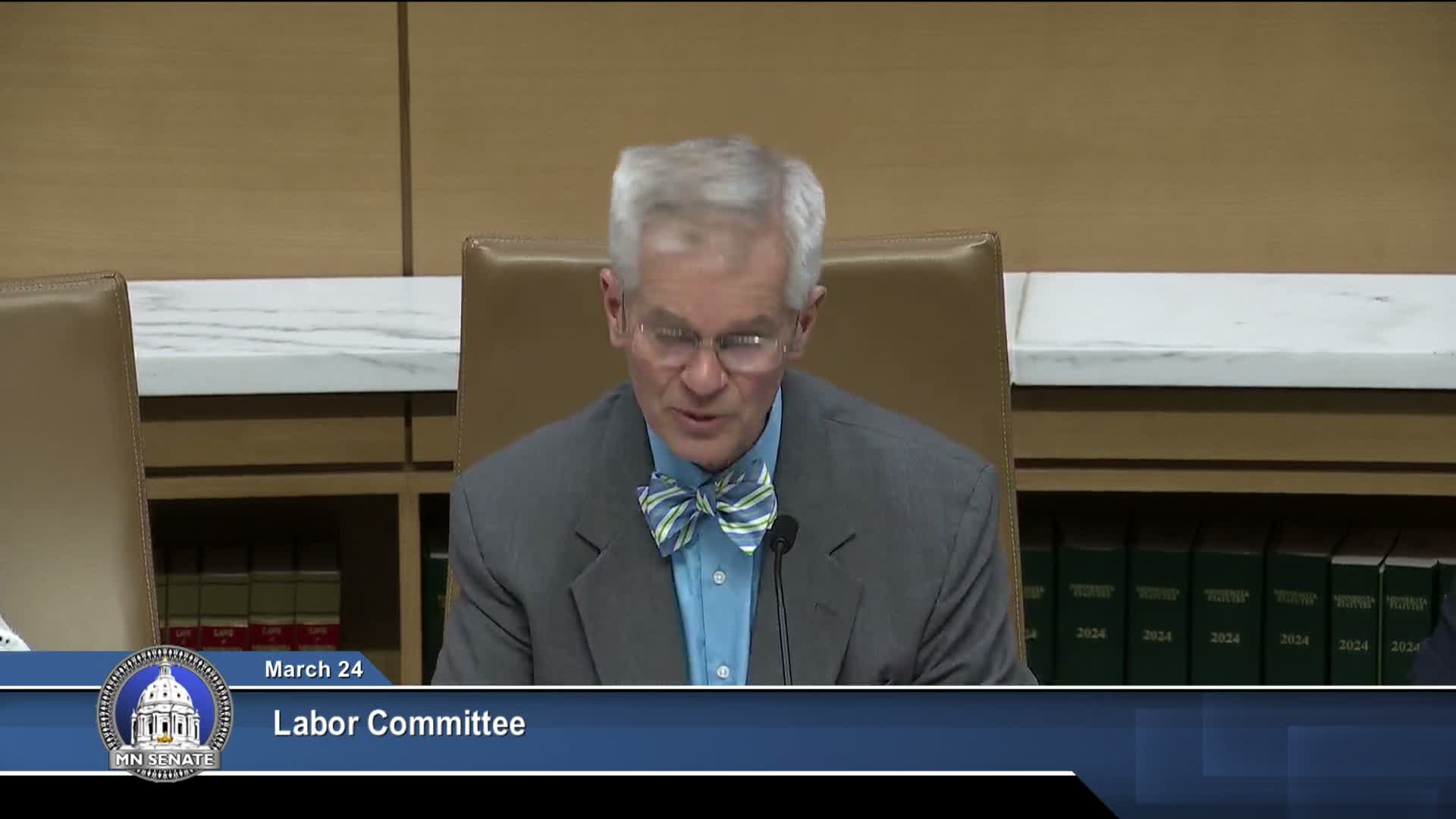
Senate File 1714, a bill to increase payment transparency on public construction projects, was recommended to pass by the Minnesota Senate Labor Committee after the committee adopted an amendment that narrows how agencies provide payment information.
Senator Johnson Stewart, the bill sponsor, told the committee the measure would let subcontractors learn whether a general contractor has been paid so subcontractors can enforce the prompt payment act. "If this goes through," she said, subcontractors would be able to contact MnDOT, DNR or the Department of Administration and request written confirmation that a contractor has been paid.
The author said the bill grew out of bipartisan work and multiple stakeholder meetings with public owners, contractors and industry groups. She described concessions made to address agency concerns and said the amendment (A7) reflects rounds of compromise; under the amendment, subcontractors must request the payment information and agencies must respond within seven days.
Opponents said the A7 amendment removed provisions that protected timely invoice submission. Senator Rehrig argued the amendment made it "really hard" to accept the bill, and warned that deleting invoice-protection language leaves subcontractors exposed. "What we're asking for is common sense," the senator said, adding that in its original form the bill offered stronger protections.
Two subcontractors testified in support. Heather Hoffman, who identified herself as owner of Commercial Drywall (a Minnesota commercial subcontractor), described repeated delays in payment on a large school project and said a public-owner response that arrived 45 days after a records request came too late to protect her company's rights. "The bill does not guarantee we get paid, but it will provide us with timely payment information and greater transparency on public work," Hoffman said.
Blake Nelson, an attorney and president of the Minnesota Subcontractors Association, said the amended approach was practical: rather than requiring agencies to notify every subcontractor proactively, the law would require agencies to provide payment information within seven days when a subcontractor asks. Nelson said stakeholders negotiated significant concessions and that the revised approach would be workable for public owners and general contractors.
The committee adopted the A7 amendment by roll-call (the chair announced the result as 5 ayes and 3 nays) and later voted to recommend the bill to pass as amended. Committee members stressed that additional work is needed on invoicing processes and procurement change-order practices and that sponsors plan to continue negotiating technical fixes over the interim.
The committee sent the amended bill to the Senate floor for further consideration.
Notes: The bill references the prompt payment act and existing state rules on retainage; members noted historical retainage caps and that current law sets timelines for subcontractor payment but that the process to obtain proof of payment has been opaque.
Senator Johnson Stewart, the bill sponsor, told the committee the measure would let subcontractors learn whether a general contractor has been paid so subcontractors can enforce the prompt payment act. "If this goes through," she said, subcontractors would be able to contact MnDOT, DNR or the Department of Administration and request written confirmation that a contractor has been paid.
The author said the bill grew out of bipartisan work and multiple stakeholder meetings with public owners, contractors and industry groups. She described concessions made to address agency concerns and said the amendment (A7) reflects rounds of compromise; under the amendment, subcontractors must request the payment information and agencies must respond within seven days.
Opponents said the A7 amendment removed provisions that protected timely invoice submission. Senator Rehrig argued the amendment made it "really hard" to accept the bill, and warned that deleting invoice-protection language leaves subcontractors exposed. "What we're asking for is common sense," the senator said, adding that in its original form the bill offered stronger protections.
Two subcontractors testified in support. Heather Hoffman, who identified herself as owner of Commercial Drywall (a Minnesota commercial subcontractor), described repeated delays in payment on a large school project and said a public-owner response that arrived 45 days after a records request came too late to protect her company's rights. "The bill does not guarantee we get paid, but it will provide us with timely payment information and greater transparency on public work," Hoffman said.
Blake Nelson, an attorney and president of the Minnesota Subcontractors Association, said the amended approach was practical: rather than requiring agencies to notify every subcontractor proactively, the law would require agencies to provide payment information within seven days when a subcontractor asks. Nelson said stakeholders negotiated significant concessions and that the revised approach would be workable for public owners and general contractors.
The committee adopted the A7 amendment by roll-call (the chair announced the result as 5 ayes and 3 nays) and later voted to recommend the bill to pass as amended. Committee members stressed that additional work is needed on invoicing processes and procurement change-order practices and that sponsors plan to continue negotiating technical fixes over the interim.
The committee sent the amended bill to the Senate floor for further consideration.
Notes: The bill references the prompt payment act and existing state rules on retainage; members noted historical retainage caps and that current law sets timelines for subcontractor payment but that the process to obtain proof of payment has been opaque.
Don't Miss a Word: See the Full Meeting!
Go beyond summaries. Unlock every video, transcript, and key insight with a Founder Membership.
✓
Get instant access to full meeting videos
✓
Search and clip any phrase from complete transcripts
✓
Receive AI-powered summaries & custom alerts
✓
Enjoy lifetime, unrestricted access to government data
30-day money-back guarantee
