Treasury outlines cash-flow safeguards and posts strong 2025 returns to Senate finance panel
March 23, 2026 | 2026 Legislature Alaska, Alaska
This article was created by AI summarizing key points discussed. AI makes mistakes, so for full details and context, please refer to the video of the full meeting. Please report any errors so we can fix them. Report an error »
Pam Leary, director of the Treasury Division at the Alaska Department of Revenue, told the Senate Finance Committee on March 23 that Treasury manages daily cash flows and invests nearly $60,000,000,000 on behalf of state fiduciaries, and that its cash-management work is intended to ensure the general fund can meet payment obligations.
"Managing cash flows and investing almost $60,000,000,000 in numerous investment funds is as complex as it sounds," Leary said, describing the division's front-, middle- and back-office functions and the daily forecasting that coordinates cash availability with investment decisions.
Leary said Treasury monitors two kinds of shortfalls: timing-related cash-flow deficiencies and revenue shortfalls that leave appropriations unfunded. "Currently, that's defined as, forecasted cash dipping below $400,000,000 for five days," she said, adding that Treasury remedies potential deficiencies by drawing on the earnings reserve, the constitutional budget reserve (CBR) or other budget reserves and by coordinating draw schedules with the Alaska Permanent Fund Corporation (APFC).
Zachary Hannah, chief investment officer for the Treasury Division, summarized market performance and said Treasury's portfolios produced strong results in 2025. "Overall returns across all the funds that Treasury manages were 12.9% for the year," Hannah said, which Treasury described as about $6.7 billion in total calendar-year gains and roughly $658 million added to the state balance sheet from state funds in 2025.
Committee members pressed Treasury officials on the longevity and sufficiency of the $400 million operational threshold. Senator Kiel asked whether the $400 million level was set in 1994 and whether it remains adequate given growth in the state budget; Leary said the $400 million figure has been in place for many years (certainly since 2014) and is intended as a limit on the maximum daily cash outflows so the general fund can meet immediate obligations.
The committee discussed the constitutional budget reserve (CBR) and its subaccount. Leary said the combined CBR accounts were approximately $2.9 billion as of 2024 and that Treasury currently keeps the CBR invested in cash equivalents to prioritize liquidity. Leary said the subaccount was created to capture higher returns for funds not needed within five years, but that a prior subaccount deposit had been returned to the main fund in 2015 when the money was expected to be needed sooner.
Senator Stedman asked about funds referenced in the presentation that had been returned to Treasury (transcript reference: "Digital Bridal"). Acting Commissioner Janelle Earls said, "The funds have been'they were returned to the subaccount and then, the subaccount was closed out and all the funds in there were returned to the main account." Senator Stedman said the matter would be revisited after an audit, expressing concerns about a prior commissioner's practices.
Hannah walked the committee through pooled general-fund investment accounts and the state's longer-horizon trust funds. He said the pooled Japonzi/Jafonzy accounts (transcript variants appear) held combined balances of about $3.4 billion as of June 30, 2025, and that those pools are managed for short horizons with an emphasis on principal protection. For long-horizon funds such as the Public School Trust Fund, Hannah said Treasury uses a higher-risk profile (about 70% equities, 30% bonds) to preserve purchasing power, noting the statutory payout objective is up to 5% of the five-year average balance.
Leary reviewed the Alaska Higher Education Investment Fund, which was capitalized with a $400 million deposit and may appropriate up to 7% annually for scholarships and grants. She said the fund held about $435 million on June 30, 2025 before a $130 million transfer to the general fund and that committee members are discussing recapitalization options.
Officials also summarized the state's retirement systems. Leary said the defined-benefit systems (PERS and TERS) held about $32.3 billion at the end of fiscal 2025 and experienced net withdrawals of roughly $1.6 billion that year; Treasury reported a 10-year return and long-run results that compare favorably to actuarial assumptions. Hannah said participant-directed plans now make up roughly $12 billion in assets across several plan types and that target-date funds are the dominant default option for new contributions.
Committee members asked about resilience to future market downturns, legacy default options that still hold large balances in some participant-directed accounts (stable value, conservative balance), and whether payout rates and draw policies should be adjusted for long-term sustainability. Treasury officials described their process for reviewing investment policies and said they coordinate with the ARM board and independent consultants.
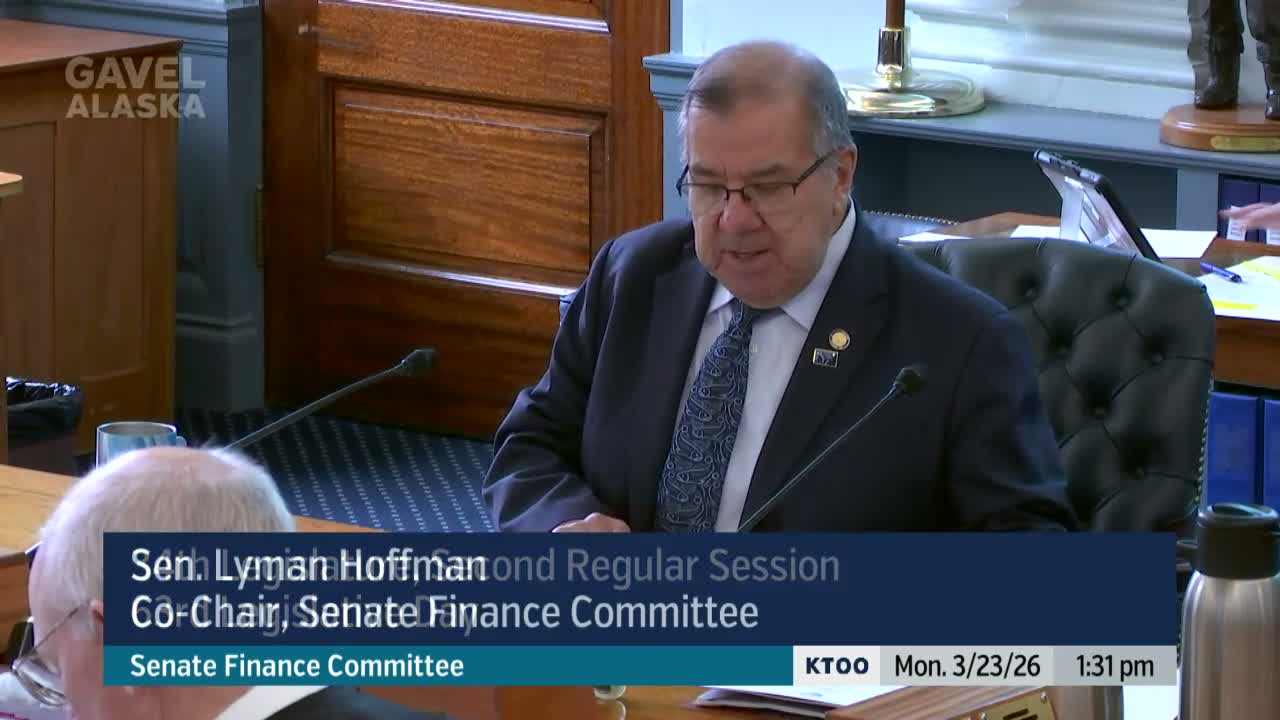
The committee took no formal action. Chairman Hoffman closed the session and said the committee is scheduled to reconvene the next morning with five items on the calendar.
"Managing cash flows and investing almost $60,000,000,000 in numerous investment funds is as complex as it sounds," Leary said, describing the division's front-, middle- and back-office functions and the daily forecasting that coordinates cash availability with investment decisions.
Leary said Treasury monitors two kinds of shortfalls: timing-related cash-flow deficiencies and revenue shortfalls that leave appropriations unfunded. "Currently, that's defined as, forecasted cash dipping below $400,000,000 for five days," she said, adding that Treasury remedies potential deficiencies by drawing on the earnings reserve, the constitutional budget reserve (CBR) or other budget reserves and by coordinating draw schedules with the Alaska Permanent Fund Corporation (APFC).
Zachary Hannah, chief investment officer for the Treasury Division, summarized market performance and said Treasury's portfolios produced strong results in 2025. "Overall returns across all the funds that Treasury manages were 12.9% for the year," Hannah said, which Treasury described as about $6.7 billion in total calendar-year gains and roughly $658 million added to the state balance sheet from state funds in 2025.
Committee members pressed Treasury officials on the longevity and sufficiency of the $400 million operational threshold. Senator Kiel asked whether the $400 million level was set in 1994 and whether it remains adequate given growth in the state budget; Leary said the $400 million figure has been in place for many years (certainly since 2014) and is intended as a limit on the maximum daily cash outflows so the general fund can meet immediate obligations.
The committee discussed the constitutional budget reserve (CBR) and its subaccount. Leary said the combined CBR accounts were approximately $2.9 billion as of 2024 and that Treasury currently keeps the CBR invested in cash equivalents to prioritize liquidity. Leary said the subaccount was created to capture higher returns for funds not needed within five years, but that a prior subaccount deposit had been returned to the main fund in 2015 when the money was expected to be needed sooner.
Senator Stedman asked about funds referenced in the presentation that had been returned to Treasury (transcript reference: "Digital Bridal"). Acting Commissioner Janelle Earls said, "The funds have been'they were returned to the subaccount and then, the subaccount was closed out and all the funds in there were returned to the main account." Senator Stedman said the matter would be revisited after an audit, expressing concerns about a prior commissioner's practices.
Hannah walked the committee through pooled general-fund investment accounts and the state's longer-horizon trust funds. He said the pooled Japonzi/Jafonzy accounts (transcript variants appear) held combined balances of about $3.4 billion as of June 30, 2025, and that those pools are managed for short horizons with an emphasis on principal protection. For long-horizon funds such as the Public School Trust Fund, Hannah said Treasury uses a higher-risk profile (about 70% equities, 30% bonds) to preserve purchasing power, noting the statutory payout objective is up to 5% of the five-year average balance.
Leary reviewed the Alaska Higher Education Investment Fund, which was capitalized with a $400 million deposit and may appropriate up to 7% annually for scholarships and grants. She said the fund held about $435 million on June 30, 2025 before a $130 million transfer to the general fund and that committee members are discussing recapitalization options.
Officials also summarized the state's retirement systems. Leary said the defined-benefit systems (PERS and TERS) held about $32.3 billion at the end of fiscal 2025 and experienced net withdrawals of roughly $1.6 billion that year; Treasury reported a 10-year return and long-run results that compare favorably to actuarial assumptions. Hannah said participant-directed plans now make up roughly $12 billion in assets across several plan types and that target-date funds are the dominant default option for new contributions.
Committee members asked about resilience to future market downturns, legacy default options that still hold large balances in some participant-directed accounts (stable value, conservative balance), and whether payout rates and draw policies should be adjusted for long-term sustainability. Treasury officials described their process for reviewing investment policies and said they coordinate with the ARM board and independent consultants.
The committee took no formal action. Chairman Hoffman closed the session and said the committee is scheduled to reconvene the next morning with five items on the calendar.
View the Full Meeting & All Its Details
This article offers just a summary. Unlock complete video, transcripts, and insights as a Founder Member.
✓
Watch full, unedited meeting videos
✓
Search every word spoken in unlimited transcripts
✓
AI summaries & real-time alerts (all government levels)
✓
Permanent access to expanding government content
30-day money-back guarantee
