Industry warns HB 306 needed to address a liquor‑liability insurance crisis; committee probes legal standards
March 23, 2026 | 2026 Legislature Alaska, Alaska
This article was created by AI summarizing key points discussed. AI makes mistakes, so for full details and context, please refer to the video of the full meeting. Please report any errors so we can fix them. Report an error »
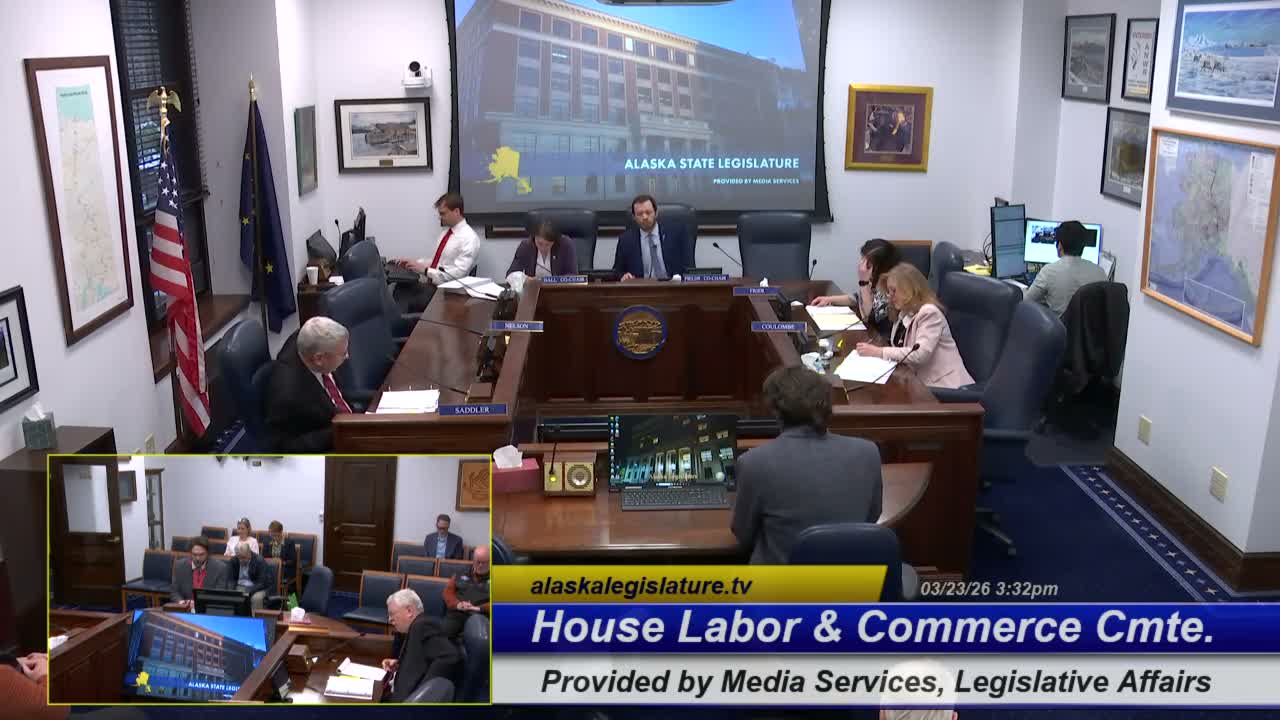
Evan Anderson, staff to Representative Fields, presented House Bill 306 as a package intended to clarify and narrow civil liability for establishments that provide alcoholic beverages. Anderson said the bill would change the burden for proving over‑service to "clear and convincing" evidence and add liability for knowingly serving after the lawful hours of an establishment’s operation.
Industry witnesses said insurers have fled Alaska’s liquor‑liability market and premiums have spiked. "As of 2024, Alaska has the worst rating in The US for liquor liability insurance," said Kyle Ivanoff of the Time Out Lounge, who described inflated prices and a near‑monopoly among carriers. Ivanoff said the industry wants statutory language that would attract more insurers.
Mike Dennis, an insurance broker with decades of experience, told the committee the state’s ISO rating (cited in testimony as an 8) discourages carriers from offering coverage and that lowering the score to below 5 helped other states draw new markets. "If we don't do something there may not be coverage available," Dennis said.
Committee members asked how changing the standard of proof would affect victims’ ability to recover damages. Nancy Mead, general counsel for the Alaska court system, described options that preserve accountability while limiting strict liability: one approach would limit liability to providers who served a person who was already drunk at the time of service; another is a "knew or should have known" formulation, which preserves evidence‑based inquiry such as slurred speech or stumbling.
Kevin Richard of the Alcohol and Marijuana Control Office said reducing strict liability would move in the right direction but he could not guarantee that the bill’s language, as written, would definitively lower insurance rates or change the ISO rating. Committee members asked the sponsor’s staff to check with ISO and legal advisers and to compare language used successfully in other states (witnesses cited Alabama, Vermont and others).
Representative Sadler and others pressed for objective measures and cautioned that lowering liability standards may make it harder for victims to prove claims; one committee member recounted following an apparently intoxicated driver and said that perspective informed concerns about protecting public safety.
No vote was taken. The committee asked staff to consult with ISO and legal counsel about possible drafting changes before the bill returns to committee.
Industry witnesses said insurers have fled Alaska’s liquor‑liability market and premiums have spiked. "As of 2024, Alaska has the worst rating in The US for liquor liability insurance," said Kyle Ivanoff of the Time Out Lounge, who described inflated prices and a near‑monopoly among carriers. Ivanoff said the industry wants statutory language that would attract more insurers.
Mike Dennis, an insurance broker with decades of experience, told the committee the state’s ISO rating (cited in testimony as an 8) discourages carriers from offering coverage and that lowering the score to below 5 helped other states draw new markets. "If we don't do something there may not be coverage available," Dennis said.
Committee members asked how changing the standard of proof would affect victims’ ability to recover damages. Nancy Mead, general counsel for the Alaska court system, described options that preserve accountability while limiting strict liability: one approach would limit liability to providers who served a person who was already drunk at the time of service; another is a "knew or should have known" formulation, which preserves evidence‑based inquiry such as slurred speech or stumbling.
Kevin Richard of the Alcohol and Marijuana Control Office said reducing strict liability would move in the right direction but he could not guarantee that the bill’s language, as written, would definitively lower insurance rates or change the ISO rating. Committee members asked the sponsor’s staff to check with ISO and legal advisers and to compare language used successfully in other states (witnesses cited Alabama, Vermont and others).
Representative Sadler and others pressed for objective measures and cautioned that lowering liability standards may make it harder for victims to prove claims; one committee member recounted following an apparently intoxicated driver and said that perspective informed concerns about protecting public safety.
No vote was taken. The committee asked staff to consult with ISO and legal counsel about possible drafting changes before the bill returns to committee.
Don't Miss a Word: See the Full Meeting!
Go beyond summaries. Unlock every video, transcript, and key insight with a Founder Membership.
✓
Get instant access to full meeting videos
✓
Search and clip any phrase from complete transcripts
✓
Receive AI-powered summaries & custom alerts
✓
Enjoy lifetime, unrestricted access to government data
30-day money-back guarantee
