Contested bill to expand Scenic River protections at Big South Fork draws hours of testimony; committee pauses vote
March 19, 2026 | 2026 Legislature TN, Tennessee
This article was created by AI summarizing key points discussed. AI makes mistakes, so for full details and context, please refer to the video of the full meeting. Please report any errors so we can fix them. Report an error »
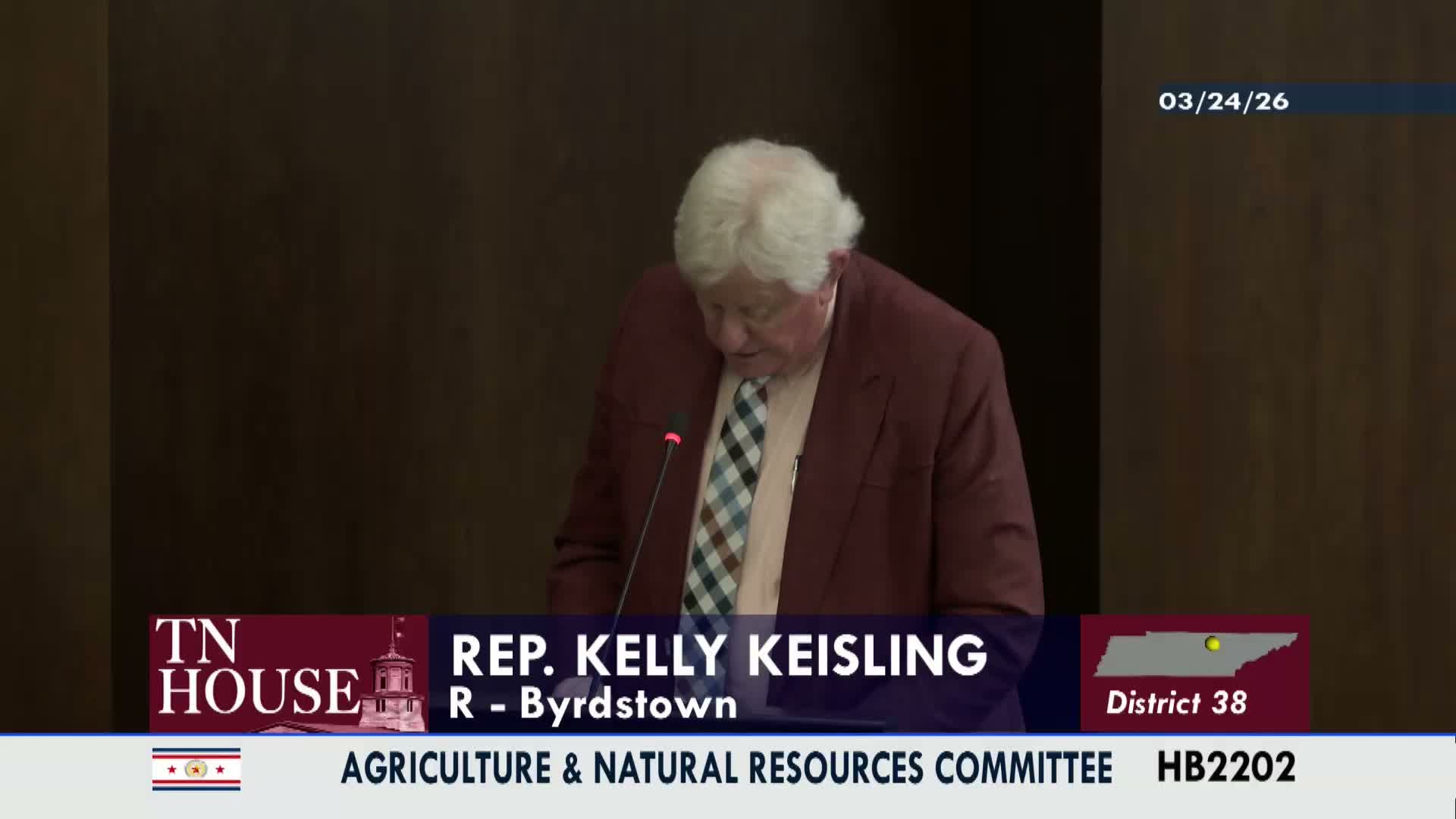
Chairman Todd opened extended consideration of House Bill 22-02, which would add the Big South Fork of the Cumberland River (Scott County segment) to a class 2 designation under Tennessee Code Annotated irstamily 11-13-104 and, as amended, prohibit future new landfills within the designated county territory. Representative Kiesling framed the measure as a continuation of a long-standing effort to protect the Big South Fork and preserve local control for Scott County.
The committee heard multiple public witnesses. Jennifer Shockley, president of Cumberland Clear, told lawmakers the Big South Fork is one of the Southeast's last large free-flowing rivers and that the National Park Service had submitted a formal letter raising serious concerns about the proposed Roberta 2 landfill and a rail-based waste-by-rail project. Shockley said the project's aquatic resource alteration permit (ARAP) application reported more than 25 streams and wetlands that the developer seeks to alter and that the plan would replace natural streams with French drains routed beneath landfill fill, potentially discharging into Bear Creek and downstream waters. "Destroy them upstream and you degrade everything downstream," Shockley said, urging the panel to consider protected aquatic species and the river's tier-3 status under Tennessee law.
Industry witnesses disputed that the Scenic River Act should be used to stop landfills. Katie Evans of the National Waste and Recycling Association said the bill would expand the Scenic River buffer from a two-mile river-centered limit to an effective county-wide prohibition and risk creating a precedent that would bypass existing zoning, Jackson-law opt-in processes and ARAP and landfill permitting. "The passage of this bill would be a step backwards," Evans said, urging the committee to rely on established local approval and TDEC permitting processes.
Members questioned both sides and asked TDEC officials to clarify the status of permits for the project identified in testimony. Ali Williamson, legislative director for the Department of Environment and Conservation, introduced Deputy General Counsel Stephanie Derman, who said two separate permits are implicated: a class-2 landfill permit that was issued 16 years ago and has been maintained but requires recertification because construction was not begun within one year, and an ARAP (aquatic resource alteration permit) that has a five-year term and for which a new application is pending. Phil Gripo, TDEC director of water resources, confirmed the applicant has requested authority to relocate or alter a stream as part of the proposal; he said the department must assess whether alteration would cause a condition of pollution under the Water Quality Control Act.
The exchange highlighted competing concerns: residents and environmental groups said the site's geology, multiple streams and proximity to critical habitat increase the risk of water-quality harm and would undercut local tourism and natural-resource values; industry and some members warned the measure would change the rules after costly permitting work and land investments. Several members asked whether TDEC already conducts sampling and monitoring and whether the bill would effectively impose a new prohibition that could lead to legal challenges; Derman said the bill would operate as a prohibition on a class-2 landfill and therefore change the regulatory framework for the proposed project.
Chairman Todd told the room the committee was up against a hard stop because another committee was arriving; after the extended testimony and questions, he said the remaining bills on the calendar would be rolled to the next calendar and the committee adjourned. No final vote on HB 22-02 was recorded in the committee during this session.
What happens next: the bill remains pending. If the sponsor refiles or the committee places the bill back on the calendar, TDEC officials and local stakeholders may provide additional technical evidence on permit status, ARAP findings, stream impacts and alternatives to support or oppose the change.
The committee heard multiple public witnesses. Jennifer Shockley, president of Cumberland Clear, told lawmakers the Big South Fork is one of the Southeast's last large free-flowing rivers and that the National Park Service had submitted a formal letter raising serious concerns about the proposed Roberta 2 landfill and a rail-based waste-by-rail project. Shockley said the project's aquatic resource alteration permit (ARAP) application reported more than 25 streams and wetlands that the developer seeks to alter and that the plan would replace natural streams with French drains routed beneath landfill fill, potentially discharging into Bear Creek and downstream waters. "Destroy them upstream and you degrade everything downstream," Shockley said, urging the panel to consider protected aquatic species and the river's tier-3 status under Tennessee law.
Industry witnesses disputed that the Scenic River Act should be used to stop landfills. Katie Evans of the National Waste and Recycling Association said the bill would expand the Scenic River buffer from a two-mile river-centered limit to an effective county-wide prohibition and risk creating a precedent that would bypass existing zoning, Jackson-law opt-in processes and ARAP and landfill permitting. "The passage of this bill would be a step backwards," Evans said, urging the committee to rely on established local approval and TDEC permitting processes.
Members questioned both sides and asked TDEC officials to clarify the status of permits for the project identified in testimony. Ali Williamson, legislative director for the Department of Environment and Conservation, introduced Deputy General Counsel Stephanie Derman, who said two separate permits are implicated: a class-2 landfill permit that was issued 16 years ago and has been maintained but requires recertification because construction was not begun within one year, and an ARAP (aquatic resource alteration permit) that has a five-year term and for which a new application is pending. Phil Gripo, TDEC director of water resources, confirmed the applicant has requested authority to relocate or alter a stream as part of the proposal; he said the department must assess whether alteration would cause a condition of pollution under the Water Quality Control Act.
The exchange highlighted competing concerns: residents and environmental groups said the site's geology, multiple streams and proximity to critical habitat increase the risk of water-quality harm and would undercut local tourism and natural-resource values; industry and some members warned the measure would change the rules after costly permitting work and land investments. Several members asked whether TDEC already conducts sampling and monitoring and whether the bill would effectively impose a new prohibition that could lead to legal challenges; Derman said the bill would operate as a prohibition on a class-2 landfill and therefore change the regulatory framework for the proposed project.
Chairman Todd told the room the committee was up against a hard stop because another committee was arriving; after the extended testimony and questions, he said the remaining bills on the calendar would be rolled to the next calendar and the committee adjourned. No final vote on HB 22-02 was recorded in the committee during this session.
What happens next: the bill remains pending. If the sponsor refiles or the committee places the bill back on the calendar, TDEC officials and local stakeholders may provide additional technical evidence on permit status, ARAP findings, stream impacts and alternatives to support or oppose the change.
View the Full Meeting & All Its Details
This article offers just a summary. Unlock complete video, transcripts, and insights as a Founder Member.
✓
Watch full, unedited meeting videos
✓
Search every word spoken in unlimited transcripts
✓
AI summaries & real-time alerts (all government levels)
✓
Permanent access to expanding government content
30-day money-back guarantee
