Bloomington council debates how to prioritize 2027 budget, emphasizing homelessness, infrastructure and measurability
March 12, 2026 | Bloomington City, Monroe County, Indiana
This article was created by AI summarizing key points discussed. AI makes mistakes, so for full details and context, please refer to the video of the full meeting. Please report any errors so we can fix them. Report an error »
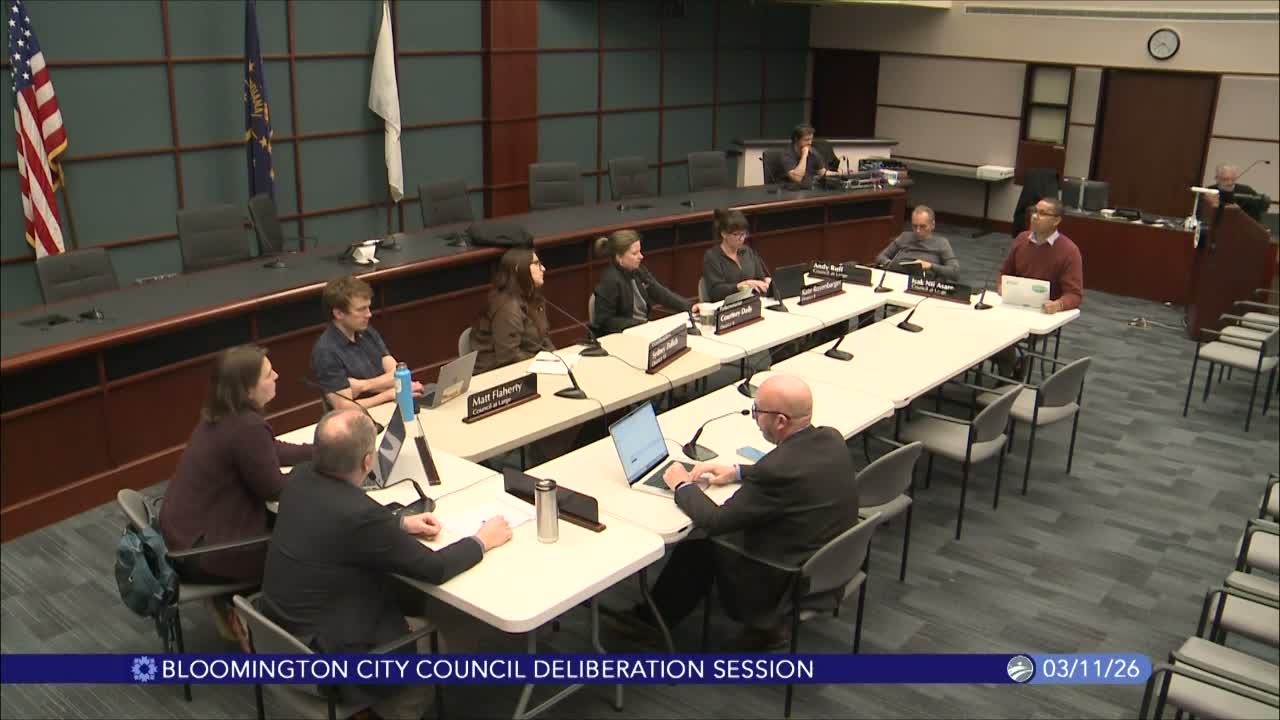
Bloomington City Council held a deliberation session on March 11 to refine a draft list of 13 shared priorities for the 2027 budget, focusing discussion on how to rank cross‑cutting items, how the administration should present budget details, and what outcomes councilors want measured.
Council member Stasberg, chair of the fiscal committee, opened the session by explaining that the list came from a December deliberation and a February survey and that the committee consolidated several overlapping items into a top‑13 draft. “The purpose of this deliberation session is the development of 2027 shared budget priorities,” Stasberg said, noting staff guidance the committee used to judge each item: is it driven by local government, is it measurable, what funding or staff time would it require, and should it be a priority for 2027.
Why it matters: councilors said the exercise should produce priorities that the administration can act on and that departments can tag in budget documents so expenditures and outcomes are traceable. Controller McKim told the council that budgets must still be presented by fund and department, but that the administration can “tag” line items to council priorities if the council provides operationalized, specific guidance: “If we have some small list of kind of operationalizable priorities from council, we can then work to sort of tag or associate expenditures with them,” McKim said.
The largest areas of substantive debate were process and framing rather than policy detail. Members disagreed about whether to keep the original thematic buckets or to ignore them and rank the 13 items in a single list. One member urged a follow‑up survey that forces respondents to allocate points (for example, 100 points spread across priorities) so averages reveal relative importance; another proposed a “cost‑to‑move” index to help compare priorities that are cheap to advance (creating plans, strengthening food security networks) versus capital‑intensive items (major infrastructure maintenance).
On content, homelessness repeatedly surfaced as a top concern. Councilors agreed the priority phrasing “make homelessness brief, rare and non‑repeating” should remain on the list, with sub‑items (job and wage growth, service coordination, mental health and addiction treatment) placed in the letter or packet as examples rather than the principal ranked item. “We could leave it as ‘make homelessness brief, rare and non‑repeating’ and then put these [sub‑bullets] into the letter underneath there,” Stasberg said.
Members also spent considerable time debating how to frame infrastructure needs. Some councilors preferred “maintain city assets” as a measurable budget priority (miles of roads repaved per year, time to repair reported potholes), while others recommended the term “capital investments” to emphasize improvement and transformation instead of mere status quo. Several members argued for separating maintenance and improvement into distinct priorities so the council could track both.
Public safety and alternatives to police for nonviolent responses were discussed as programmatic priorities that are largely within local control and can be measured and funded. Councilors proposed asking the administration to describe, during budget presentations, concrete steps and funding for achieving near‑term progress on plans such as the Safe Streets for All action plan.
No formal votes or motions were taken. Stasberg said she will compile meeting feedback, send a revised survey to council members, and draft a letter or resolution to the administration that will be circulated for review; she aims to bring a draft for approval at the next regular council meeting in April.
What to watch next: the follow‑up survey and the draft letter or resolution that Stasberg plans to circulate; the administration’s response about how it will tag and report budget items against council priorities.
Council member Stasberg, chair of the fiscal committee, opened the session by explaining that the list came from a December deliberation and a February survey and that the committee consolidated several overlapping items into a top‑13 draft. “The purpose of this deliberation session is the development of 2027 shared budget priorities,” Stasberg said, noting staff guidance the committee used to judge each item: is it driven by local government, is it measurable, what funding or staff time would it require, and should it be a priority for 2027.
Why it matters: councilors said the exercise should produce priorities that the administration can act on and that departments can tag in budget documents so expenditures and outcomes are traceable. Controller McKim told the council that budgets must still be presented by fund and department, but that the administration can “tag” line items to council priorities if the council provides operationalized, specific guidance: “If we have some small list of kind of operationalizable priorities from council, we can then work to sort of tag or associate expenditures with them,” McKim said.
The largest areas of substantive debate were process and framing rather than policy detail. Members disagreed about whether to keep the original thematic buckets or to ignore them and rank the 13 items in a single list. One member urged a follow‑up survey that forces respondents to allocate points (for example, 100 points spread across priorities) so averages reveal relative importance; another proposed a “cost‑to‑move” index to help compare priorities that are cheap to advance (creating plans, strengthening food security networks) versus capital‑intensive items (major infrastructure maintenance).
On content, homelessness repeatedly surfaced as a top concern. Councilors agreed the priority phrasing “make homelessness brief, rare and non‑repeating” should remain on the list, with sub‑items (job and wage growth, service coordination, mental health and addiction treatment) placed in the letter or packet as examples rather than the principal ranked item. “We could leave it as ‘make homelessness brief, rare and non‑repeating’ and then put these [sub‑bullets] into the letter underneath there,” Stasberg said.
Members also spent considerable time debating how to frame infrastructure needs. Some councilors preferred “maintain city assets” as a measurable budget priority (miles of roads repaved per year, time to repair reported potholes), while others recommended the term “capital investments” to emphasize improvement and transformation instead of mere status quo. Several members argued for separating maintenance and improvement into distinct priorities so the council could track both.
Public safety and alternatives to police for nonviolent responses were discussed as programmatic priorities that are largely within local control and can be measured and funded. Councilors proposed asking the administration to describe, during budget presentations, concrete steps and funding for achieving near‑term progress on plans such as the Safe Streets for All action plan.
No formal votes or motions were taken. Stasberg said she will compile meeting feedback, send a revised survey to council members, and draft a letter or resolution to the administration that will be circulated for review; she aims to bring a draft for approval at the next regular council meeting in April.
What to watch next: the follow‑up survey and the draft letter or resolution that Stasberg plans to circulate; the administration’s response about how it will tag and report budget items against council priorities.
View the Full Meeting & All Its Details
This article offers just a summary. Unlock complete video, transcripts, and insights as a Founder Member.
✓
Watch full, unedited meeting videos
✓
Search every word spoken in unlimited transcripts
✓
AI summaries & real-time alerts (all government levels)
✓
Permanent access to expanding government content
30-day money-back guarantee
