D.C. hearing weighs split funeral licenses and authorizing water cremation; industry and labor advocates clash
March 23, 2026 | Committee on Health, Committees, Legislative, District of Columbia
This article was created by AI summarizing key points discussed. AI makes mistakes, so for full details and context, please refer to the video of the full meeting. Please report any errors so we can fix them. Report an error »
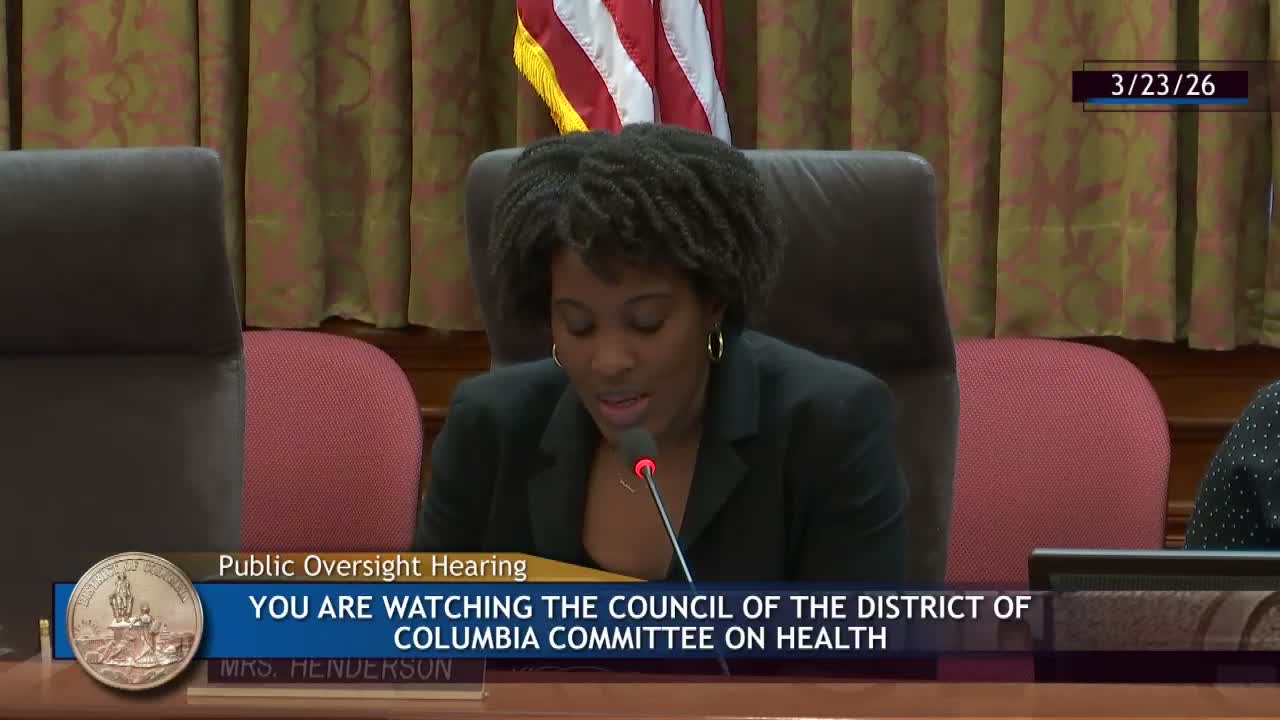
The D.C. Council Committee on Health on March 23 heard detailed testimony and agency input on two bills that would reshape funeral‑service regulation in the District: B26‑47 (Funeral Director's Licensing Reform Amendment Act of 2025) and B26‑547 (Green Death Care Option Amendment Act of 2025).
Supporters from the funeral profession argued the changes would expand workforce pathways and align D.C. with neighboring jurisdictions. Blair Nelson of Gollars Funeral Home and Rachel Mackey, a licensed funeral director with regional credentials, said separate embalmer and funeral director licenses can broaden access and accommodate specialists. "Creating separate licenses increases the opportunity for employment in the district by making the funeral profession more accessible to a wider range of prospective candidates," Nelson said.
Practitioner testimony and DLCP (Department of Licensing and Consumer Protection) and Board of Funeral Directors staff noted current apprenticeship and internship structures and proposed changes. John Maguire, chair of the District of Columbia Board of Funeral Directors, outlined existing requirements (apprentice applicants currently must embalm at least 25 human remains and conduct at least 25 funerals) and the board’s enforcement and outreach activities. Tiffany Crow of DLCP supported the bills’ intent to create additional licensing opportunities but recommended retaining a high‑school diploma or GED requirement, clarifying education/enrollment requirements for interns, and considering a combined license option so licensees could perform both funeral directing and embalming where appropriate.
Opponents and labor‑policy experts warned about additional licensing burdens. Amelia Colma of the DC Policy Center argued that adding a separate embalmer license and a 2,000‑hour internship requirement could raise costs, limit labor market entry and reduce workforce diversity. "Licensing requirements routinely raise prices for consumers, restrict employment opportunity, and produce little to no measurable improvement in service quality or public safety," Colma said.
The committee examined contentious details: apprenticeship vs internship terminology (apprenticeship may qualify for funding and supports workforce pathways), the proposed 2,000‑hour requirement (Virginia’s standard) versus Maryland’s 1,000 hours, reciprocity and courtesy card rules with Maryland and Virginia, and a draft automatic conversion of existing funeral director licenses into embalmer licenses. DLCP warned the split could increase agency workload and recommended a single internship program with clear supervision rules, while the board favored a three‑tier approach (embalmer, funeral director, and combination license) to preserve flexibility.
On B26‑547, proponents argued alkaline hydrolysis (water cremation) is a lower‑energy, lower‑emissions alternative to flame cremation; Sean Heath described it as using roughly one‑tenth the energy of flame cremation and said effluent is treated by municipal wastewater systems. DLCP and the board recommended consulting DC Water, the Department of Energy and Environment, and other infrastructure agencies before finalizing rules and noted zoning and siting requirements could affect whether a crematorium can be built in the District.
Committee members also raised consumer‑protection issues: the FTC has inspected funeral homes for pricing transparency, and the committee asked DLCP and OAG about coordinating enforcement and ensuring accurate price lists and disclosure practices for firms that use out‑of‑state crematories.
Next steps: the committee will circulate follow‑up questions to agencies (DLCP, DC Water, DOEE) and consider technical edits during markup. The record remains open until April 6 for written testimony on both bills.
Supporters from the funeral profession argued the changes would expand workforce pathways and align D.C. with neighboring jurisdictions. Blair Nelson of Gollars Funeral Home and Rachel Mackey, a licensed funeral director with regional credentials, said separate embalmer and funeral director licenses can broaden access and accommodate specialists. "Creating separate licenses increases the opportunity for employment in the district by making the funeral profession more accessible to a wider range of prospective candidates," Nelson said.
Practitioner testimony and DLCP (Department of Licensing and Consumer Protection) and Board of Funeral Directors staff noted current apprenticeship and internship structures and proposed changes. John Maguire, chair of the District of Columbia Board of Funeral Directors, outlined existing requirements (apprentice applicants currently must embalm at least 25 human remains and conduct at least 25 funerals) and the board’s enforcement and outreach activities. Tiffany Crow of DLCP supported the bills’ intent to create additional licensing opportunities but recommended retaining a high‑school diploma or GED requirement, clarifying education/enrollment requirements for interns, and considering a combined license option so licensees could perform both funeral directing and embalming where appropriate.
Opponents and labor‑policy experts warned about additional licensing burdens. Amelia Colma of the DC Policy Center argued that adding a separate embalmer license and a 2,000‑hour internship requirement could raise costs, limit labor market entry and reduce workforce diversity. "Licensing requirements routinely raise prices for consumers, restrict employment opportunity, and produce little to no measurable improvement in service quality or public safety," Colma said.
The committee examined contentious details: apprenticeship vs internship terminology (apprenticeship may qualify for funding and supports workforce pathways), the proposed 2,000‑hour requirement (Virginia’s standard) versus Maryland’s 1,000 hours, reciprocity and courtesy card rules with Maryland and Virginia, and a draft automatic conversion of existing funeral director licenses into embalmer licenses. DLCP warned the split could increase agency workload and recommended a single internship program with clear supervision rules, while the board favored a three‑tier approach (embalmer, funeral director, and combination license) to preserve flexibility.
On B26‑547, proponents argued alkaline hydrolysis (water cremation) is a lower‑energy, lower‑emissions alternative to flame cremation; Sean Heath described it as using roughly one‑tenth the energy of flame cremation and said effluent is treated by municipal wastewater systems. DLCP and the board recommended consulting DC Water, the Department of Energy and Environment, and other infrastructure agencies before finalizing rules and noted zoning and siting requirements could affect whether a crematorium can be built in the District.
Committee members also raised consumer‑protection issues: the FTC has inspected funeral homes for pricing transparency, and the committee asked DLCP and OAG about coordinating enforcement and ensuring accurate price lists and disclosure practices for firms that use out‑of‑state crematories.
Next steps: the committee will circulate follow‑up questions to agencies (DLCP, DC Water, DOEE) and consider technical edits during markup. The record remains open until April 6 for written testimony on both bills.
Don't Miss a Word: See the Full Meeting!
Go beyond summaries. Unlock every video, transcript, and key insight with a Founder Membership.
✓
Get instant access to full meeting videos
✓
Search and clip any phrase from complete transcripts
✓
Receive AI-powered summaries & custom alerts
✓
Enjoy lifetime, unrestricted access to government data
30-day money-back guarantee
