D.C. hearing backs pass-through entity tax but flags equity and implementation questions
March 19, 2026 | Committee of the Whole, Committees, Legislative, District of Columbia
This article was created by AI summarizing key points discussed. AI makes mistakes, so for full details and context, please refer to the video of the full meeting. Please report any errors so we can fix them. Report an error »
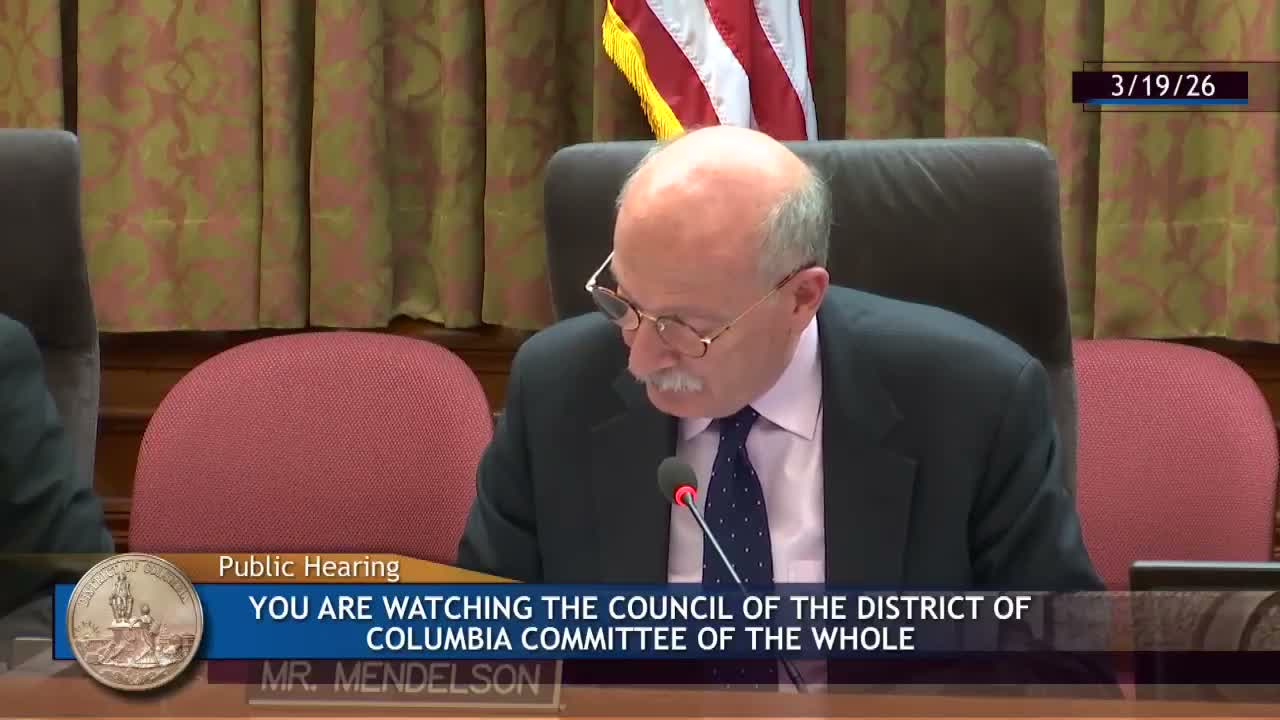
The Committee as a Whole of the Council of the District of Columbia held a public hearing on March 19, 2026, on Bill 26-324, the Pass Through Entities Income Tax and Tax Credit on Certain S Corporations and Partnerships Amendment Act of 2025, a proposal to allow eligible pass-through entities to elect to be taxed at the entity level and to provide an equivalent credit to individual members.
Chair Phil Mendelson opened the hearing, read the bill’s purpose and noted that roughly 36 other jurisdictions have adopted similar workarounds to the federal SALT deduction cap. He said the Council intends to accept written testimony for two weeks and will consider drafting changes before markup.
Business groups, tax policy experts and small-business owners told the committee they favor a PTE-style mechanism but urged careful drafting. Jeanette Hubbard, president and CEO of the D.C. Chamber of Commerce, said the measure would restore competitive parity with Maryland and Virginia and is revenue neutral ‘‘for the district’’ as drafted. Small business owner Diana Mubarak urged emergency adoption so firms could claim the benefit in the current tax year.
Several tax-policy witnesses and attorneys recommended building the relief on the District’s existing Unincorporated Business Tax (UBT) rather than adopting Maryland’s model verbatim. Nicholas Johnson (Institute on Taxation and Economic Policy) argued the draft modeled on Maryland is ‘‘too complex’’ and risks undermining progressivity; he proposed replacing the UBT exemption with a dollar-for-dollar credit so resident owners are taxed under the District’s graduated personal-income schedule while non-UBT entities could elect into a similar regime. Johnson said that change could, by some estimates he cited, raise roughly $14,000,000 a year for the District (presented as an estimate, not an official fiscal analysis).
Michael Hilkin (McDermott, Will & Schulte) and other witnesses endorsed Diane Smith’s earlier draft as a practicable framework that would conform PTE relief to the District’s tax code and reduce administrative burden. Salvatore Zambery (Trial Lawyers Association of Metropolitan Washington, D.C.) urged that many issues OTR identified can be fixed by drafting clarifications — for example, credit provisions that prevent double taxation and language specifying whether the PTE election is annual and whether credits for nonresidents are refundable.
John Michael Olsen of the Office of Tax and Revenue (OTR) briefed the committee on technical and administrative issues the bill would raise if enacted as written. Olsen described two statutory routes the bill proposes (treating the tax as imposed on nonresident members in some cases or as an entity-level tax where the PTE elects to pay on behalf of all members), and he stressed that the enacted PTAT would need to be conformed with existing UBT and corporate franchise tax provisions to prevent duplicate taxation of the same income. OTR told the committee it has not completed a fiscal-impact analysis and flagged several operational challenges observed in other jurisdictions, including large numbers of refunds and significant manual review workload when credits exceed withholding or estimated payments.
The most contested operational questions involved retroactivity and timing. The bill text discussed retroactive applicability to tax years beginning after 12/31/2023; OTR said it had not modeled fiscal effects of that retroactivity and asked for extra lead time to program forms, create guidance and train staff. OTR described implementation tasks that could require months of systems work and manual review processes; the office suggested a multi-year lead time for safe implementation. Chair Mendelson pushed back on the length of OTR’s proposed window, citing recent examples of rapid implementation and asking OTR for a formal fiscal-impact analysis and to work with Council staff to accelerate work where possible.
No formal vote or amendment occurred at the hearing; Chair Mendelson said the record would remain open until April 2, 2026, for written comment and that the Council would consider drafting changes informed by testimony. The committee did not set a final markup date at the hearing.
The hearing transcript shows multiple technical proposals and points of disagreement that Council staff and OTR will need to resolve in drafting: (1) whether to adopt a Maryland-style PTAT or to modify the UBT to produce comparable federal deductibility without undermining progressivity; (2) precise credit and add-back language to prevent double taxation; (3) whether credits for nonresident owners should be refundable and how quarterly estimated payments should be coordinated; and (4) the effective date and any retroactivity of the law. Witnesses recommended prompt action but said most concerns could be addressed through targeted drafting changes rather than by abandoning the policy.
Next steps: the record remains open through 5 p.m. on April 2, 2026; OTR and Council staff will pursue the technical issues highlighted at the hearing and provide further analysis — including a requested fiscal impact review — before the Council schedules markup.
Chair Phil Mendelson opened the hearing, read the bill’s purpose and noted that roughly 36 other jurisdictions have adopted similar workarounds to the federal SALT deduction cap. He said the Council intends to accept written testimony for two weeks and will consider drafting changes before markup.
Business groups, tax policy experts and small-business owners told the committee they favor a PTE-style mechanism but urged careful drafting. Jeanette Hubbard, president and CEO of the D.C. Chamber of Commerce, said the measure would restore competitive parity with Maryland and Virginia and is revenue neutral ‘‘for the district’’ as drafted. Small business owner Diana Mubarak urged emergency adoption so firms could claim the benefit in the current tax year.
Several tax-policy witnesses and attorneys recommended building the relief on the District’s existing Unincorporated Business Tax (UBT) rather than adopting Maryland’s model verbatim. Nicholas Johnson (Institute on Taxation and Economic Policy) argued the draft modeled on Maryland is ‘‘too complex’’ and risks undermining progressivity; he proposed replacing the UBT exemption with a dollar-for-dollar credit so resident owners are taxed under the District’s graduated personal-income schedule while non-UBT entities could elect into a similar regime. Johnson said that change could, by some estimates he cited, raise roughly $14,000,000 a year for the District (presented as an estimate, not an official fiscal analysis).
Michael Hilkin (McDermott, Will & Schulte) and other witnesses endorsed Diane Smith’s earlier draft as a practicable framework that would conform PTE relief to the District’s tax code and reduce administrative burden. Salvatore Zambery (Trial Lawyers Association of Metropolitan Washington, D.C.) urged that many issues OTR identified can be fixed by drafting clarifications — for example, credit provisions that prevent double taxation and language specifying whether the PTE election is annual and whether credits for nonresidents are refundable.
John Michael Olsen of the Office of Tax and Revenue (OTR) briefed the committee on technical and administrative issues the bill would raise if enacted as written. Olsen described two statutory routes the bill proposes (treating the tax as imposed on nonresident members in some cases or as an entity-level tax where the PTE elects to pay on behalf of all members), and he stressed that the enacted PTAT would need to be conformed with existing UBT and corporate franchise tax provisions to prevent duplicate taxation of the same income. OTR told the committee it has not completed a fiscal-impact analysis and flagged several operational challenges observed in other jurisdictions, including large numbers of refunds and significant manual review workload when credits exceed withholding or estimated payments.
The most contested operational questions involved retroactivity and timing. The bill text discussed retroactive applicability to tax years beginning after 12/31/2023; OTR said it had not modeled fiscal effects of that retroactivity and asked for extra lead time to program forms, create guidance and train staff. OTR described implementation tasks that could require months of systems work and manual review processes; the office suggested a multi-year lead time for safe implementation. Chair Mendelson pushed back on the length of OTR’s proposed window, citing recent examples of rapid implementation and asking OTR for a formal fiscal-impact analysis and to work with Council staff to accelerate work where possible.
No formal vote or amendment occurred at the hearing; Chair Mendelson said the record would remain open until April 2, 2026, for written comment and that the Council would consider drafting changes informed by testimony. The committee did not set a final markup date at the hearing.
The hearing transcript shows multiple technical proposals and points of disagreement that Council staff and OTR will need to resolve in drafting: (1) whether to adopt a Maryland-style PTAT or to modify the UBT to produce comparable federal deductibility without undermining progressivity; (2) precise credit and add-back language to prevent double taxation; (3) whether credits for nonresident owners should be refundable and how quarterly estimated payments should be coordinated; and (4) the effective date and any retroactivity of the law. Witnesses recommended prompt action but said most concerns could be addressed through targeted drafting changes rather than by abandoning the policy.
Next steps: the record remains open through 5 p.m. on April 2, 2026; OTR and Council staff will pursue the technical issues highlighted at the hearing and provide further analysis — including a requested fiscal impact review — before the Council schedules markup.
Don't Miss a Word: See the Full Meeting!
Go beyond summaries. Unlock every video, transcript, and key insight with a Founder Membership.
✓
Get instant access to full meeting videos
✓
Search and clip any phrase from complete transcripts
✓
Receive AI-powered summaries & custom alerts
✓
Enjoy lifetime, unrestricted access to government data
30-day money-back guarantee
