University of Minnesota tells capital committee Minnesota must design infrastructure for a hotter, wetter future
March 24, 2026 | 2026 Legislature MN, Minnesota
This article was created by AI summarizing key points discussed. AI makes mistakes, so for full details and context, please refer to the video of the full meeting. Please report any errors so we can fix them. Report an error »
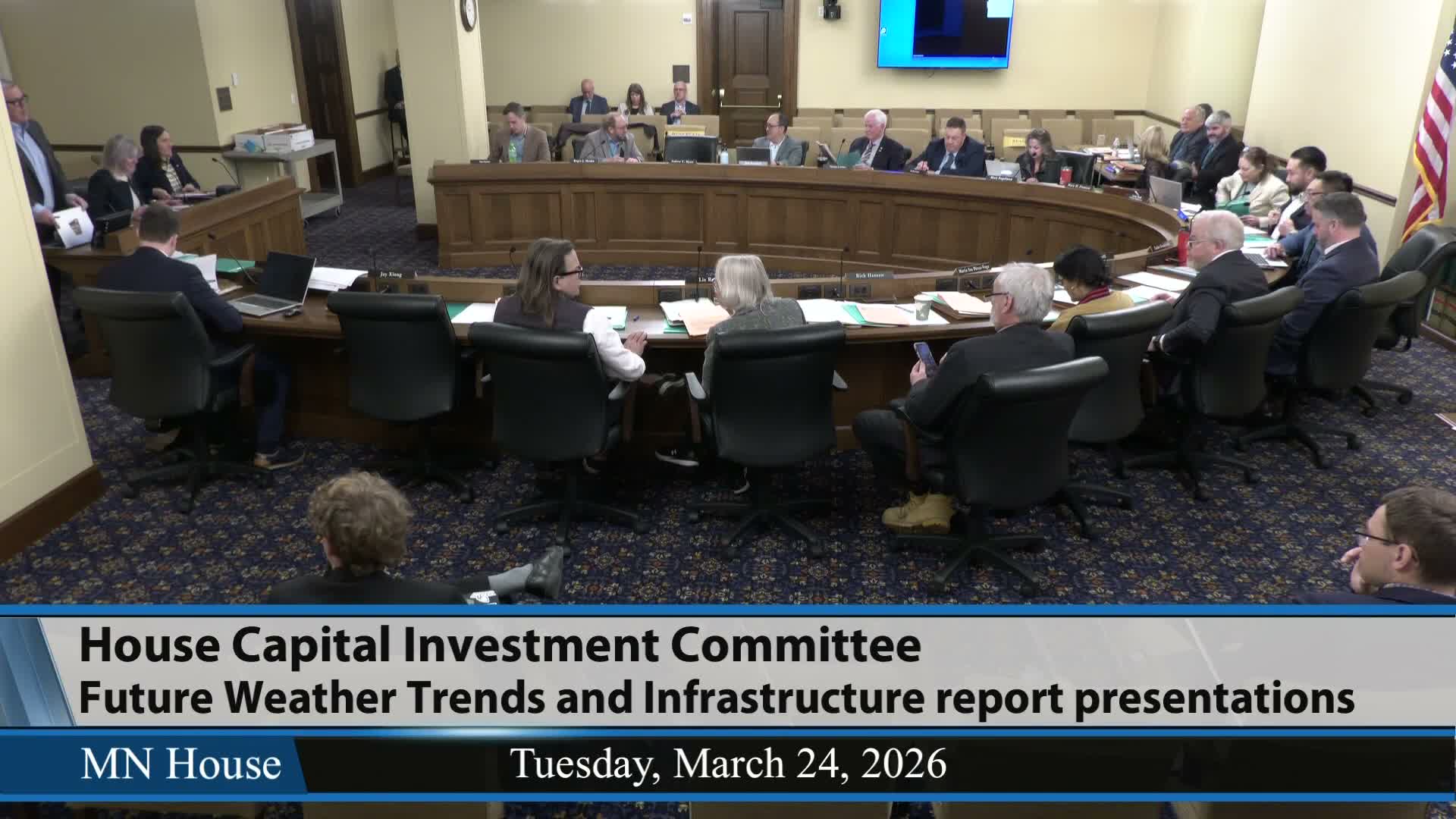
A University of Minnesota research team told the House Capital Investment Committee on March 24 that Minnesota’s infrastructure was built for a different climate and needs planning and investment to be resilient to projected warmer, wetter conditions.
Jessica Hellman (S18) introduced the team and said the report was commissioned by the 2023 Legislature to provide "evidence based information" to guide fiscally responsible, forward-looking decisions. Dr. Heidi Roop (S19), the state extension specialist for climate and risk management, summarized observed changes: "Our average annual air temperature has increased by over 3 degrees Fahrenheit since 1895, and our average annual precipitation has increased by over 3 inches per year." She said Minnesotans are experiencing more rapid swings between extreme wet and dry conditions, straining dams, roads, culverts and water systems.
Dr. Richard Graves (S13) described a systems-based "SETS" framework (social, ecological, technical) the report recommends to avoid maladaptation — solutions that solve a problem in one system but create new risks in another. The researchers said that, in the built environment, climate-driven changes can lower heating demand but increase cooling demand and change energy mix (less natural gas, more electricity), with implications for utility planning.
On fiscal questions, the presenters cited an analysis indicating that incremental resilience investments — roughly $800 million annually for roads, rail, culverts and electric infrastructure under a medium scenario — could prevent over $4.3 billion annually in repair and delay costs projected in the absence of preparedness. The team recommended funding for additional research on using future-weather scenarios in planning, integrating resilience considerations into bonding reviews, and developing standardized resilience indicators.
Committee members pressed on method and stakeholder representation. Representative Allen (S10) asked about the study budget; presenters said the legislature appropriated roughly $690,000 in 2023 and that about $100,000 remained unspent and returned. Representative Scrabble (S2) and Chair Franzen (S9) voiced skepticism about long‑term projections and historical trend reliability; the researchers responded that models use well‑established physics, multiple scenarios and are intended to bound possibilities rather than predict exact years.
The presenters recommended the legislature and Department of Administration collaborate with agencies such as the Minnesota Pollution Control Agency to integrate resilience into project review and bond‑funded decisions and to fund further application work with local governments. Members did not vote on legislation; the presentation was informational.
Jessica Hellman (S18) introduced the team and said the report was commissioned by the 2023 Legislature to provide "evidence based information" to guide fiscally responsible, forward-looking decisions. Dr. Heidi Roop (S19), the state extension specialist for climate and risk management, summarized observed changes: "Our average annual air temperature has increased by over 3 degrees Fahrenheit since 1895, and our average annual precipitation has increased by over 3 inches per year." She said Minnesotans are experiencing more rapid swings between extreme wet and dry conditions, straining dams, roads, culverts and water systems.
Dr. Richard Graves (S13) described a systems-based "SETS" framework (social, ecological, technical) the report recommends to avoid maladaptation — solutions that solve a problem in one system but create new risks in another. The researchers said that, in the built environment, climate-driven changes can lower heating demand but increase cooling demand and change energy mix (less natural gas, more electricity), with implications for utility planning.
On fiscal questions, the presenters cited an analysis indicating that incremental resilience investments — roughly $800 million annually for roads, rail, culverts and electric infrastructure under a medium scenario — could prevent over $4.3 billion annually in repair and delay costs projected in the absence of preparedness. The team recommended funding for additional research on using future-weather scenarios in planning, integrating resilience considerations into bonding reviews, and developing standardized resilience indicators.
Committee members pressed on method and stakeholder representation. Representative Allen (S10) asked about the study budget; presenters said the legislature appropriated roughly $690,000 in 2023 and that about $100,000 remained unspent and returned. Representative Scrabble (S2) and Chair Franzen (S9) voiced skepticism about long‑term projections and historical trend reliability; the researchers responded that models use well‑established physics, multiple scenarios and are intended to bound possibilities rather than predict exact years.
The presenters recommended the legislature and Department of Administration collaborate with agencies such as the Minnesota Pollution Control Agency to integrate resilience into project review and bond‑funded decisions and to fund further application work with local governments. Members did not vote on legislation; the presentation was informational.
Don't Miss a Word: See the Full Meeting!
Go beyond summaries. Unlock every video, transcript, and key insight with a Founder Membership.
✓
Get instant access to full meeting videos
✓
Search and clip any phrase from complete transcripts
✓
Receive AI-powered summaries & custom alerts
✓
Enjoy lifetime, unrestricted access to government data
30-day money-back guarantee
