Idaho House advances multiple maintenance and enhancement budgets, approves cap on off‑session spending
March 13, 2026 | Legislative, Idaho
This article was created by AI summarizing key points discussed. AI makes mistakes, so for full details and context, please refer to the video of the full meeting. Please report any errors so we can fix them. Report an error »
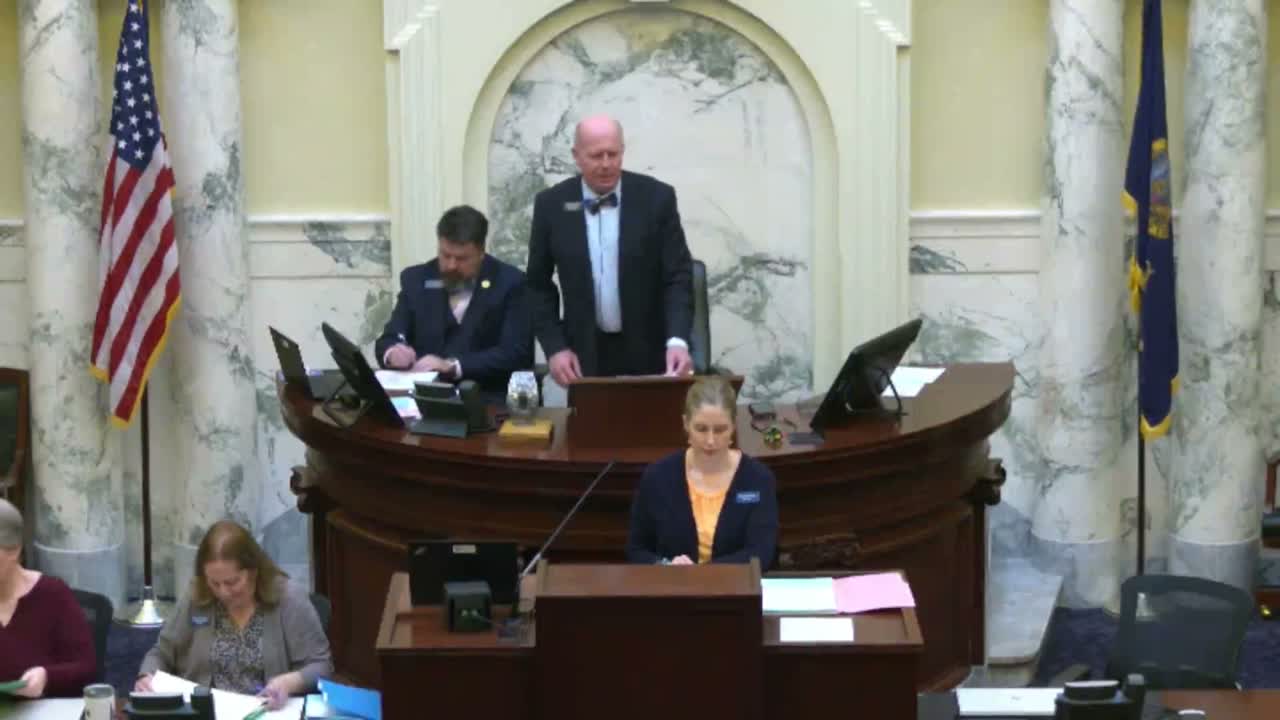
The Idaho House of Representatives on March 13 advanced a cluster of maintenance and enhancement appropriations and passed a bill limiting 'noncognizable' off‑session spending.
House members suspended the rules to consider a sequence of appropriation measures, moving House Bills 8‑66, 8‑67, 8‑68, 8‑69, 8‑70, 8‑71 and 8‑35 for immediate consideration. Sponsors described the measures as maintenance budgets or targeted enhancements: restoring prior rescissions, funding pension software completion, restoring services for blind and visually impaired Idahoans, modernizing state IT and adding resources for tax‑system operations.
Supporters said the measures restore necessary functions and use a mix of general and dedicated funds. The sponsor of the Office of Information Technology Services package told colleagues the bill includes a general‑fund enterprise cybersecurity hardware and software line and a modernization transfer that moves 58 positions into OITS and about $7.5 million in dedicated funds, a net‑zero shift that, proponents said, improves statewide cybersecurity architecture and reduces agency fragmentation.
Opponents repeatedly pressed for more line‑item transparency. One lawmaker urged caution before approving what he described as a roughly $500 million consolidated appropriation without a clearer fiscal‑note breakdown, saying the current presentation made it “virtually impossible…to evaluate and really cast an informed vote.” Another member said some legislators had pledged last year to oppose enhancements that expanded federal funding or added full‑time positions, and that pledge influenced their vote.
Several bills generated specific debate and questions. For House Bill 8‑68, sponsors described three one‑time items for the Public Employee Retirement System (a final software upgrade year at about $12,000,000, a disaster recovery continuity program for $227,300, and replacement items); members asked which one‑time expenditures were removed from base budgets and were told most removals were routine one‑time capital or software costs.
On House Bill 8‑69, the sponsor said the Commission for the Blind and Visually Impaired would use roughly $62,700 from rehabilitation revenues and about $65,000 from an adaptive‑aid store to avoid service reductions for blind Idahoans. On House Bill 8‑70, proponents emphasized the cybersecurity need and the consolidation of IT staff from other agencies; critics sought contract protections and questioned the use of federal funds and added positions.
Votes and outcomes were recorded on the floor. House Bill 8‑68 was passed by roll call (recorded as 36 ayes, 33 nays and 1 abstain). House Bill 8‑35, which limits noncognizable off‑session spending and establishes a $10 million cap with exemptions for declared emergencies and specified uses, passed with the roll call result recorded in the transcript as 62 ayes, 7 nays and 1 abstain. Other appropriation and enhancement bills were approved and will be transmitted according to regular process.
The House also received messages from the governor and the Senate reporting signed and enrolled bills and advanced numerous bills and committee reports for second reading and referral. Leaders closed the day with scheduling announcements and adjourned until 10:30 a.m. Monday, March 16, 2026.
What’s next: the bills passed will be transmitted as required; several members requested additional detail on enhancements and line‑item changes and said they will seek that information from JFAC staff before final consideration in subsequent calendar actions.
House members suspended the rules to consider a sequence of appropriation measures, moving House Bills 8‑66, 8‑67, 8‑68, 8‑69, 8‑70, 8‑71 and 8‑35 for immediate consideration. Sponsors described the measures as maintenance budgets or targeted enhancements: restoring prior rescissions, funding pension software completion, restoring services for blind and visually impaired Idahoans, modernizing state IT and adding resources for tax‑system operations.
Supporters said the measures restore necessary functions and use a mix of general and dedicated funds. The sponsor of the Office of Information Technology Services package told colleagues the bill includes a general‑fund enterprise cybersecurity hardware and software line and a modernization transfer that moves 58 positions into OITS and about $7.5 million in dedicated funds, a net‑zero shift that, proponents said, improves statewide cybersecurity architecture and reduces agency fragmentation.
Opponents repeatedly pressed for more line‑item transparency. One lawmaker urged caution before approving what he described as a roughly $500 million consolidated appropriation without a clearer fiscal‑note breakdown, saying the current presentation made it “virtually impossible…to evaluate and really cast an informed vote.” Another member said some legislators had pledged last year to oppose enhancements that expanded federal funding or added full‑time positions, and that pledge influenced their vote.
Several bills generated specific debate and questions. For House Bill 8‑68, sponsors described three one‑time items for the Public Employee Retirement System (a final software upgrade year at about $12,000,000, a disaster recovery continuity program for $227,300, and replacement items); members asked which one‑time expenditures were removed from base budgets and were told most removals were routine one‑time capital or software costs.
On House Bill 8‑69, the sponsor said the Commission for the Blind and Visually Impaired would use roughly $62,700 from rehabilitation revenues and about $65,000 from an adaptive‑aid store to avoid service reductions for blind Idahoans. On House Bill 8‑70, proponents emphasized the cybersecurity need and the consolidation of IT staff from other agencies; critics sought contract protections and questioned the use of federal funds and added positions.
Votes and outcomes were recorded on the floor. House Bill 8‑68 was passed by roll call (recorded as 36 ayes, 33 nays and 1 abstain). House Bill 8‑35, which limits noncognizable off‑session spending and establishes a $10 million cap with exemptions for declared emergencies and specified uses, passed with the roll call result recorded in the transcript as 62 ayes, 7 nays and 1 abstain. Other appropriation and enhancement bills were approved and will be transmitted according to regular process.
The House also received messages from the governor and the Senate reporting signed and enrolled bills and advanced numerous bills and committee reports for second reading and referral. Leaders closed the day with scheduling announcements and adjourned until 10:30 a.m. Monday, March 16, 2026.
What’s next: the bills passed will be transmitted as required; several members requested additional detail on enhancements and line‑item changes and said they will seek that information from JFAC staff before final consideration in subsequent calendar actions.
View the Full Meeting & All Its Details
This article offers just a summary. Unlock complete video, transcripts, and insights as a Founder Member.
✓
Watch full, unedited meeting videos
✓
Search every word spoken in unlimited transcripts
✓
AI summaries & real-time alerts (all government levels)
✓
Permanent access to expanding government content
30-day money-back guarantee
