Newburgh zoning board allows school activities on residential lot but denies commercial-style sign
March 24, 2026 | Town of Newburgh, Warrick County, Indiana
This article was created by AI summarizing key points discussed. AI makes mistakes, so for full details and context, please refer to the video of the full meeting. Please report any errors so we can fix them. Report an error »
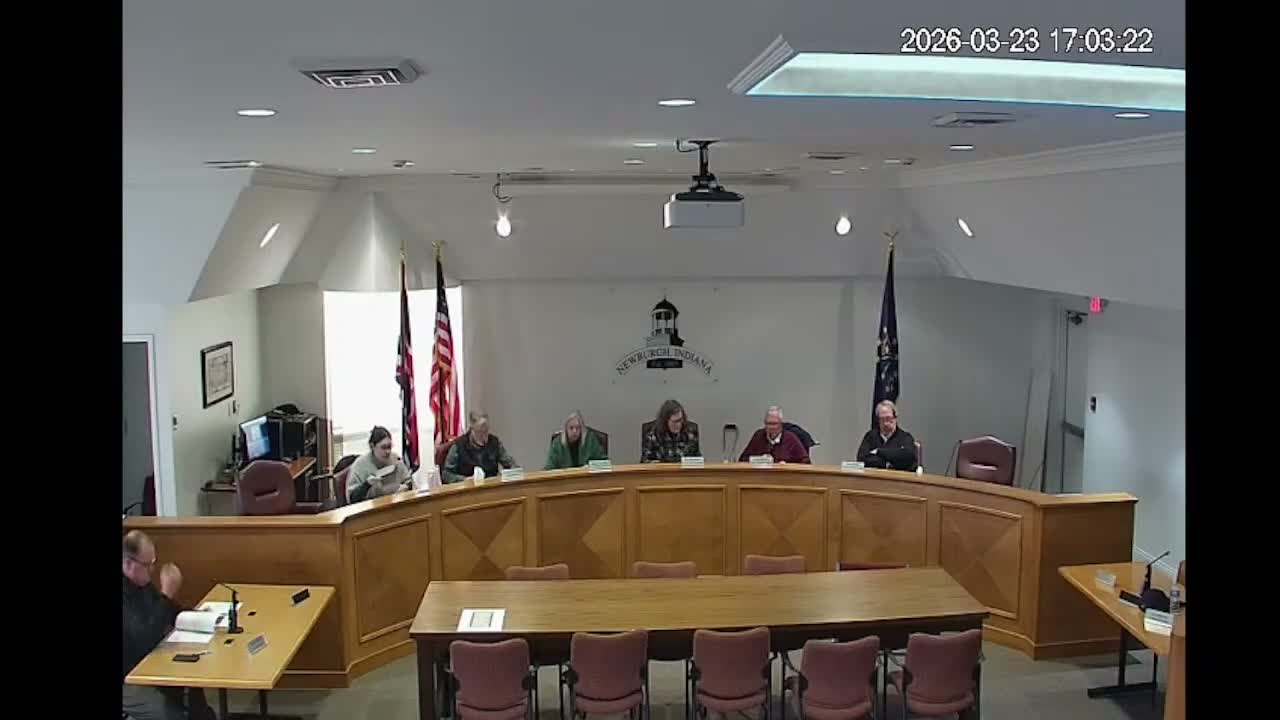
The Town of Newburgh Board of Zoning Appeals voted to allow a school to continue using a residential property for school activities but denied a separate request to keep a commercial-style sign on that residential lot.
The board reopened the public hearing to hear the petitioner and nearby residents before taking votes. Committee member (speaker 6) moved to approve the conditional-use permit for school activities and the board chairman declared the motion carried after the ayes were called. The board later considered the sign as a distinct conditional-use item and, after public comment and discussion about relocation options and grant constraints, voted to deny allowing the sign to remain in its current residential location.
Why it matters: The decisions separate the land-use question (allowing school activities to continue on the residentially zoned parcel) from the aesthetics and placement of signage that neighbors say functions as advertising. The board’s rulings let the school continue outdoor programming while requiring the applicant to remove or relocate the larger sign from the residential lot unless they return with new information, a variance, or move it onto the commercial parcel or another approved location.
What speakers told the board
Randy Kennedy, identified by the chair as the petitioner/neighbor, told the board he owns three nearby houses (206, 210 and 214) and urged the board to require maintenance conditions for the multi-sided sign and to move a bench: “If we're gonna have to look at these signs, can we incorporate some kind of maintenance?” He said the backs of the panels are deteriorating and volunteers have been helping but the boards need more durable materials.
A representative of the applicant (speaker 10) told the board the school has used the property since 2018 and asked that the board permit school activities there so students can access outdoor space and the river: "We've been there since 2018, and it wasn't until recently that it was brought to our attention that we needed to do that." The representative said the pieces commonly described as a sign were intended as grant-funded community art created with children’s contributions, not commercial advertising, and that volunteers have been maintaining the installation.
Tara Bevel, who identified herself as an employee of Optimal Access, clarified the function of a QR code on the installation: “They don't go to our website. It goes to our Facebook page, so the parents can interact and the families can interact.”
Board discussion and rationale
Committee member (speaker 6) argued the property’s current condition and limited development potential made the school use the “highest and best use” at this time and moved for approval of the conditional use for school activities. Staff (speaker 4) reminded the board that a conditional use does not change residential zoning but permits specific activities and that separate approvals (for example, a driveway or land disturbance) would require review by drainage/engineering staff.
On the sign, neighbors and some board members said the large, highly visible panel functions as a commercial sign and is inappropriate in its present residential location. Mr. Taylor (speaker 11) and another neighbor offered to help relocate the installation onto the applicant’s commercial parcel or up the hill so it would remain visible from the trail without sitting in the middle of residences. Staff and board members also discussed whether moving the piece would affect conditions of the grant that funded the artwork.
Votes at a glance
- Conditional-use permit to allow school activities on the residential parcel: Motion moved by Committee member (speaker 6), seconded; chair called the ayes and declared the motion carried (board declared approval at the meeting). The record captures at least two affirmative ayes announced and the chair’s declaration that the motion passed; the meeting record indicates the board approved the conditional use and will allow school activities to continue pending any required separate permits (driveway, drainage) for land disturbance.
- Conditional-use request to allow a commercial-style sign to remain on the residential lot: Motion to approve the sign was made and seconded; roll-call-style voting resulted in three recorded nays and the motion failed. The board denied the special use for the sign; staff explained the applicant may file a new petition, apply for a variance, or relocate the sign to an allowable location.
What’s next
Staff directed the applicant to coordinate potential relocation options with Riley and Chris (permits and site review) and confirmed the applicant may return with revised plans or seek a variance if required. The board closed the meeting after miscellaneous business and adjourned.
Sources: Meeting transcript of the Town of Newburgh Board of Zoning Appeals; quoted speakers are identified in the transcript.
The board reopened the public hearing to hear the petitioner and nearby residents before taking votes. Committee member (speaker 6) moved to approve the conditional-use permit for school activities and the board chairman declared the motion carried after the ayes were called. The board later considered the sign as a distinct conditional-use item and, after public comment and discussion about relocation options and grant constraints, voted to deny allowing the sign to remain in its current residential location.
Why it matters: The decisions separate the land-use question (allowing school activities to continue on the residentially zoned parcel) from the aesthetics and placement of signage that neighbors say functions as advertising. The board’s rulings let the school continue outdoor programming while requiring the applicant to remove or relocate the larger sign from the residential lot unless they return with new information, a variance, or move it onto the commercial parcel or another approved location.
What speakers told the board
Randy Kennedy, identified by the chair as the petitioner/neighbor, told the board he owns three nearby houses (206, 210 and 214) and urged the board to require maintenance conditions for the multi-sided sign and to move a bench: “If we're gonna have to look at these signs, can we incorporate some kind of maintenance?” He said the backs of the panels are deteriorating and volunteers have been helping but the boards need more durable materials.
A representative of the applicant (speaker 10) told the board the school has used the property since 2018 and asked that the board permit school activities there so students can access outdoor space and the river: "We've been there since 2018, and it wasn't until recently that it was brought to our attention that we needed to do that." The representative said the pieces commonly described as a sign were intended as grant-funded community art created with children’s contributions, not commercial advertising, and that volunteers have been maintaining the installation.
Tara Bevel, who identified herself as an employee of Optimal Access, clarified the function of a QR code on the installation: “They don't go to our website. It goes to our Facebook page, so the parents can interact and the families can interact.”
Board discussion and rationale
Committee member (speaker 6) argued the property’s current condition and limited development potential made the school use the “highest and best use” at this time and moved for approval of the conditional use for school activities. Staff (speaker 4) reminded the board that a conditional use does not change residential zoning but permits specific activities and that separate approvals (for example, a driveway or land disturbance) would require review by drainage/engineering staff.
On the sign, neighbors and some board members said the large, highly visible panel functions as a commercial sign and is inappropriate in its present residential location. Mr. Taylor (speaker 11) and another neighbor offered to help relocate the installation onto the applicant’s commercial parcel or up the hill so it would remain visible from the trail without sitting in the middle of residences. Staff and board members also discussed whether moving the piece would affect conditions of the grant that funded the artwork.
Votes at a glance
- Conditional-use permit to allow school activities on the residential parcel: Motion moved by Committee member (speaker 6), seconded; chair called the ayes and declared the motion carried (board declared approval at the meeting). The record captures at least two affirmative ayes announced and the chair’s declaration that the motion passed; the meeting record indicates the board approved the conditional use and will allow school activities to continue pending any required separate permits (driveway, drainage) for land disturbance.
- Conditional-use request to allow a commercial-style sign to remain on the residential lot: Motion to approve the sign was made and seconded; roll-call-style voting resulted in three recorded nays and the motion failed. The board denied the special use for the sign; staff explained the applicant may file a new petition, apply for a variance, or relocate the sign to an allowable location.
What’s next
Staff directed the applicant to coordinate potential relocation options with Riley and Chris (permits and site review) and confirmed the applicant may return with revised plans or seek a variance if required. The board closed the meeting after miscellaneous business and adjourned.
Sources: Meeting transcript of the Town of Newburgh Board of Zoning Appeals; quoted speakers are identified in the transcript.
View the Full Meeting & All Its Details
This article offers just a summary. Unlock complete video, transcripts, and insights as a Founder Member.
✓
Watch full, unedited meeting videos
✓
Search every word spoken in unlimited transcripts
✓
AI summaries & real-time alerts (all government levels)
✓
Permanent access to expanding government content
30-day money-back guarantee
