Dubuque County supervisors seek clarity on $270,000 local match, cash flow and oversight for multi‑state RCPP grant
March 09, 2026 | Dubuque County, Iowa
This article was created by AI summarizing key points discussed. AI makes mistakes, so for full details and context, please refer to the video of the full meeting. Please report any errors so we can fix them. Report an error »
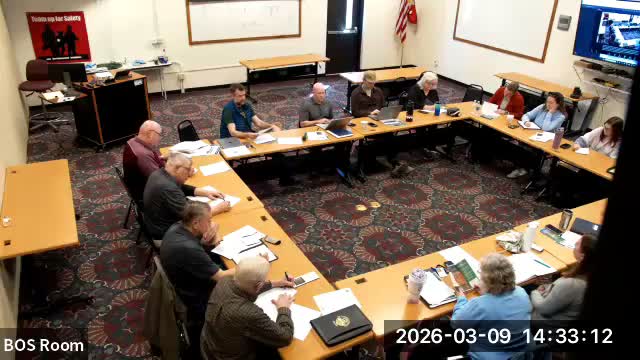
Dubuque County supervisors held a special work session to review implementation of a USDA Regional Conservation Partnership Program (RCPP) grant administered through Sand County Foundation and a newly formed Farmer‑to‑Farmer nonprofit, focusing on how a $270,000 county match and federal reimbursements will be tracked and spent.
The meeting, called to order by Chair Riley, heard a program update from county staff who said the partnership is about a year and a half into a five‑year RCPP grant. "The agreement was signed that Sand County would handle the majority of the contractual obligations of dispersing this money out to Dubuque County," the staff member said, describing a funding flow in which Dubuque County provides seed money that Sand County Foundation seeks to have reimbursed by NRCS and then redistributes to local programs.
Why it matters: supervisors pressed for assurances that the county’s $270,000 match will be spent in Dubuque County and that accounting and audit controls will be sufficient when Farmer‑to‑Farmer plays a larger administrative role. "What the agreement is saying is those matching dollars come back to Dubuque County and should be spent in Dubuque County," the staff member said.
Sand County Foundation representative Haley Summers stressed a practical cash‑flow problem tied to federal reimbursements. "That money that 270,000 is critical for us to be able to cash flow all of this," Summers said, noting NRCS reimbursements can be delayed several months and contractors must be paid on shorter cycles.
Officials described the existing 20/80 (2080) agreement that sets the county match and the federal shares across three states and discussed whether a separate county agreement is needed to clarify how and when local match funds return to county projects. "We didn't want to terminate the existing 20/80. It's laid out, signed, it's approved," the staff member said, adding county staff will work with Sand County and Farmer‑to‑Farmer to confirm whether further documentation is needed.
County commissioners and program participants asked for stronger transparency and audit safeguards. One supervisor urged that multiple signatures or county financial support be involved when a small nonprofit handles large sums. The county staff said spreadsheets track enrollments, acres and invoices and that Farmer‑to‑Farmer treasurer Josh coordinates bank statements and payment flow with county staff.
Program mechanics: presenters said the largest cover‑crop work will remain administered by Sand County Foundation (expected to be the highest dollar project), while Farmer‑to‑Farmer could manage additional programs that are not strictly NRCS‑eligible. The staff member noted that the $855,000 federal portion must meet NRCS practice codes to be reimbursed; local match can be used to fund activities that do not meet those codes, such as nutrient‑management planning or private engineering and design for stream‑bank stabilization.
Next steps: staff committed to provide supervisors a spreadsheet summary of projects, acres enrolled and the detailed funding flow. The group scheduled further follow‑up later in the fiscal year to review the accounting and to decide whether to add contractual language clarifying county oversight of Farmer‑to‑Farmer spending.
The work session ended with a motion to adjourn.
The meeting, called to order by Chair Riley, heard a program update from county staff who said the partnership is about a year and a half into a five‑year RCPP grant. "The agreement was signed that Sand County would handle the majority of the contractual obligations of dispersing this money out to Dubuque County," the staff member said, describing a funding flow in which Dubuque County provides seed money that Sand County Foundation seeks to have reimbursed by NRCS and then redistributes to local programs.
Why it matters: supervisors pressed for assurances that the county’s $270,000 match will be spent in Dubuque County and that accounting and audit controls will be sufficient when Farmer‑to‑Farmer plays a larger administrative role. "What the agreement is saying is those matching dollars come back to Dubuque County and should be spent in Dubuque County," the staff member said.
Sand County Foundation representative Haley Summers stressed a practical cash‑flow problem tied to federal reimbursements. "That money that 270,000 is critical for us to be able to cash flow all of this," Summers said, noting NRCS reimbursements can be delayed several months and contractors must be paid on shorter cycles.
Officials described the existing 20/80 (2080) agreement that sets the county match and the federal shares across three states and discussed whether a separate county agreement is needed to clarify how and when local match funds return to county projects. "We didn't want to terminate the existing 20/80. It's laid out, signed, it's approved," the staff member said, adding county staff will work with Sand County and Farmer‑to‑Farmer to confirm whether further documentation is needed.
County commissioners and program participants asked for stronger transparency and audit safeguards. One supervisor urged that multiple signatures or county financial support be involved when a small nonprofit handles large sums. The county staff said spreadsheets track enrollments, acres and invoices and that Farmer‑to‑Farmer treasurer Josh coordinates bank statements and payment flow with county staff.
Program mechanics: presenters said the largest cover‑crop work will remain administered by Sand County Foundation (expected to be the highest dollar project), while Farmer‑to‑Farmer could manage additional programs that are not strictly NRCS‑eligible. The staff member noted that the $855,000 federal portion must meet NRCS practice codes to be reimbursed; local match can be used to fund activities that do not meet those codes, such as nutrient‑management planning or private engineering and design for stream‑bank stabilization.
Next steps: staff committed to provide supervisors a spreadsheet summary of projects, acres enrolled and the detailed funding flow. The group scheduled further follow‑up later in the fiscal year to review the accounting and to decide whether to add contractual language clarifying county oversight of Farmer‑to‑Farmer spending.
The work session ended with a motion to adjourn.
Don't Miss a Word: See the Full Meeting!
Go beyond summaries. Unlock every video, transcript, and key insight with a Founder Membership.
✓
Get instant access to full meeting videos
✓
Search and clip any phrase from complete transcripts
✓
Receive AI-powered summaries & custom alerts
✓
Enjoy lifetime, unrestricted access to government data
30-day money-back guarantee
