House committee approves bill to license IVF labs and practitioners, sponsors say it codifies federal guidance
March 19, 2026 | 2026 Legislature TN, Tennessee
This article was created by AI summarizing key points discussed. AI makes mistakes, so for full details and context, please refer to the video of the full meeting. Please report any errors so we can fix them. Report an error »
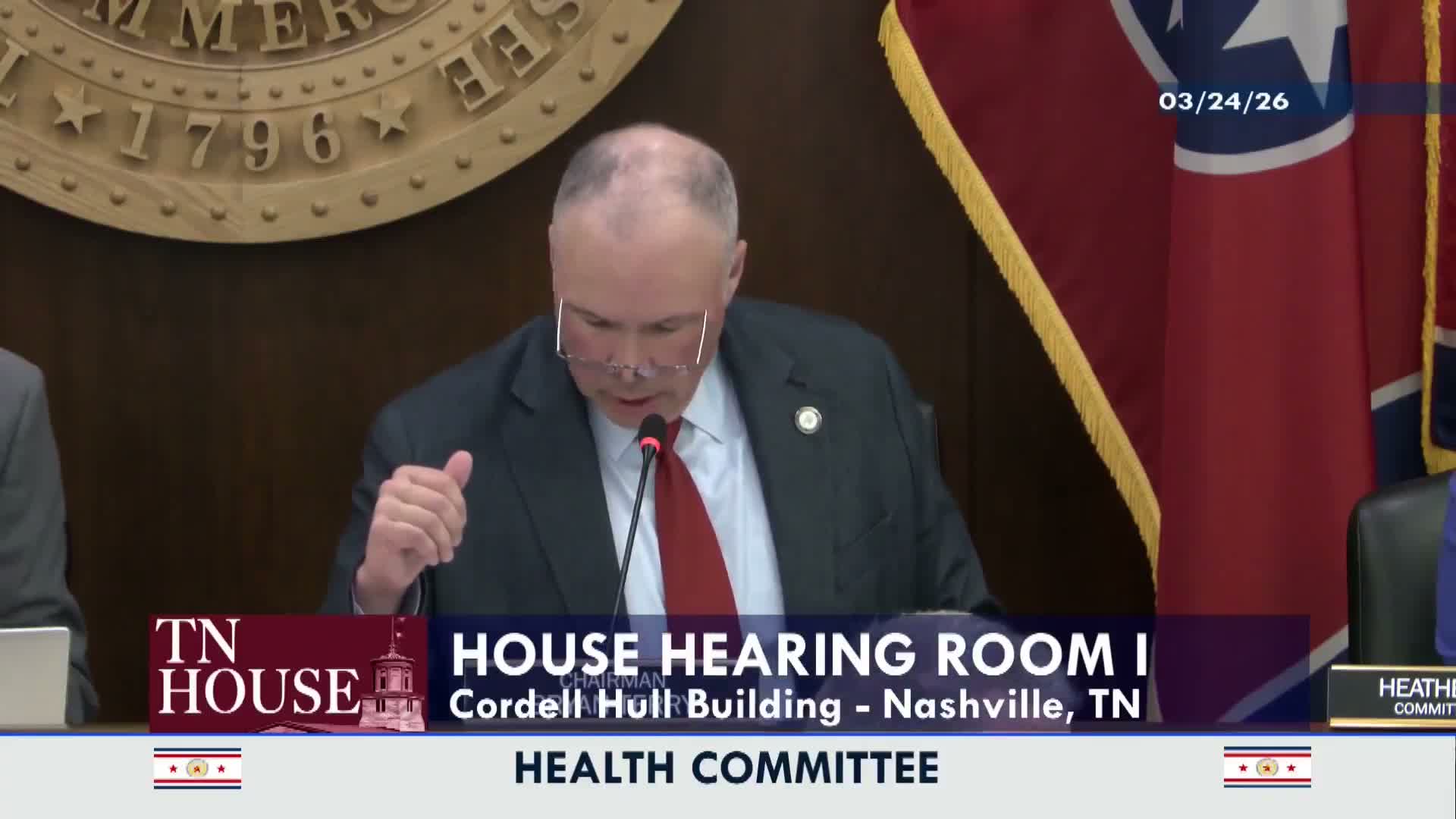
The House Health Committee voted to advance legislation establishing licensure and certification standards for in‑vitro fertilization (IVF) laboratories and clinicians.
Sponsor overview: The bill’s sponsor (speaker 8) told the committee HB 22‑90 would create licensure for IVF laboratories, a certificate for physicians practicing IVF and set testing/quality standards centered on the Society for Assisted Reproductive Technology (SART). The sponsor framed the bill as a response to operational failures at a single clinic and said licensure would allow the Department of Health to intervene to protect embryos and patients.
Support and purpose: Committee proponents and some clinic representatives told sponsors they helped draft the measure to codify current professional practice and avoid regulatory gaps. The sponsor said most in‑state clinics already follow SART guidance and the bill primarily codifies that standard.
Concerns and member questions: Several members asked about the degree of discretion the Department of Health would retain when issuing certifications and whether that discretion could be used to limit practitioners who meet federal guidelines. One member said the department’s discretionary authority remained a concern even if clinics complied with statutory criteria; the sponsor replied that the department has historically not denied practice when criteria were met, and that the bill simply codifies inspection and certification to protect embryos and families.
Vote and next steps: The committee approved the bill as amended by a vote of 15‑yes, 5‑no, 1‑present‑not‑voting. HB 22‑90 will move to Government Operations as amended.
Implications: Supporters described the measure as a patient‑safety and standards bill; critics urged careful limits on administrative discretion to avoid unintended barriers to clinical practice. The committee record shows robust discussion about regulatory design rather than ideological disagreement over IVF itself.
Sponsor overview: The bill’s sponsor (speaker 8) told the committee HB 22‑90 would create licensure for IVF laboratories, a certificate for physicians practicing IVF and set testing/quality standards centered on the Society for Assisted Reproductive Technology (SART). The sponsor framed the bill as a response to operational failures at a single clinic and said licensure would allow the Department of Health to intervene to protect embryos and patients.
Support and purpose: Committee proponents and some clinic representatives told sponsors they helped draft the measure to codify current professional practice and avoid regulatory gaps. The sponsor said most in‑state clinics already follow SART guidance and the bill primarily codifies that standard.
Concerns and member questions: Several members asked about the degree of discretion the Department of Health would retain when issuing certifications and whether that discretion could be used to limit practitioners who meet federal guidelines. One member said the department’s discretionary authority remained a concern even if clinics complied with statutory criteria; the sponsor replied that the department has historically not denied practice when criteria were met, and that the bill simply codifies inspection and certification to protect embryos and families.
Vote and next steps: The committee approved the bill as amended by a vote of 15‑yes, 5‑no, 1‑present‑not‑voting. HB 22‑90 will move to Government Operations as amended.
Implications: Supporters described the measure as a patient‑safety and standards bill; critics urged careful limits on administrative discretion to avoid unintended barriers to clinical practice. The committee record shows robust discussion about regulatory design rather than ideological disagreement over IVF itself.
View the Full Meeting & All Its Details
This article offers just a summary. Unlock complete video, transcripts, and insights as a Founder Member.
✓
Watch full, unedited meeting videos
✓
Search every word spoken in unlimited transcripts
✓
AI summaries & real-time alerts (all government levels)
✓
Permanent access to expanding government content
30-day money-back guarantee
