Advocates and returning citizens urge council to pass EASE Act to let incarcerated residents testify
March 18, 2026 | Committee on Judiciary and Public Safety, Committees, Legislative, District of Columbia
This article was created by AI summarizing key points discussed. AI makes mistakes, so for full details and context, please refer to the video of the full meeting. Please report any errors so we can fix them. Report an error »
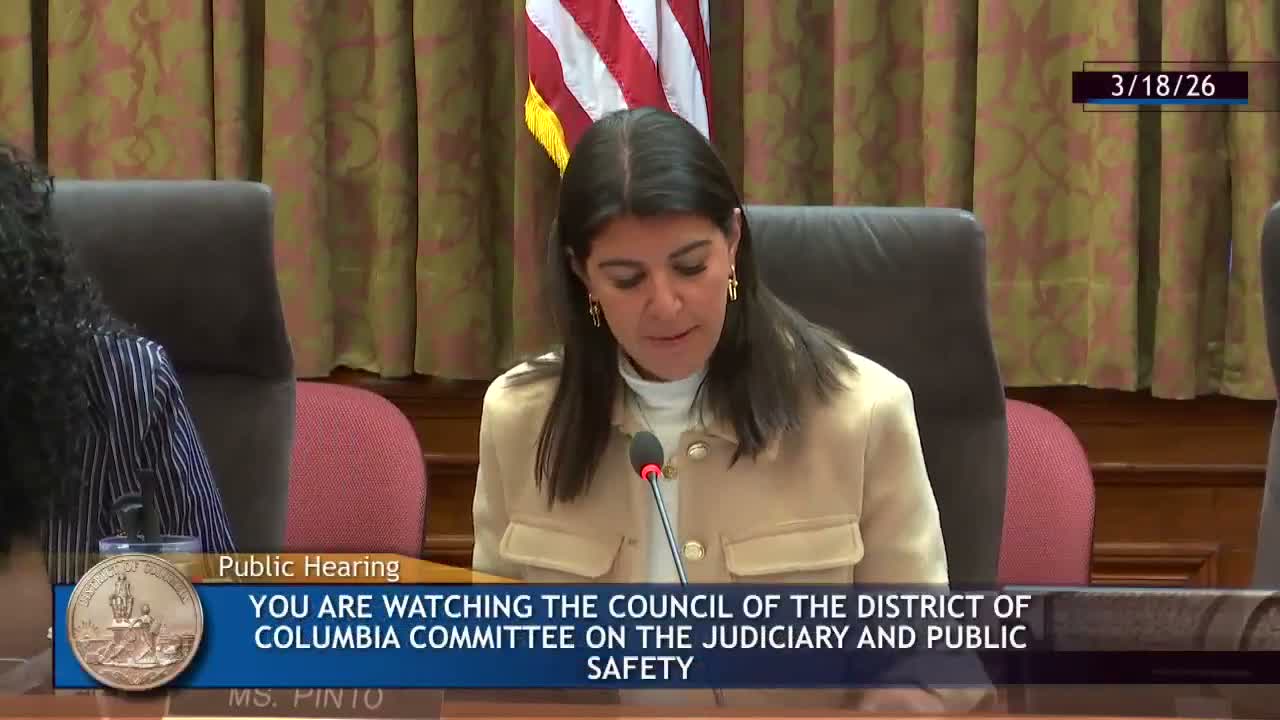
Chair Brooke Pinto opened a March 18 hearing of the Council's Committee on Judiciary and Public Safety to consider the Ensuring Access to Supporting Engagement (EASE) Act, which would require the Department of Corrections to provide devices, Internet access and no‑cost communications so incarcerated residents can register for and deliver oral and written testimony to the DC Council and contact their Advisory Neighborhood Commissioner (ANC).
The bill drew broad support from returning citizens, legal advocates and civic organizations who said allowing testimony would improve oversight, reveal conditions inside the jails, and strengthen rehabilitation and reentry. "Being heard is therapeutic," said ANC Commissioner Harold Cunningham, who represents residents of the DC jail and read testimony from more than a half dozen incarcerated people who could not appear in person. Cunningham told the committee he speaks on behalf of roughly 2,200 residents but warned, "It is impossible for 1 person to truly speak for 2,200 people."
Advocates from Legal Aid DC, the League of Women Voters, the Second Look Project, the DC Justice Lab and returning citizens described concrete failures they said the bill would help surface: allegations of inadequate pregnancy and postpartum supports, long suspensions of library services, restricted visitation, food‑quality complaints and prolonged periods of restrictive housing. Jessie White, legislative director at Prisoners Legal Services of Massachusetts, described an incremental model used in Massachusetts and said the legislature there found the technology and process inexpensive to implement and valuable for policymaking.
DOC Deputy Director Lenard Johnson told the committee his agency supports meaningful civic participation but opposed the EASE Act as written, arguing it would create security, staffing and infrastructure risks. "Introducing open and expanded Internet functionality in a correctional environment creates significant risk," he testified, citing unauthorized communications, coordinated criminal activity and "digital contraband." Johnson said current inside‑facility computer stations are restricted and used for court and attorney visits; expanding that access would require secure rooms, additional staff escorts, upgraded bandwidth and real‑time monitoring.
Committee members and witnesses pressed for operational solutions during the hearing. Several witnesses suggested phased or unit‑based approaches: permit testimony through fixed, monitored visitation stations or designated hearing rooms; allow anonymous or audio‑only participation when safety concerns exist; require DOC to provide educational materials and annual reporting on requests to testify and denials; and explicitly guarantee access for residents in restrictive housing, solitary confinement and mental‑health units.
Shamika Hayes, a returning citizen and former ANC commissioner, urged the committee to ensure the process is "cost free," that ANC commissioners can reach constituents by multiple methods (email, phone, letter and meetings), and that communications be treated as confidential. Councilmembers asked DOC and advocates to collaborate on pilot arrangements: using existing attorney‑visit stations for council testimony, creating limited unit monitors during hearings, and scheduling testimony to avoid count times and other operational peaks.
Chair Pinto said the bill is intended to close a democratic gap created by recent voting access reforms. "Voting rights without the ability to participate in the legislative process create an incomplete democracy," she said. No final vote was taken; the committee heard government and public testimony and signaled it will consider operational amendments and a phased implementation plan.
The bill drew broad support from returning citizens, legal advocates and civic organizations who said allowing testimony would improve oversight, reveal conditions inside the jails, and strengthen rehabilitation and reentry. "Being heard is therapeutic," said ANC Commissioner Harold Cunningham, who represents residents of the DC jail and read testimony from more than a half dozen incarcerated people who could not appear in person. Cunningham told the committee he speaks on behalf of roughly 2,200 residents but warned, "It is impossible for 1 person to truly speak for 2,200 people."
Advocates from Legal Aid DC, the League of Women Voters, the Second Look Project, the DC Justice Lab and returning citizens described concrete failures they said the bill would help surface: allegations of inadequate pregnancy and postpartum supports, long suspensions of library services, restricted visitation, food‑quality complaints and prolonged periods of restrictive housing. Jessie White, legislative director at Prisoners Legal Services of Massachusetts, described an incremental model used in Massachusetts and said the legislature there found the technology and process inexpensive to implement and valuable for policymaking.
DOC Deputy Director Lenard Johnson told the committee his agency supports meaningful civic participation but opposed the EASE Act as written, arguing it would create security, staffing and infrastructure risks. "Introducing open and expanded Internet functionality in a correctional environment creates significant risk," he testified, citing unauthorized communications, coordinated criminal activity and "digital contraband." Johnson said current inside‑facility computer stations are restricted and used for court and attorney visits; expanding that access would require secure rooms, additional staff escorts, upgraded bandwidth and real‑time monitoring.
Committee members and witnesses pressed for operational solutions during the hearing. Several witnesses suggested phased or unit‑based approaches: permit testimony through fixed, monitored visitation stations or designated hearing rooms; allow anonymous or audio‑only participation when safety concerns exist; require DOC to provide educational materials and annual reporting on requests to testify and denials; and explicitly guarantee access for residents in restrictive housing, solitary confinement and mental‑health units.
Shamika Hayes, a returning citizen and former ANC commissioner, urged the committee to ensure the process is "cost free," that ANC commissioners can reach constituents by multiple methods (email, phone, letter and meetings), and that communications be treated as confidential. Councilmembers asked DOC and advocates to collaborate on pilot arrangements: using existing attorney‑visit stations for council testimony, creating limited unit monitors during hearings, and scheduling testimony to avoid count times and other operational peaks.
Chair Pinto said the bill is intended to close a democratic gap created by recent voting access reforms. "Voting rights without the ability to participate in the legislative process create an incomplete democracy," she said. No final vote was taken; the committee heard government and public testimony and signaled it will consider operational amendments and a phased implementation plan.
Don't Miss a Word: See the Full Meeting!
Go beyond summaries. Unlock every video, transcript, and key insight with a Founder Membership.
✓
Get instant access to full meeting videos
✓
Search and clip any phrase from complete transcripts
✓
Receive AI-powered summaries & custom alerts
✓
Enjoy lifetime, unrestricted access to government data
30-day money-back guarantee
