911 officials and EMS experts push for medical oversight and new funding as Council weighs OUC bills
March 18, 2026 | Committee on Judiciary and Public Safety, Committees, Legislative, District of Columbia
This article was created by AI summarizing key points discussed. AI makes mistakes, so for full details and context, please refer to the video of the full meeting. Please report any errors so we can fix them. Report an error »
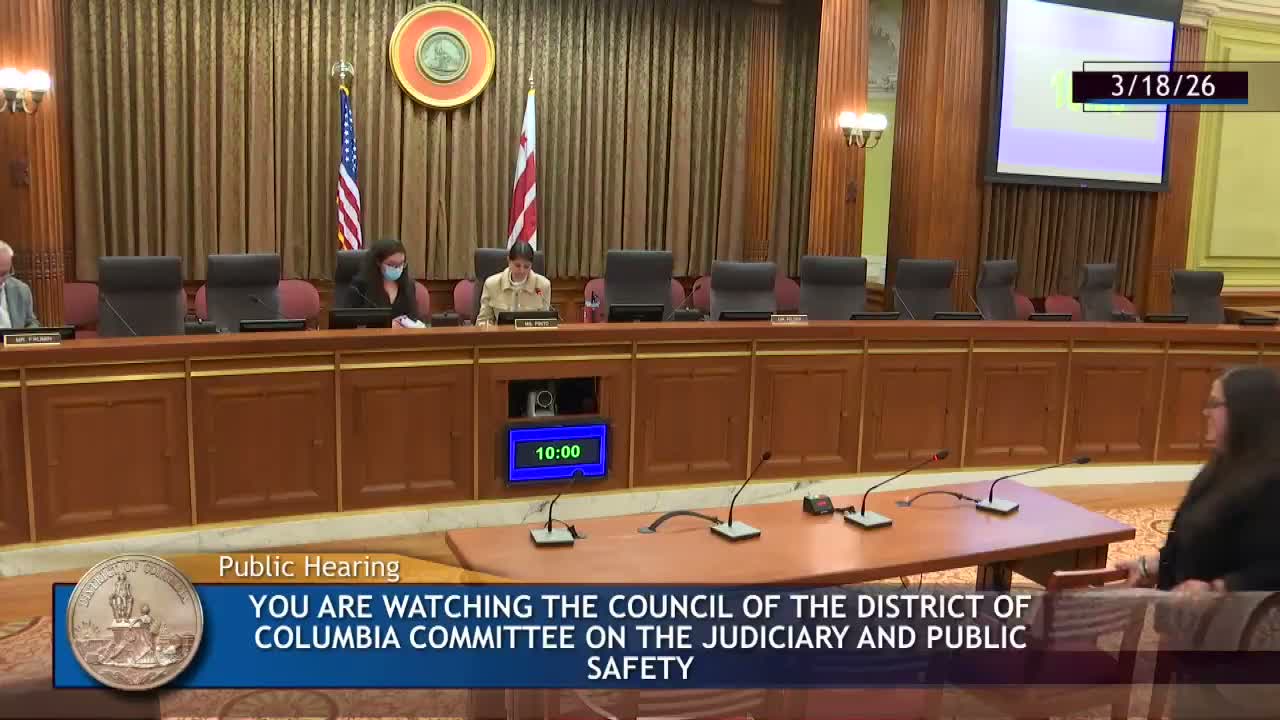
The Committee on Judiciary and Public Safety heard lengthy testimony on March 18 about two related bills aimed at strengthening the District's 911 system: the Emergency Medical Services Clarification Amendment Act of 2026, which would explicitly codify medical oversight of OUC, and the E911 Modernization Amendment Act of 2025, which would reform the fee structure used to fund emergency communications.
OUC Director Heather McGaffin supported both bills in principle. "Our communications platforms have grown extensively since the fund was set in 2000," McGaffin told the committee, arguing current special‑revenue collections cover only about 20% of OUC's operating costs. She proposed a modest hotel room surcharge that her office estimates would generate roughly $7.5 million annually to help stabilize funding for next‑generation 911 upgrades.
On clinical oversight, public‑safety witnesses including former DC Fire & EMS medical director Dr. Robert Holman, EMS advocates and union leaders urged the committee to give a single medical director explicit authority over OUC dispatch protocols, triage and quality improvement. "Emergency medical response begins at the moment the call is answered," said Dr. Holman, who argued that the medical director needs authority to revise dispatch protocols, correct mis‑routing and oversee continuous quality improvement programs.
Witnesses pointed to the nurse triage line as an example of unrealized clinical potential. Dr. Holman said sample audits show roughly 22% of EMS calls meet criteria for referral to the nurse triage line, while OUC referred only about 3% in some reporting periods. Proponents said this gap can be reduced by aligning dispatch protocols with clinical oversight and by raising minimum training/licensure standards for telecommunicators.
Several panelists recommended expanding training beyond procedural EMD certification. Fire union leaders suggested an "EMR floor" with pathways for EMT/paramedic recruitment into dispatch, while OUC supported codifying EMD certification within a specified timeframe and said it already requires new hires to receive EMD training within weeks of onboarding.
Director McGaffin acknowledged implementation tensions: OUC favors a dedicated medical subject‑matter expert for day‑to‑day operations, but also said coordination with FEMS and other emergency agencies is vital. "We do this collaboratively," she said. Public witnesses urged that medical oversight must be empowered to access 911 call audio for QA reviews and to correct systemic dispatch errors.
Councilmembers questioned staffing and recruitment: McGaffin reported 23 call‑taker vacancies and described expanded QA using AI tools that now run automated reviews of 100% of calls for supervisory feedback. Committee members asked for follow‑up materials on nurse‑triage referral rates, call‑origin maps (tourist vs resident volume), and the fiscal impact of various fee proposals.
No final action was taken; the committee asked OUC and stakeholders to provide detailed data on triage referrals, QA metrics, staffing and the fiscal model for any surcharge or fee changes. The hearing closed with committee members stressing the urgency of a stable funding path and clearer clinical authority at the 911 center.
OUC Director Heather McGaffin supported both bills in principle. "Our communications platforms have grown extensively since the fund was set in 2000," McGaffin told the committee, arguing current special‑revenue collections cover only about 20% of OUC's operating costs. She proposed a modest hotel room surcharge that her office estimates would generate roughly $7.5 million annually to help stabilize funding for next‑generation 911 upgrades.
On clinical oversight, public‑safety witnesses including former DC Fire & EMS medical director Dr. Robert Holman, EMS advocates and union leaders urged the committee to give a single medical director explicit authority over OUC dispatch protocols, triage and quality improvement. "Emergency medical response begins at the moment the call is answered," said Dr. Holman, who argued that the medical director needs authority to revise dispatch protocols, correct mis‑routing and oversee continuous quality improvement programs.
Witnesses pointed to the nurse triage line as an example of unrealized clinical potential. Dr. Holman said sample audits show roughly 22% of EMS calls meet criteria for referral to the nurse triage line, while OUC referred only about 3% in some reporting periods. Proponents said this gap can be reduced by aligning dispatch protocols with clinical oversight and by raising minimum training/licensure standards for telecommunicators.
Several panelists recommended expanding training beyond procedural EMD certification. Fire union leaders suggested an "EMR floor" with pathways for EMT/paramedic recruitment into dispatch, while OUC supported codifying EMD certification within a specified timeframe and said it already requires new hires to receive EMD training within weeks of onboarding.
Director McGaffin acknowledged implementation tensions: OUC favors a dedicated medical subject‑matter expert for day‑to‑day operations, but also said coordination with FEMS and other emergency agencies is vital. "We do this collaboratively," she said. Public witnesses urged that medical oversight must be empowered to access 911 call audio for QA reviews and to correct systemic dispatch errors.
Councilmembers questioned staffing and recruitment: McGaffin reported 23 call‑taker vacancies and described expanded QA using AI tools that now run automated reviews of 100% of calls for supervisory feedback. Committee members asked for follow‑up materials on nurse‑triage referral rates, call‑origin maps (tourist vs resident volume), and the fiscal impact of various fee proposals.
No final action was taken; the committee asked OUC and stakeholders to provide detailed data on triage referrals, QA metrics, staffing and the fiscal model for any surcharge or fee changes. The hearing closed with committee members stressing the urgency of a stable funding path and clearer clinical authority at the 911 center.
View the Full Meeting & All Its Details
This article offers just a summary. Unlock complete video, transcripts, and insights as a Founder Member.
✓
Watch full, unedited meeting videos
✓
Search every word spoken in unlimited transcripts
✓
AI summaries & real-time alerts (all government levels)
✓
Permanent access to expanding government content
30-day money-back guarantee
