Attorney General and advocates press Council to pass child‑support overhaul to send more money to families
March 18, 2026 | Committee on Judiciary and Public Safety, Committees, Legislative, District of Columbia
This article was created by AI summarizing key points discussed. AI makes mistakes, so for full details and context, please refer to the video of the full meeting. Please report any errors so we can fix them. Report an error »
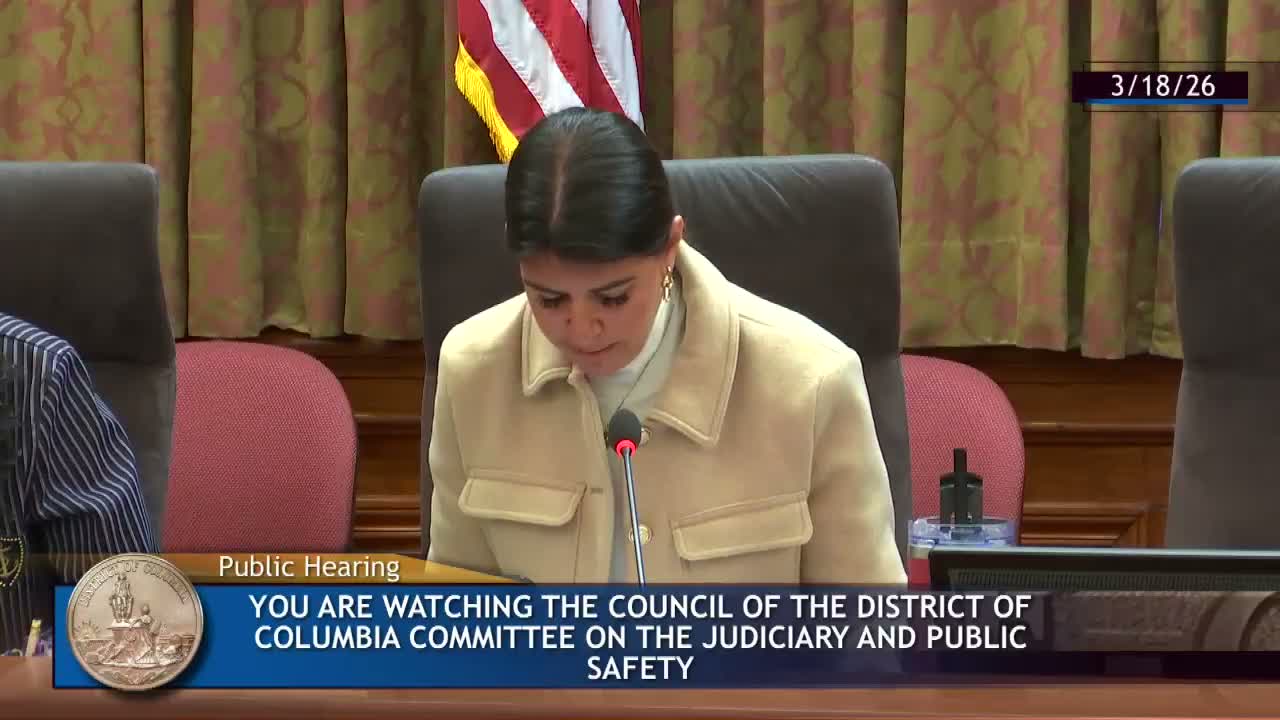
At a March 18 hearing the Council considered the Child Support Improvement Amendment Act of 2026, introduced by Attorney General Brian Schwab with Councilmembers Brooke Pinto and Matt Fruman. The bill would change how the District handles child‑support collections for families receiving or who previously received Temporary Assistance for Needy Families (TANF), expand pass‑throughs to allow custodial households to keep more—ultimately all—of the child support collected on their behalf, and revise the period of enforceability for past‑due support.
Attorney General Schwab told the committee the current cost‑recovery model routes much of collected support to government coffers rather than directly to families. "The Child Support Improvement Act will shift our priorities by adopting a family‑first model, where all child support collections go directly to the families for whom those payments are intended," he said. He and OAG staff outlined a phased approach to implementation: some coding and program changes could be made quickly with modest one‑time costs, while full uncapped pass‑through depends on a longer IT modernization with federal match.
Legal Aid DC, the Gender Justice Clinic, Bread for the City and other advocates urged several amendments during testimony: automatic suspension or modification of orders during incarceration to avoid mounting arrears, expanded "good cause" exemptions and confidentiality and safety protections for survivors of domestic violence, relief or write‑offs for very old arrears, and exemptions from driver's‑license suspensions for low‑income parents. Legal Aid urged the committee to make the period of enforceability automatic (not dependent on defendants raising the defense) and recommended a clear end date for revival of old judgments.
OAG estimated fiscal impacts and a phased cost list. Staff testified the immediate changes would require a one‑time legacy code update (approx. $300,000) and recurring operating costs to expand pass‑throughs to families previously on TANF (estimates in testimony included approx. $75,000 and $650,000 recurring elements depending on scope), while full modernization to support an uncapped pass‑through could entail larger capital work over multiple years with a federal match covering a substantial share. OAG said it has submitted a feasibility study for federal modernization funds and anticipates phased completion in the 2028–2031 timeframe, depending on procurement and approvals.
Councilmembers broadly praised the bill as an anti‑poverty reform that would put cash directly into children's hands, noting the disproportionate benefit to low‑income women and families. Members asked OAG for supplemental fiscal figures, data on how much the District now retains versus passes through, and details about the modernization timetable. No vote was taken; the committee expects to mark up the bill after follow‑up materials and budget discussions.
Attorney General Schwab told the committee the current cost‑recovery model routes much of collected support to government coffers rather than directly to families. "The Child Support Improvement Act will shift our priorities by adopting a family‑first model, where all child support collections go directly to the families for whom those payments are intended," he said. He and OAG staff outlined a phased approach to implementation: some coding and program changes could be made quickly with modest one‑time costs, while full uncapped pass‑through depends on a longer IT modernization with federal match.
Legal Aid DC, the Gender Justice Clinic, Bread for the City and other advocates urged several amendments during testimony: automatic suspension or modification of orders during incarceration to avoid mounting arrears, expanded "good cause" exemptions and confidentiality and safety protections for survivors of domestic violence, relief or write‑offs for very old arrears, and exemptions from driver's‑license suspensions for low‑income parents. Legal Aid urged the committee to make the period of enforceability automatic (not dependent on defendants raising the defense) and recommended a clear end date for revival of old judgments.
OAG estimated fiscal impacts and a phased cost list. Staff testified the immediate changes would require a one‑time legacy code update (approx. $300,000) and recurring operating costs to expand pass‑throughs to families previously on TANF (estimates in testimony included approx. $75,000 and $650,000 recurring elements depending on scope), while full modernization to support an uncapped pass‑through could entail larger capital work over multiple years with a federal match covering a substantial share. OAG said it has submitted a feasibility study for federal modernization funds and anticipates phased completion in the 2028–2031 timeframe, depending on procurement and approvals.
Councilmembers broadly praised the bill as an anti‑poverty reform that would put cash directly into children's hands, noting the disproportionate benefit to low‑income women and families. Members asked OAG for supplemental fiscal figures, data on how much the District now retains versus passes through, and details about the modernization timetable. No vote was taken; the committee expects to mark up the bill after follow‑up materials and budget discussions.
View the Full Meeting & All Its Details
This article offers just a summary. Unlock complete video, transcripts, and insights as a Founder Member.
✓
Watch full, unedited meeting videos
✓
Search every word spoken in unlimited transcripts
✓
AI summaries & real-time alerts (all government levels)
✓
Permanent access to expanding government content
30-day money-back guarantee
