Supporters tell Senate panel raising age of consent to 18 would help prosecutors, investigators
March 23, 2026 | 2026 Legislature Alaska, Alaska
This article was created by AI summarizing key points discussed. AI makes mistakes, so for full details and context, please refer to the video of the full meeting. Please report any errors so we can fix them. Report an error »
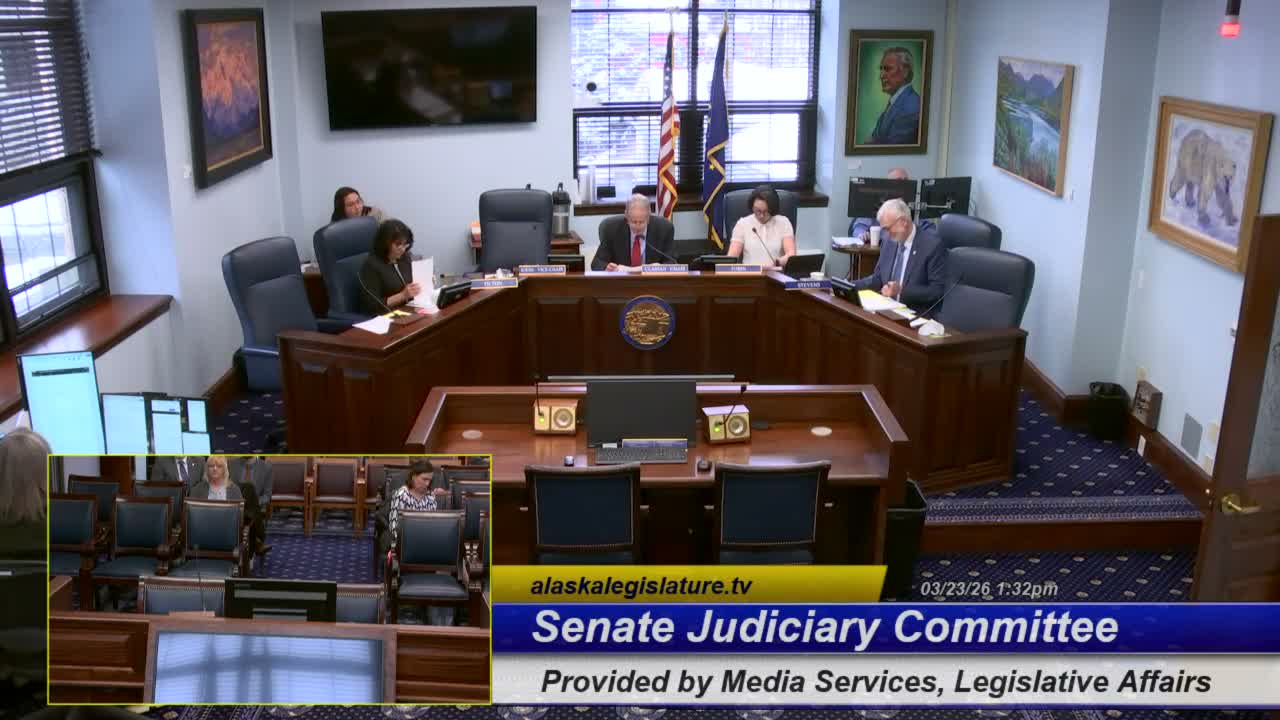
The Senate Judiciary Committee heard invited and public testimony Wednesday on House Bill 101, which would add 16- and 17-year-olds to the statutory definition of minors for criminal statutes and limit lawful close-in-age sexual contact when an adult is six or more years older.
Chief Sean Case of the Anchorage Police Department told the panel that detectives who reviewed the proposed language expect the change to generate only "a handful or two" of additional cases per year in Anchorage, and that it would give law enforcement and prosecutors "stronger tools to hold offenders accountable and to intervene before further harm occurs." Case also said some rural jurisdictions expect relatively larger increases in workload because close-knit communities are more likely to report suspected predatory behavior.
Advocates who spoke in public testimony framed the bill as a measure to protect young people from exploitation. Brenda Standville, executive director of the Alaska Network on Domestic Violence and Sexual Assault, said HB101 would align Alaska with a dozen other states and the District of Columbia by raising the age of consent to 18 for unlimited sexual contact. Standville told the committee the bill would allow police to investigate alleged exploitative relationships involving 16- and 17-year-olds — particularly where there is a six-year age difference — and urged the committee to move the bill forward.
Multiple survivors and victim-service providers testified in favor. Joey Telson, a Ketchikan resident and former evidence officer, described predatory dynamics in small communities and said he supports the change. Jabez Woody, speaking from Fairbanks, described being tried as an adult after crimes committed at 16 and urged the committee to consider a mechanism for people waived into the adult system as youths to petition for record transfer back to juvenile court after a review period (he suggested five years or at age 25).
Testifiers and committee members acknowledged uncertainty about how many additional cases would be generated statewide. "We anticipate only a handful or two of additional cases per year as a result of this legislation," Chief Case said. Brenda Standville and other advocates said they expect investigations to increase and expressed the hope that prosecutions would follow, but they noted that investigation rates do not always translate directly into prosecution rates.
The committee closed public testimony and left HB101 "aside for further review" with no committee vote recorded.
What happens next: The committee did not take a vote on HB101 at this hearing; committee members said the bill will be reviewed further before a future action.
Chief Sean Case of the Anchorage Police Department told the panel that detectives who reviewed the proposed language expect the change to generate only "a handful or two" of additional cases per year in Anchorage, and that it would give law enforcement and prosecutors "stronger tools to hold offenders accountable and to intervene before further harm occurs." Case also said some rural jurisdictions expect relatively larger increases in workload because close-knit communities are more likely to report suspected predatory behavior.
Advocates who spoke in public testimony framed the bill as a measure to protect young people from exploitation. Brenda Standville, executive director of the Alaska Network on Domestic Violence and Sexual Assault, said HB101 would align Alaska with a dozen other states and the District of Columbia by raising the age of consent to 18 for unlimited sexual contact. Standville told the committee the bill would allow police to investigate alleged exploitative relationships involving 16- and 17-year-olds — particularly where there is a six-year age difference — and urged the committee to move the bill forward.
Multiple survivors and victim-service providers testified in favor. Joey Telson, a Ketchikan resident and former evidence officer, described predatory dynamics in small communities and said he supports the change. Jabez Woody, speaking from Fairbanks, described being tried as an adult after crimes committed at 16 and urged the committee to consider a mechanism for people waived into the adult system as youths to petition for record transfer back to juvenile court after a review period (he suggested five years or at age 25).
Testifiers and committee members acknowledged uncertainty about how many additional cases would be generated statewide. "We anticipate only a handful or two of additional cases per year as a result of this legislation," Chief Case said. Brenda Standville and other advocates said they expect investigations to increase and expressed the hope that prosecutions would follow, but they noted that investigation rates do not always translate directly into prosecution rates.
The committee closed public testimony and left HB101 "aside for further review" with no committee vote recorded.
What happens next: The committee did not take a vote on HB101 at this hearing; committee members said the bill will be reviewed further before a future action.
View the Full Meeting & All Its Details
This article offers just a summary. Unlock complete video, transcripts, and insights as a Founder Member.
✓
Watch full, unedited meeting videos
✓
Search every word spoken in unlimited transcripts
✓
AI summaries & real-time alerts (all government levels)
✓
Permanent access to expanding government content
30-day money-back guarantee
