Alaska caucus briefing spotlights federal conservation funding, recruitment and local outreach
March 23, 2026 | 2026 Legislature Alaska, Alaska
This article was created by AI summarizing key points discussed. AI makes mistakes, so for full details and context, please refer to the video of the full meeting. Please report any errors so we can fix them. Report an error »
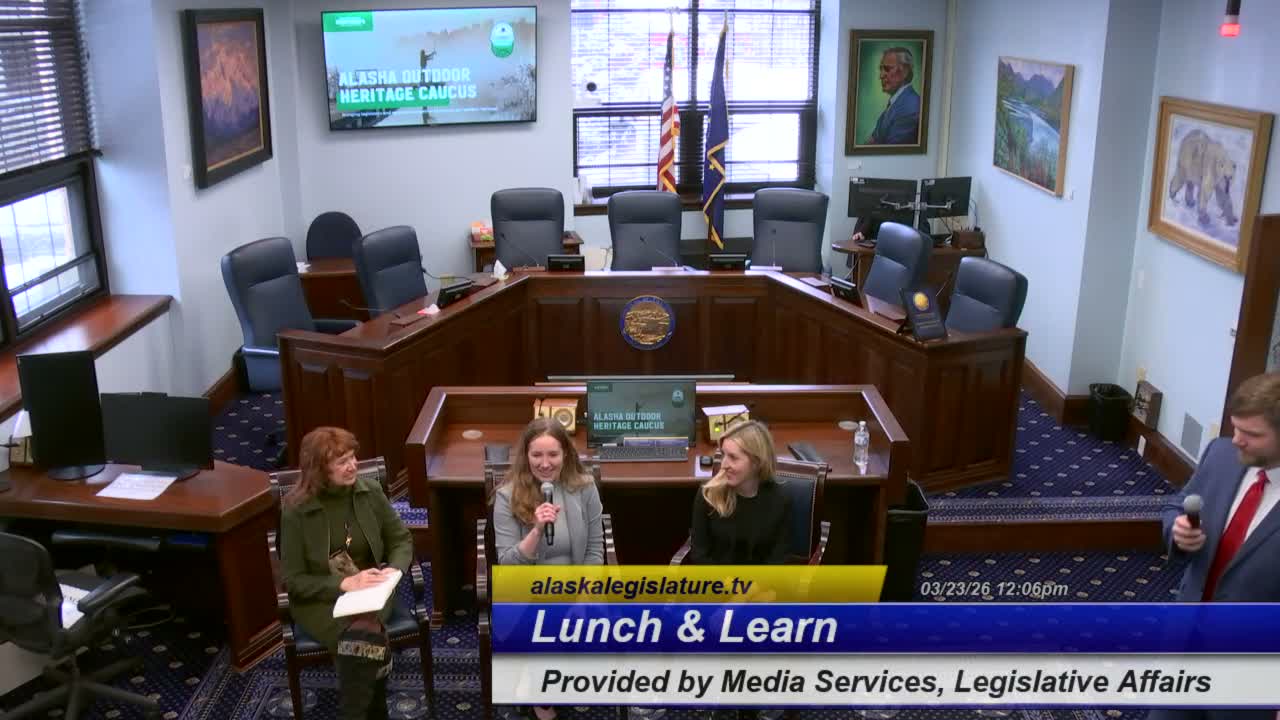
At a March lunch-and-learn hosted by an Alaska senator, Marie Newmiller of the Congressional Sportsmen's Foundation and Keeley Hawkins of Safari Club International outlined how sportsmen's caucuses connect lawmakers with local experts, and how license and excise-tax dollars fund state wildlife and fisheries work.
The presenters said the caucus's role is primarily educational: providing a nonbinding, bipartisan forum where legislators can learn technical details about wildlife, fisheries and forestry policy before taking positions on legislation. "As he said, my name is Marie Newmiller, and I work for Congressional Sportsmen's Foundation," Newmiller told the room, explaining CSF serves as an administrative helper for the Alaska Outdoor Heritage Caucus and helps arrange subject-matter briefings.
Why it matters: speakers said Alaska's conservation and resource-management decisions rely on data and funding that often come from a "user-pay" system — hunting and fishing license fees and federal excise taxes. "That is the money that was brought to Alaska through sportsmen's dollars," Newmiller said, describing how those revenues support the Alaska Department of Fish and Game's conservation, wildlife and fisheries work.
Presenters detailed two federal funding streams frequently cited at the briefing: Pittman-Robertson funds (excise taxes on hunting equipment) and Dingell-Johnson funds (excise taxes for sport-fish restoration). According to the presentation, those federal excise revenues are used for conservation projects, access improvements (boat ramps and docks), biological studies and other license-holder benefits; the speakers characterized the federal-state funding relationship as a critical match for state conservation projects. A speaker also noted a separate ammunition-tax match amendment attributed in the talk to Rep. Young that was described as providing a 10-to-1 match for shooting-range improvements.
The caucus presenters described recent CSF work on forestry policy, including a CSF forestry advisory council launched in 2025 to help state and federal lawmakers navigate issues that affect Alaska, such as the roadless rule and other federal forest legislation. Newmiller offered to connect attendees with CSF's forestry lead for detailed federal policy questions.
Outreach and recruitment were a major focus of the session. Speakers stressed "R3" (recruitment, retention and reactivation) efforts to grow and diversify the pool of licensed hunters and anglers. "One of the fastest growing populations in license buying is women," Keeley Hawkins said, and SCI and partner NGOs described training and scholarship programs intended to introduce new participants to hunting and shooting sports.
Speakers gave specific local examples: NGO pilot scholarships awarded to a Fairbanks bison biologist and long-term moose research on the Kenai Peninsula, including a 10-mile-by-10-mile research pen. Presenters also highlighted nonprofit food programs such as Hunters for the Hungry and volunteer recovery projects that route harvested or recovered meat to local food banks via USDA-licensed processors.
Audience members pressed the presenters on contested topics such as the roadless rule and whether the organizations support rescinding protections in Southeast Alaska. Presenters declined to take a position in the briefing and instead offered to provide the forum's forestry lead for a detailed federal-policy response. An attendee asked how the caucus engages other conservation groups; presenters said outreach varies by co-chair and staff capacity and listed national partners they work with in states: Safari Club International, Rocky Mountain Elk Foundation, Wild Sheep Foundation, Delta Waterfowl, Ducks Unlimited and the National Wildlife Federation.
The session closed with thanks and a reminder of a follow-up meeting in Representative Johnson's office the next day for those who wanted more information or to join the caucus.
The presenters said the caucus's role is primarily educational: providing a nonbinding, bipartisan forum where legislators can learn technical details about wildlife, fisheries and forestry policy before taking positions on legislation. "As he said, my name is Marie Newmiller, and I work for Congressional Sportsmen's Foundation," Newmiller told the room, explaining CSF serves as an administrative helper for the Alaska Outdoor Heritage Caucus and helps arrange subject-matter briefings.
Why it matters: speakers said Alaska's conservation and resource-management decisions rely on data and funding that often come from a "user-pay" system — hunting and fishing license fees and federal excise taxes. "That is the money that was brought to Alaska through sportsmen's dollars," Newmiller said, describing how those revenues support the Alaska Department of Fish and Game's conservation, wildlife and fisheries work.
Presenters detailed two federal funding streams frequently cited at the briefing: Pittman-Robertson funds (excise taxes on hunting equipment) and Dingell-Johnson funds (excise taxes for sport-fish restoration). According to the presentation, those federal excise revenues are used for conservation projects, access improvements (boat ramps and docks), biological studies and other license-holder benefits; the speakers characterized the federal-state funding relationship as a critical match for state conservation projects. A speaker also noted a separate ammunition-tax match amendment attributed in the talk to Rep. Young that was described as providing a 10-to-1 match for shooting-range improvements.
The caucus presenters described recent CSF work on forestry policy, including a CSF forestry advisory council launched in 2025 to help state and federal lawmakers navigate issues that affect Alaska, such as the roadless rule and other federal forest legislation. Newmiller offered to connect attendees with CSF's forestry lead for detailed federal policy questions.
Outreach and recruitment were a major focus of the session. Speakers stressed "R3" (recruitment, retention and reactivation) efforts to grow and diversify the pool of licensed hunters and anglers. "One of the fastest growing populations in license buying is women," Keeley Hawkins said, and SCI and partner NGOs described training and scholarship programs intended to introduce new participants to hunting and shooting sports.
Speakers gave specific local examples: NGO pilot scholarships awarded to a Fairbanks bison biologist and long-term moose research on the Kenai Peninsula, including a 10-mile-by-10-mile research pen. Presenters also highlighted nonprofit food programs such as Hunters for the Hungry and volunteer recovery projects that route harvested or recovered meat to local food banks via USDA-licensed processors.
Audience members pressed the presenters on contested topics such as the roadless rule and whether the organizations support rescinding protections in Southeast Alaska. Presenters declined to take a position in the briefing and instead offered to provide the forum's forestry lead for a detailed federal-policy response. An attendee asked how the caucus engages other conservation groups; presenters said outreach varies by co-chair and staff capacity and listed national partners they work with in states: Safari Club International, Rocky Mountain Elk Foundation, Wild Sheep Foundation, Delta Waterfowl, Ducks Unlimited and the National Wildlife Federation.
The session closed with thanks and a reminder of a follow-up meeting in Representative Johnson's office the next day for those who wanted more information or to join the caucus.
View the Full Meeting & All Its Details
This article offers just a summary. Unlock complete video, transcripts, and insights as a Founder Member.
✓
Watch full, unedited meeting videos
✓
Search every word spoken in unlimited transcripts
✓
AI summaries & real-time alerts (all government levels)
✓
Permanent access to expanding government content
30-day money-back guarantee
