Committee reviews DIV labor models for SB217; CS adopted as working document and set aside for more analysis
March 23, 2026 | 2026 Legislature Alaska, Alaska
This article was created by AI summarizing key points discussed. AI makes mistakes, so for full details and context, please refer to the video of the full meeting. Please report any errors so we can fix them. Report an error »
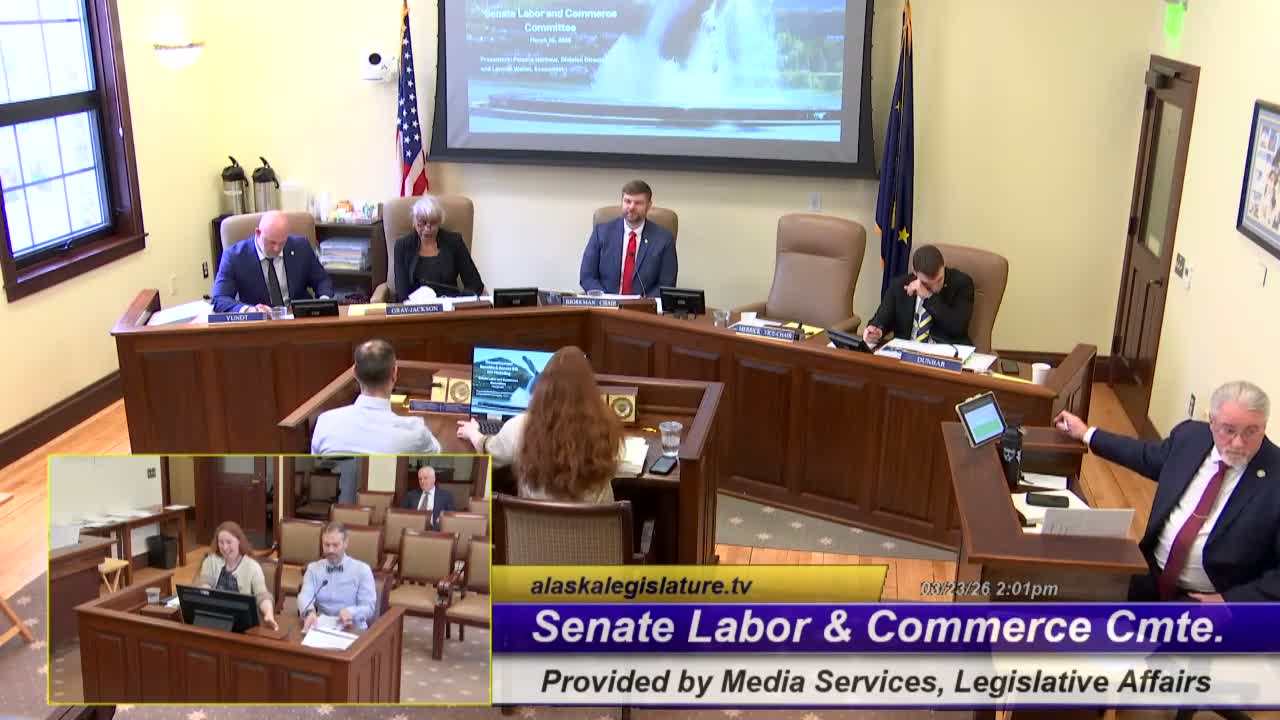
The Senate Labor and Commerce Committee on March 23 heard detailed modeling from the Department of Labor and Workforce Development on Senate Bill 217, a bill that would change employer and employee contributions for the unemployment insurance (UI) trust fund and create a dedicated training revenue source.
Paloma Harbor, director of the Division of Employment and Training Services, told the committee SB217 addresses the UI triad of taxes, benefits and training. "This bill implements a new employer tax of 0.4% for the State Training and Employment Program," Harbor said, explaining the revenue would fund grants to businesses, training providers and individuals. Harbor also said the bill would permit UI tax rates to fall to 0 when trust-fund solvency allows and reduce employer step contributions when employers need to contribute back to UI.
Lennon Weller, an economist and the system actuary in the department's Research and Analysis section, presented three modeling scenarios: the bill as introduced; the bill with the maximum weekly benefit increased to an inflation-adjusted $525; and the bill with an additional employee contribution increase to 0.2%. Weller said the department modeled indexing the maximum weekly benefit to wages (roughly the historical replacement rate), projecting how different cost trajectories would affect the trust fund and the "rate space" available to divert employer funds to STEP.
Weller described trade-offs: under current trends the trust fund balance provides room to lower employer UI rates and use some of that space for training revenue, but if benefit costs rise (for example, by increasing the maximum weekly benefit) the ability to divert revenue to STEP declines. The CS explained specific statutory adjustments: an employee contribution increase (0.1% to 0.2% of wages to STEP), a statutory increase to a $525 maximum weekly UI benefit, exemptions clarifying certain sports officials as independent contractors for workers' compensation, clarifying that certain 10%+ corporate owners are not employees, and conditional effective dates that require U.S. Secretary of Labor approval for some sections by July 1, 2027.
The committee placed the CS (version N) before members as a working document and left public testimony open for future hearings; no public testimony was offered at this session. The chair asked the department to provide modeling that combines multiple changes (for example, both an employee contribution increase and a higher maximum benefit) to show how the interactions affect the fund. The committee set SB217 aside for further consideration at a future meeting rather than reporting it out at this session.
What happens next: The department will produce additional models as requested; the committee expects to revisit SB217 at a later meeting to consider the combined modeling and to hear from stakeholders on cooperative and sports-official provisions.
Paloma Harbor, director of the Division of Employment and Training Services, told the committee SB217 addresses the UI triad of taxes, benefits and training. "This bill implements a new employer tax of 0.4% for the State Training and Employment Program," Harbor said, explaining the revenue would fund grants to businesses, training providers and individuals. Harbor also said the bill would permit UI tax rates to fall to 0 when trust-fund solvency allows and reduce employer step contributions when employers need to contribute back to UI.
Lennon Weller, an economist and the system actuary in the department's Research and Analysis section, presented three modeling scenarios: the bill as introduced; the bill with the maximum weekly benefit increased to an inflation-adjusted $525; and the bill with an additional employee contribution increase to 0.2%. Weller said the department modeled indexing the maximum weekly benefit to wages (roughly the historical replacement rate), projecting how different cost trajectories would affect the trust fund and the "rate space" available to divert employer funds to STEP.
Weller described trade-offs: under current trends the trust fund balance provides room to lower employer UI rates and use some of that space for training revenue, but if benefit costs rise (for example, by increasing the maximum weekly benefit) the ability to divert revenue to STEP declines. The CS explained specific statutory adjustments: an employee contribution increase (0.1% to 0.2% of wages to STEP), a statutory increase to a $525 maximum weekly UI benefit, exemptions clarifying certain sports officials as independent contractors for workers' compensation, clarifying that certain 10%+ corporate owners are not employees, and conditional effective dates that require U.S. Secretary of Labor approval for some sections by July 1, 2027.
The committee placed the CS (version N) before members as a working document and left public testimony open for future hearings; no public testimony was offered at this session. The chair asked the department to provide modeling that combines multiple changes (for example, both an employee contribution increase and a higher maximum benefit) to show how the interactions affect the fund. The committee set SB217 aside for further consideration at a future meeting rather than reporting it out at this session.
What happens next: The department will produce additional models as requested; the committee expects to revisit SB217 at a later meeting to consider the combined modeling and to hear from stakeholders on cooperative and sports-official provisions.
View the Full Meeting & All Its Details
This article offers just a summary. Unlock complete video, transcripts, and insights as a Founder Member.
✓
Watch full, unedited meeting videos
✓
Search every word spoken in unlimited transcripts
✓
AI summaries & real-time alerts (all government levels)
✓
Permanent access to expanding government content
30-day money-back guarantee
