Housing authority outlines Dixie Manor repositioning plan, HUD application and tenant protections
March 25, 2024 | Boca Raton, Palm Beach County, Florida
This article was created by AI summarizing key points discussed. AI makes mistakes, so for full details and context, please refer to the video of the full meeting. Please report any errors so we can fix them. Report an error »
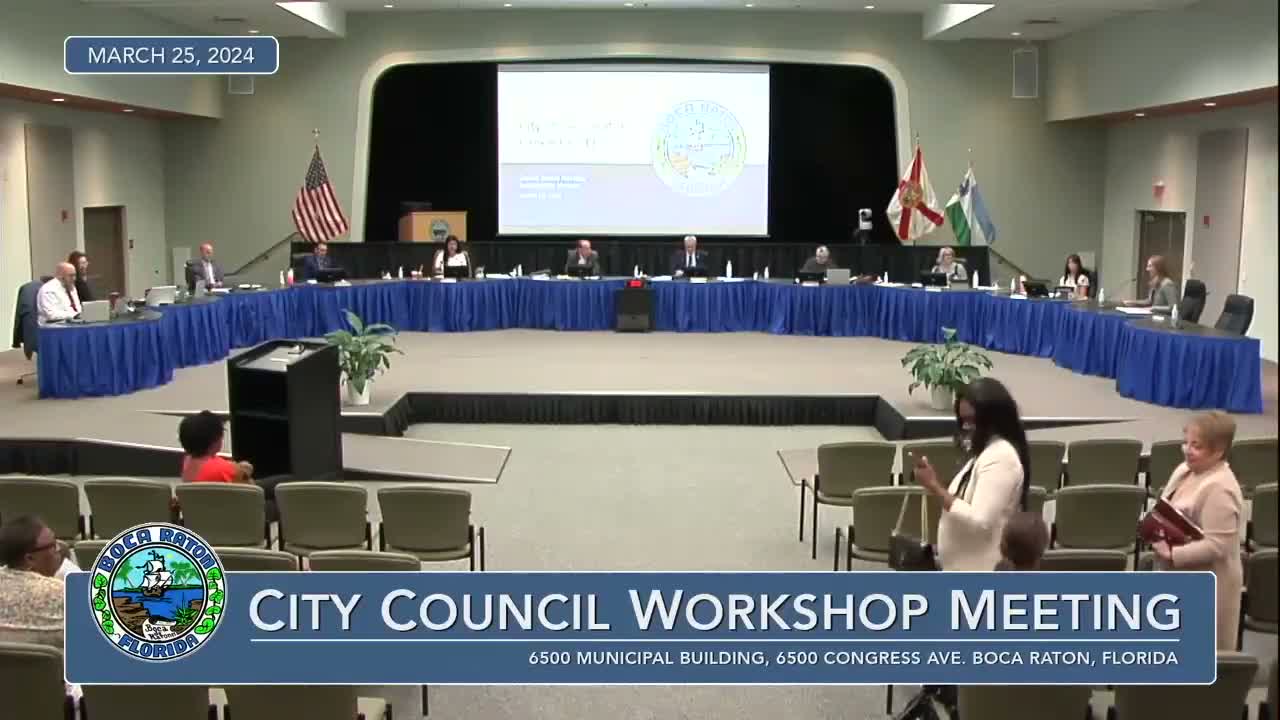
The Boca Raton Housing Authority on Monday laid out a multi-step plan to reposition Dixie Manor, an aging public housing site, saying the goal is to replace outdated units with modern, energy-efficient housing while preserving community history and offering tenant protections.
"Repositioning does not change our mission," Ashley Whitby, executive director of the Housing Authority, told the City Council. Whitby said the authority chose HUD's Streamlined Voluntary Conversion (SVC) because it offers tenant-protection vouchers for 100% of families on site and a financially feasible route to rebuild.
Michelle Feigenbaum, a representative of co-developer Atlantic Pacific Companies, told the council the team has secured key financing commitments for phase 1: approximately $18 million in low-income housing tax credits, $24 million in tax-exempt bonds and roughly $7 million in subordinate financing from the Florida Housing Finance Corporation. Feigenbaum said the team is working toward a financing closing and start of construction with a target deadline in January 2025.
Under the plan presented, the northern half of the roughly 10-acre site would be redeveloped first. The current site contains 95 units; the initial replacement will provide 95 new units on the northern half, with the south half held for future development. BRHA said it intends the redevelopment ultimately to support more total affordable units across the full property.
Whitby described steps the authority has taken on resident engagement and relocation counseling. "We have far exceeded the statutory requirement of a single meeting," she said, noting BRHA and partners have hosted multiple resident meetings, provided materials in Spanish and Creole, and engaged the Urban Group as relocation consultant. The presentation said staff had interviewed 88 of 94 households: just under 60% said they would prefer off-site relocation during construction, 27% said they would like to remain on-site while work proceeds, 7% were undecided and six households were pending interviews. BRHA said it can make available up to 47 on-site units for residents who wish to stay on the property during construction.
Council members pressed BRHA for details about who is eligible to return and how "right to return" will work under tax-credit restrictions. BRHA counsel said that because the redevelopment will use low-income housing tax credit financing, income limits will apply: households with incomes above 80% of Palm Beach County AMI will not qualify to move back into tax-credit‑restricted units. Whitby acknowledged one of the current households already exceeds the 80% threshold. "Other than income or loss of program participation (for example, termination from the voucher program), there is not a categorical restriction preventing a resident who remains eligible from returning," she said.
Council members and residents urged clearer, more consistent communications for tenants. Several councilors recommended independent legal or relocation counseling for residents so families can understand the regulations, waiting-list mechanics and practical impacts on schooling and daily life. Resident speakers echoed anxiety about moving and emphasized the cultural importance of the Pearl City community; one resident urged that historical features be preserved rather than merely memorialized.
On preservation, Whitby said the property's environmental review flagged historic concerns and that the state Historic Preservation Office (SHPO) requested a Section 106 case study. "We remain committed to preserving this history," she said, and listed potential measures such as protecting on-site greenery, museum-style exhibits in a new clubhouse, and renaming community spaces in honor of local leaders.
Next steps outlined to the council included: completing the Section 106 case study with SHPO; finalizing a written relocation agreement and selection criteria; obtaining SVC approval from HUD; requesting tenant protection vouchers; submitting site-plan and rezoning applications to the Planning & Zoning Board (BRHA said it anticipates appearing April 4 for recommendations) and pursuing permits and financial closing so construction can start on schedule.
The presentation did not ask the council to take formal action; BRHA and APC staff instead sought feedback and said they would continue resident meetings and post documents on bocahousing.org/repositioning. Whitby urged residents to attend BRHA board meetings and to send questions to the housing authority.
What happens next: the project team expects the Planning & Zoning hearing on April 4, continued work with SHPO on historic-preservation measures, and HUD review of the SVC application. Financing closing and construction start are targeted for January 2025, subject to underwriting and permitting.
Authority references in the presentation included HUD's Streamlined Voluntary Conversion guidance, the Uniform Relocation Act, low-income housing tax credit rules and communications with SHPO. BRHA and Atlantic Pacific said they will publish relocation materials and draft agreements for resident review before any required approvals are finalized.
"Repositioning does not change our mission," Ashley Whitby, executive director of the Housing Authority, told the City Council. Whitby said the authority chose HUD's Streamlined Voluntary Conversion (SVC) because it offers tenant-protection vouchers for 100% of families on site and a financially feasible route to rebuild.
Michelle Feigenbaum, a representative of co-developer Atlantic Pacific Companies, told the council the team has secured key financing commitments for phase 1: approximately $18 million in low-income housing tax credits, $24 million in tax-exempt bonds and roughly $7 million in subordinate financing from the Florida Housing Finance Corporation. Feigenbaum said the team is working toward a financing closing and start of construction with a target deadline in January 2025.
Under the plan presented, the northern half of the roughly 10-acre site would be redeveloped first. The current site contains 95 units; the initial replacement will provide 95 new units on the northern half, with the south half held for future development. BRHA said it intends the redevelopment ultimately to support more total affordable units across the full property.
Whitby described steps the authority has taken on resident engagement and relocation counseling. "We have far exceeded the statutory requirement of a single meeting," she said, noting BRHA and partners have hosted multiple resident meetings, provided materials in Spanish and Creole, and engaged the Urban Group as relocation consultant. The presentation said staff had interviewed 88 of 94 households: just under 60% said they would prefer off-site relocation during construction, 27% said they would like to remain on-site while work proceeds, 7% were undecided and six households were pending interviews. BRHA said it can make available up to 47 on-site units for residents who wish to stay on the property during construction.
Council members pressed BRHA for details about who is eligible to return and how "right to return" will work under tax-credit restrictions. BRHA counsel said that because the redevelopment will use low-income housing tax credit financing, income limits will apply: households with incomes above 80% of Palm Beach County AMI will not qualify to move back into tax-credit‑restricted units. Whitby acknowledged one of the current households already exceeds the 80% threshold. "Other than income or loss of program participation (for example, termination from the voucher program), there is not a categorical restriction preventing a resident who remains eligible from returning," she said.
Council members and residents urged clearer, more consistent communications for tenants. Several councilors recommended independent legal or relocation counseling for residents so families can understand the regulations, waiting-list mechanics and practical impacts on schooling and daily life. Resident speakers echoed anxiety about moving and emphasized the cultural importance of the Pearl City community; one resident urged that historical features be preserved rather than merely memorialized.
On preservation, Whitby said the property's environmental review flagged historic concerns and that the state Historic Preservation Office (SHPO) requested a Section 106 case study. "We remain committed to preserving this history," she said, and listed potential measures such as protecting on-site greenery, museum-style exhibits in a new clubhouse, and renaming community spaces in honor of local leaders.
Next steps outlined to the council included: completing the Section 106 case study with SHPO; finalizing a written relocation agreement and selection criteria; obtaining SVC approval from HUD; requesting tenant protection vouchers; submitting site-plan and rezoning applications to the Planning & Zoning Board (BRHA said it anticipates appearing April 4 for recommendations) and pursuing permits and financial closing so construction can start on schedule.
The presentation did not ask the council to take formal action; BRHA and APC staff instead sought feedback and said they would continue resident meetings and post documents on bocahousing.org/repositioning. Whitby urged residents to attend BRHA board meetings and to send questions to the housing authority.
What happens next: the project team expects the Planning & Zoning hearing on April 4, continued work with SHPO on historic-preservation measures, and HUD review of the SVC application. Financing closing and construction start are targeted for January 2025, subject to underwriting and permitting.
Authority references in the presentation included HUD's Streamlined Voluntary Conversion guidance, the Uniform Relocation Act, low-income housing tax credit rules and communications with SHPO. BRHA and Atlantic Pacific said they will publish relocation materials and draft agreements for resident review before any required approvals are finalized.
View the Full Meeting & All Its Details
This article offers just a summary. Unlock complete video, transcripts, and insights as a Founder Member.
✓
Watch full, unedited meeting videos
✓
Search every word spoken in unlimited transcripts
✓
AI summaries & real-time alerts (all government levels)
✓
Permanent access to expanding government content
30-day money-back guarantee
