City staff recommends incentive-based green-building pilot; council favors fee-rebate approach
March 25, 2024 | Boca Raton, Palm Beach County, Florida
This article was created by AI summarizing key points discussed. AI makes mistakes, so for full details and context, please refer to the video of the full meeting. Please report any errors so we can fix them. Report an error »
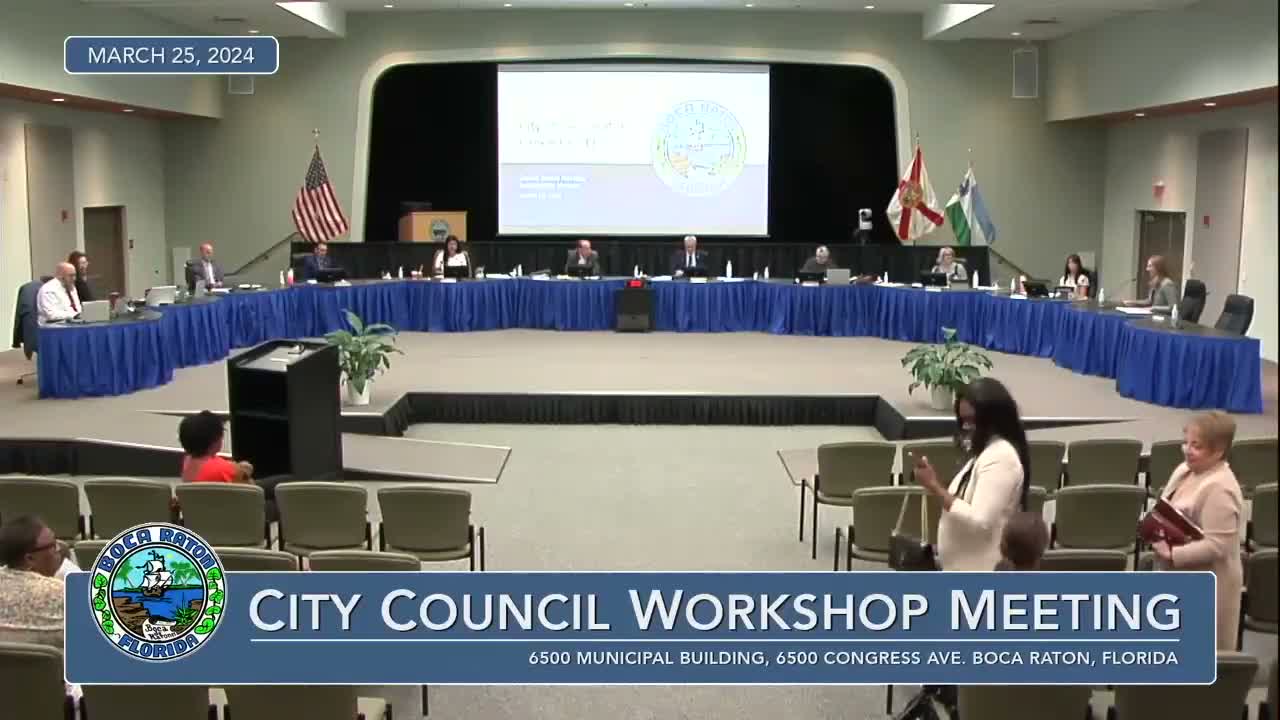
City sustainability staff proposed an incentive-first approach to encourage greener construction and lower the city's building-sector emissions as part of its Race to 0 goals.
Lindsay Norecke, the city's sustainability manager, presented options including cool roofs, third-party green-building certifications (LEED, Florida Green Building Coalition, Green Globes, Energy Star) and a fee-or-bond mechanism to ensure certification follow-through. "We would recommend that we start with an incentive based program, for a few years and see what the uptake of that is and the results of that and come back after a couple of years, and assess the results," Norecke told council members.
Staff proposed a pilot that would include permit-fee rebates and expedited "concierge" permitting for qualifying projects, limited to a small number of projects per year (staff estimated two to three projects initially). Norecke emphasized that a bond or fee can act as a compliance hook because certification outcomes are often verified only after occupancy.
Council members generally favored an incentive pilot. Deputy Mayor Mayotte and others urged an initial pilot to see who will participate and to learn how the program would interact with other development incentives such as density or affordability programs. Council Member Wigder noted that federal programs (e.g., Energy Star incentives and new tax credits) make voluntary certification more attractive to developers and that green buildings can reduce long-term operating costs for lower-income tenants.
Staff said they will return with a more detailed implementation proposal, including a projected fiscal impact and eligibility thresholds, after stakeholder consultation.
Why this matters: Buildings account for a large share of local greenhouse gas emissions. An incentive pilot that leverages third-party certification and available federal incentives could reduce operating costs for owners and tenants, attract sustainability-minded businesses, and help the city meet climate targets without immediately imposing mandatory certification requirements.
Lindsay Norecke, the city's sustainability manager, presented options including cool roofs, third-party green-building certifications (LEED, Florida Green Building Coalition, Green Globes, Energy Star) and a fee-or-bond mechanism to ensure certification follow-through. "We would recommend that we start with an incentive based program, for a few years and see what the uptake of that is and the results of that and come back after a couple of years, and assess the results," Norecke told council members.
Staff proposed a pilot that would include permit-fee rebates and expedited "concierge" permitting for qualifying projects, limited to a small number of projects per year (staff estimated two to three projects initially). Norecke emphasized that a bond or fee can act as a compliance hook because certification outcomes are often verified only after occupancy.
Council members generally favored an incentive pilot. Deputy Mayor Mayotte and others urged an initial pilot to see who will participate and to learn how the program would interact with other development incentives such as density or affordability programs. Council Member Wigder noted that federal programs (e.g., Energy Star incentives and new tax credits) make voluntary certification more attractive to developers and that green buildings can reduce long-term operating costs for lower-income tenants.
Staff said they will return with a more detailed implementation proposal, including a projected fiscal impact and eligibility thresholds, after stakeholder consultation.
Why this matters: Buildings account for a large share of local greenhouse gas emissions. An incentive pilot that leverages third-party certification and available federal incentives could reduce operating costs for owners and tenants, attract sustainability-minded businesses, and help the city meet climate targets without immediately imposing mandatory certification requirements.
Don't Miss a Word: See the Full Meeting!
Go beyond summaries. Unlock every video, transcript, and key insight with a Founder Membership.
✓
Get instant access to full meeting videos
✓
Search and clip any phrase from complete transcripts
✓
Receive AI-powered summaries & custom alerts
✓
Enjoy lifetime, unrestricted access to government data
30-day money-back guarantee
