Boca Raton CRA approves Meissner Plaza Hotel with parking deviation and safety conditions
March 23, 2026 | Boca Raton, Palm Beach County, Florida
This article was created by AI summarizing key points discussed. AI makes mistakes, so for full details and context, please refer to the video of the full meeting. Please report any errors so we can fix them. Report an error »
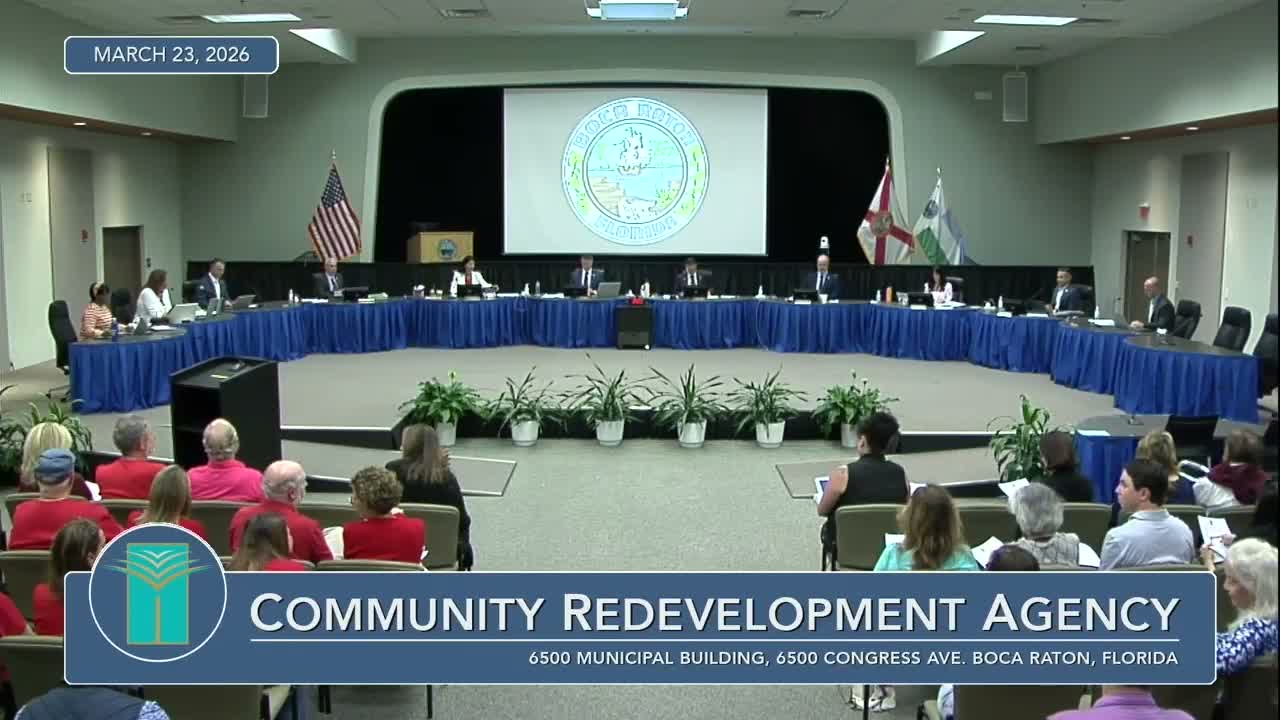
The Boca Raton Community Redevelopment Agency voted 4-1 to approve an individual development approval for the Meissner Plaza Hotel, a two-tower, 12-story, mixed-use project that would add 219 hotel rooms and about 31,000 square feet of retail and restaurant space to downtown Boca Raton. The board adopted the resolution after negotiating several conditions intended to address neighbors’ safety and traffic concerns.
The approved development order allows the applicant to reduce required off-street parking from 557 to 328 spaces — a 229-space (about 41%) technical deviation the applicant said is justified by modern downtown travel patterns and a transportation demand management plan. Senior planner Susan Lesser told the board the application otherwise complies with ordinance 40-35 and recommended approval, subject to technical conditions and studies.
The project team and staff described streetscape changes and mitigation measures. Applicant representative Ellie Zacharaitis said the hotel design prioritizes pedestrians and connectivity, noting widened sidewalks of 15–19 feet on the north frontage, a 275-foot pedestrian promenade, a 20-foot widened alley for two-way service access, and a TDM program that would include transit-pass subsidies and a coordinator to manage alternatives to single-occupancy vehicle trips. “This project exemplifies putting the pedestrian first,” Zacharaitis said in the presentation, and she stressed that the team would work with city staff on operational details such as off-hour servicing and wayfinding.
Neighbors at Tower 155 and other nearby residents opposed the IDA in large numbers during public comment, raising safety and quality-of-life concerns. Ellen Bogdanoff, representing the Tower 155 association, urged the board to require more protections, citing what she and a retained structural engineer say are existing defects in Tower 155’s parking garage and asking for continuous vibration monitoring, immediate notification if thresholds are exceeded and pre/post-construction surveys. “Our biggest concern happens to be with the alleyway,” Bogdanoff said; she added that if the widened alley becomes a route for more than 1,000 vehicles a day, it would function as a roadway rather than a service alley.
Applicant and staff responses focused on engineering and operational safeguards. The city’s traffic consultant and the applicant’s traffic engineer accounted for peak-hour trips and proposed that most service and garage access would be at the rear; John Donaldson (traffic) noted the project’s predicted increase in daily trips and that peak-hour increments are manageable. The applicant agreed to several additional protections in the IDA language, including vibration monitoring and a requirement for a structural evaluation of Tower 155’s garage before construction begins and a follow-up evaluation after construction is complete.
To address the board’s concerns, members negotiated and inserted specific conditions into the development order before voting. Key conditions added to the approval require that:
- If the city manager or designee determines on-site parking is insufficient or creating adverse impacts, the applicant must secure off-site parking within 600 feet within 90 days and provide a legally binding instrument ensuring availability; any off-site measures must be reasonably proportionate to the demonstrated deficiency and include signage and a parking-management plan. Staff indicated candidate off-site locations near Federal Highway that could provide additional spaces.
- A raised crosswalk (described in the record as a ‘raised’ pedestrian crossing/short speed table) must be installed to connect Tower 155 and the new project, with location and design reviewed by public works.
- Vibration monitoring and structural-protection measures must be implemented during construction, including benchmarks, tilt meters and a 24/7 alerting platform to notify responsible construction personnel if thresholds are exceeded; noncompliance may trigger stop-work authority.
- Pre- and post-construction structural evaluations of Tower 155 must be submitted to the chief building official; the applicant’s obligations for these protective measures are contingent on Tower 155’s ownership/association providing reasonable access to perform the required surveys and monitoring.
- The applicant committed to maintain and improve any alley area on its property as required in the development order, and to coordinate with public works on long-term maintenance responsibilities.
Board members discussed the tension between property rights and neighborhood impacts. Several members said the code allows taller, denser development in downtown Boca but that conditions were necessary given the scale of the requested parking deviation. Mayor Lehi Thompson noted the long-standing redevelopment plan and the property rights that come with vested downtown entitlements; other members emphasized design benefits and the need for contingency measures if parking or safety problems arise.
After the amendments were incorporated into the IDA, the CRA adopted resolution DDRI/CRP 2301 approving the Meissner Plaza Hotel with the added conditions; the motion passed 4-1. The adopted order requires the applicant to deliver the specified studies, monitoring plans and legal assurances before receiving future permits or Certificates of Occupancy tied to the IDA conditions.
The vote concludes the quasi-judicial approval phase at the CRA; implementation steps include execution of the legally binding off-site parking agreements if triggered, final public-works reviews for the raised crosswalk and detailed construction-permit reviews that will verify vibration and structural monitoring plans. The board’s action does not alter other regulatory reviews that may apply; the development will proceed under the conditions recorded in the adopted IDA.
The approved development order allows the applicant to reduce required off-street parking from 557 to 328 spaces — a 229-space (about 41%) technical deviation the applicant said is justified by modern downtown travel patterns and a transportation demand management plan. Senior planner Susan Lesser told the board the application otherwise complies with ordinance 40-35 and recommended approval, subject to technical conditions and studies.
The project team and staff described streetscape changes and mitigation measures. Applicant representative Ellie Zacharaitis said the hotel design prioritizes pedestrians and connectivity, noting widened sidewalks of 15–19 feet on the north frontage, a 275-foot pedestrian promenade, a 20-foot widened alley for two-way service access, and a TDM program that would include transit-pass subsidies and a coordinator to manage alternatives to single-occupancy vehicle trips. “This project exemplifies putting the pedestrian first,” Zacharaitis said in the presentation, and she stressed that the team would work with city staff on operational details such as off-hour servicing and wayfinding.
Neighbors at Tower 155 and other nearby residents opposed the IDA in large numbers during public comment, raising safety and quality-of-life concerns. Ellen Bogdanoff, representing the Tower 155 association, urged the board to require more protections, citing what she and a retained structural engineer say are existing defects in Tower 155’s parking garage and asking for continuous vibration monitoring, immediate notification if thresholds are exceeded and pre/post-construction surveys. “Our biggest concern happens to be with the alleyway,” Bogdanoff said; she added that if the widened alley becomes a route for more than 1,000 vehicles a day, it would function as a roadway rather than a service alley.
Applicant and staff responses focused on engineering and operational safeguards. The city’s traffic consultant and the applicant’s traffic engineer accounted for peak-hour trips and proposed that most service and garage access would be at the rear; John Donaldson (traffic) noted the project’s predicted increase in daily trips and that peak-hour increments are manageable. The applicant agreed to several additional protections in the IDA language, including vibration monitoring and a requirement for a structural evaluation of Tower 155’s garage before construction begins and a follow-up evaluation after construction is complete.
To address the board’s concerns, members negotiated and inserted specific conditions into the development order before voting. Key conditions added to the approval require that:
- If the city manager or designee determines on-site parking is insufficient or creating adverse impacts, the applicant must secure off-site parking within 600 feet within 90 days and provide a legally binding instrument ensuring availability; any off-site measures must be reasonably proportionate to the demonstrated deficiency and include signage and a parking-management plan. Staff indicated candidate off-site locations near Federal Highway that could provide additional spaces.
- A raised crosswalk (described in the record as a ‘raised’ pedestrian crossing/short speed table) must be installed to connect Tower 155 and the new project, with location and design reviewed by public works.
- Vibration monitoring and structural-protection measures must be implemented during construction, including benchmarks, tilt meters and a 24/7 alerting platform to notify responsible construction personnel if thresholds are exceeded; noncompliance may trigger stop-work authority.
- Pre- and post-construction structural evaluations of Tower 155 must be submitted to the chief building official; the applicant’s obligations for these protective measures are contingent on Tower 155’s ownership/association providing reasonable access to perform the required surveys and monitoring.
- The applicant committed to maintain and improve any alley area on its property as required in the development order, and to coordinate with public works on long-term maintenance responsibilities.
Board members discussed the tension between property rights and neighborhood impacts. Several members said the code allows taller, denser development in downtown Boca but that conditions were necessary given the scale of the requested parking deviation. Mayor Lehi Thompson noted the long-standing redevelopment plan and the property rights that come with vested downtown entitlements; other members emphasized design benefits and the need for contingency measures if parking or safety problems arise.
After the amendments were incorporated into the IDA, the CRA adopted resolution DDRI/CRP 2301 approving the Meissner Plaza Hotel with the added conditions; the motion passed 4-1. The adopted order requires the applicant to deliver the specified studies, monitoring plans and legal assurances before receiving future permits or Certificates of Occupancy tied to the IDA conditions.
The vote concludes the quasi-judicial approval phase at the CRA; implementation steps include execution of the legally binding off-site parking agreements if triggered, final public-works reviews for the raised crosswalk and detailed construction-permit reviews that will verify vibration and structural monitoring plans. The board’s action does not alter other regulatory reviews that may apply; the development will proceed under the conditions recorded in the adopted IDA.
View the Full Meeting & All Its Details
This article offers just a summary. Unlock complete video, transcripts, and insights as a Founder Member.
✓
Watch full, unedited meeting videos
✓
Search every word spoken in unlimited transcripts
✓
AI summaries & real-time alerts (all government levels)
✓
Permanent access to expanding government content
30-day money-back guarantee
