Legislators probe $350 million in cash leaving MSP airport, hear whistleblower and DHS forensics claims
March 23, 2026 | 2026 Legislature MN, Minnesota
This article was created by AI summarizing key points discussed. AI makes mistakes, so for full details and context, please refer to the video of the full meeting. Please report any errors so we can fix them. Report an error »
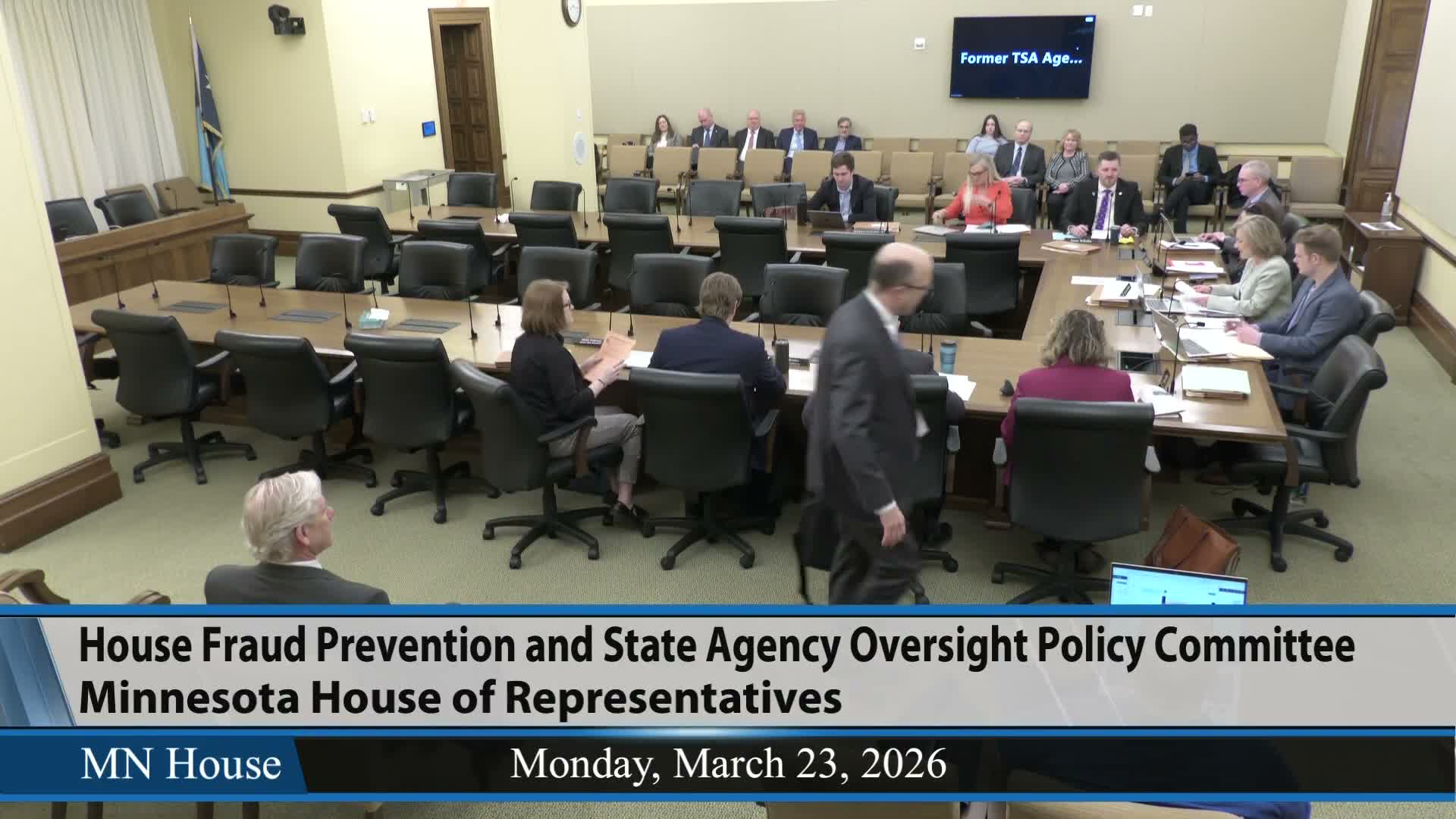
Chair Robinson convened a Minnesota House oversight hearing March 23 to examine large volumes of cash leaving Minneapolis–St. Paul International Airport and the state and federal roles in tracking international remittances.
The committee highlighted recent federal reporting that about $343 million left MSP in 2024 and $350 million in 2025, figures Chair Robinson said were disclosed in a January 2026 TSA bulletin and prompted Department of the Treasury action. Robinson framed the hearing as an effort to identify gaps between state and federal jurisdiction and to find ways the state can help stop laundering of funds tied to prior Medicaid and childcare fraud prosecutions.
Matt Christiansen, chief of police for the Metropolitan Airports Commission, told the panel that airport police enforce Minnesota law and MAC ordinances while Transportation Security Administration personnel perform passenger and baggage screening and Customs and Border Protection handles international currency reporting and reviews FinCEN Form 105 submissions. "Federal law regulates the international movement of currency in excess of $10,000," Christiansen said, noting that the FinCEN Form 105 (the currency reporting form) and CBP are the federal mechanisms for overseeing large cross‑border currency movements.
A witness testifying by Zoom who was permitted to remain anonymous described seeing "millions of dollars" carried through screening lanes and said TSA screening staff would pull cash‑filled luggage into a private screening room, open and visually inspect it and then allow couriers to proceed when paperwork appeared in order. The witness said she had earlier spoken to an investigative reporter and urged the committee to keep sources protected while pursuing accountability.
Scott Stillman, a retired Department of Human Services forensics supervisor, described digital forensic work done from roughly 2011 through his departure in late 2017. He said investigators used search warrants and seized cell phones, servers and surveillance video; he described findings of overseas money‑transfer apps, rapid multi‑account bank routing that often ended in the United Arab Emirates, and cases in which payments flowed through shell companies. Stillman said he preserved emails and evidence at the DHS forensics lab and that a temporary IP "trap" in 2015 logged overseas access to the state's billing system and helped link billing to foreign locations.
Stillman additionally alleged that he was coerced into a settlement during litigation in 2017 and that his warnings to DHS senior managers went unheeded. Several lawmakers noted that a 2019 review by the Office of Legislative Auditor (OLA) had been unable to substantiate some of his claims; Stillman disputed the OLA's access to federal records and urged the committee to seek federal cooperation.
Several members pushed for federal partners to provide additional information; Chair Robinson said Treasury has issued geographic targeting orders and notices of investigation to some money services businesses and said Treasury is requiring additional reporting in Hennepin and Ramsey counties down to a $3,000 reporting threshold for certain transactions. Robinson said the department will publish a public report later in the month and the committee will send follow‑up questions to Treasury and to DHS about whether the state now captures IP addresses and other electronic indicators discussed by witnesses.
Lawmakers emphasized that criminal prosecutions already brought by federal authorities (including Feeding Our Future prosecutions cited by the committee) remain ongoing and that asset recovery and international coordination generally require federal law‑enforcement action. No formal policy changes were adopted at the hearing; members said they will use the testimony to inform future oversight and potential state‑level tightening of internal controls.
The committee adjourned after directing staff to follow up with Treasury and DHS and after thanking the Metropolitan Airports Commission and the witnesses for their testimony.
The committee highlighted recent federal reporting that about $343 million left MSP in 2024 and $350 million in 2025, figures Chair Robinson said were disclosed in a January 2026 TSA bulletin and prompted Department of the Treasury action. Robinson framed the hearing as an effort to identify gaps between state and federal jurisdiction and to find ways the state can help stop laundering of funds tied to prior Medicaid and childcare fraud prosecutions.
Matt Christiansen, chief of police for the Metropolitan Airports Commission, told the panel that airport police enforce Minnesota law and MAC ordinances while Transportation Security Administration personnel perform passenger and baggage screening and Customs and Border Protection handles international currency reporting and reviews FinCEN Form 105 submissions. "Federal law regulates the international movement of currency in excess of $10,000," Christiansen said, noting that the FinCEN Form 105 (the currency reporting form) and CBP are the federal mechanisms for overseeing large cross‑border currency movements.
A witness testifying by Zoom who was permitted to remain anonymous described seeing "millions of dollars" carried through screening lanes and said TSA screening staff would pull cash‑filled luggage into a private screening room, open and visually inspect it and then allow couriers to proceed when paperwork appeared in order. The witness said she had earlier spoken to an investigative reporter and urged the committee to keep sources protected while pursuing accountability.
Scott Stillman, a retired Department of Human Services forensics supervisor, described digital forensic work done from roughly 2011 through his departure in late 2017. He said investigators used search warrants and seized cell phones, servers and surveillance video; he described findings of overseas money‑transfer apps, rapid multi‑account bank routing that often ended in the United Arab Emirates, and cases in which payments flowed through shell companies. Stillman said he preserved emails and evidence at the DHS forensics lab and that a temporary IP "trap" in 2015 logged overseas access to the state's billing system and helped link billing to foreign locations.
Stillman additionally alleged that he was coerced into a settlement during litigation in 2017 and that his warnings to DHS senior managers went unheeded. Several lawmakers noted that a 2019 review by the Office of Legislative Auditor (OLA) had been unable to substantiate some of his claims; Stillman disputed the OLA's access to federal records and urged the committee to seek federal cooperation.
Several members pushed for federal partners to provide additional information; Chair Robinson said Treasury has issued geographic targeting orders and notices of investigation to some money services businesses and said Treasury is requiring additional reporting in Hennepin and Ramsey counties down to a $3,000 reporting threshold for certain transactions. Robinson said the department will publish a public report later in the month and the committee will send follow‑up questions to Treasury and to DHS about whether the state now captures IP addresses and other electronic indicators discussed by witnesses.
Lawmakers emphasized that criminal prosecutions already brought by federal authorities (including Feeding Our Future prosecutions cited by the committee) remain ongoing and that asset recovery and international coordination generally require federal law‑enforcement action. No formal policy changes were adopted at the hearing; members said they will use the testimony to inform future oversight and potential state‑level tightening of internal controls.
The committee adjourned after directing staff to follow up with Treasury and DHS and after thanking the Metropolitan Airports Commission and the witnesses for their testimony.
View the Full Meeting & All Its Details
This article offers just a summary. Unlock complete video, transcripts, and insights as a Founder Member.
✓
Watch full, unedited meeting videos
✓
Search every word spoken in unlimited transcripts
✓
AI summaries & real-time alerts (all government levels)
✓
Permanent access to expanding government content
30-day money-back guarantee
