Minn. committee deadlocks on Starter Homes Act after hours of testimony; HF3895 fails 5-7
March 24, 2026 | 2026 Legislature MN, Minnesota
This article was created by AI summarizing key points discussed. AI makes mistakes, so for full details and context, please refer to the video of the full meeting. Please report any errors so we can fix them. Report an error »
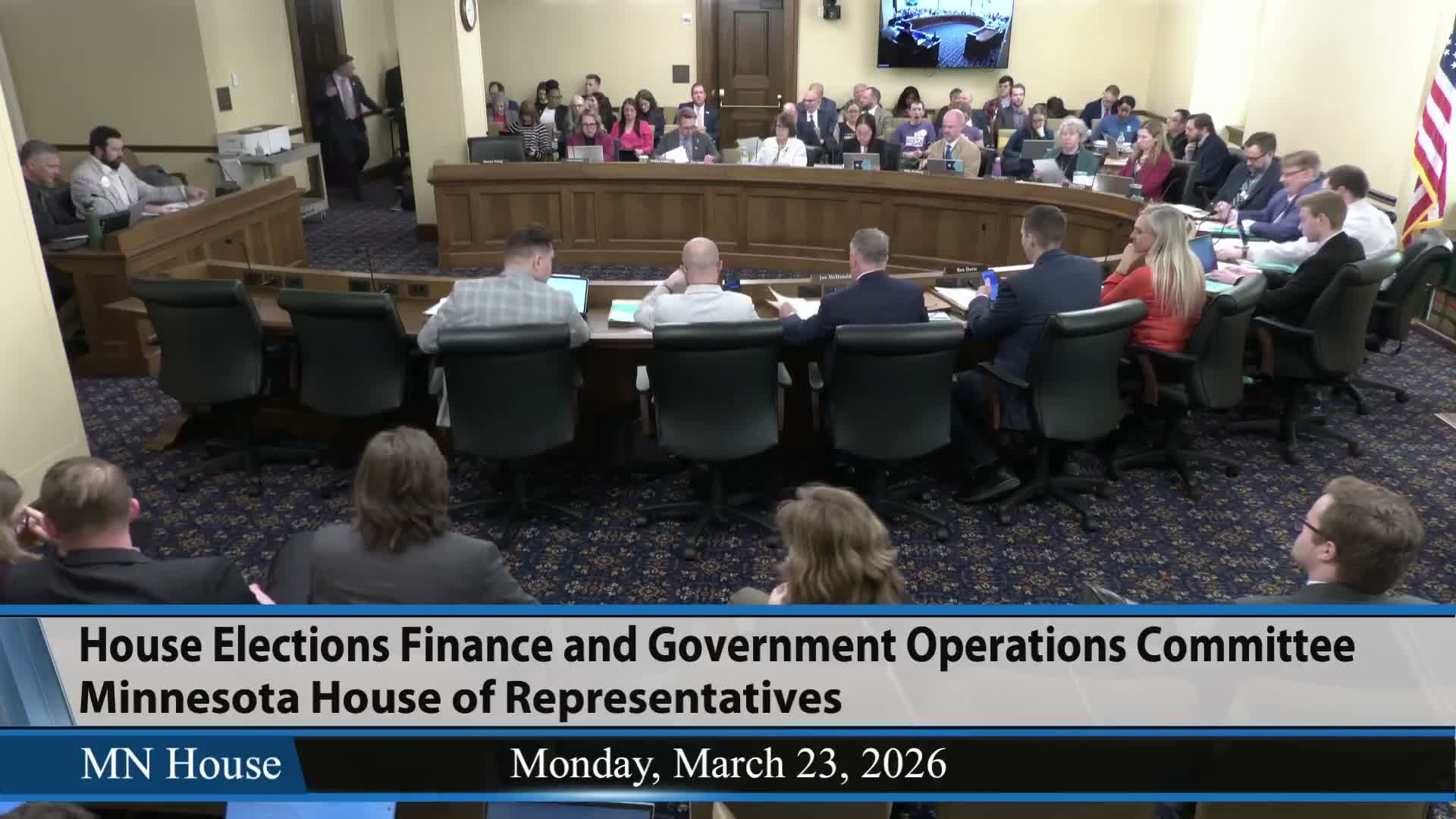
The Elections, Finance and Government Operations Committee declined to advance the Starter Homes Act (HF 3895) after a lengthy hearing that featured bipartisan authors and more than a dozen pro and con witnesses. Representative McDonald, presenting the bill, described it as a "collaborative approach" aimed at increasing housing supply by removing mandates, shortening administrative review timelines and legalizing accessory dwelling units. He said implementation would begin Jan. 1, 2028.
Proponents framed the bill as a supply-side solution. "This bill is a result of months of work between our bill authors, cities, planners, housing advocates, and the housing industry," Nick Erickson, senior director of housing policy for Housing First Minnesota, told the committee. Gabe Kravitz of the Pew Charitable Trusts cited evidence from other states and urged members to support measures that enable ADUs and middle housing.
Local officials and planners pushed back. "This is a set of mandates that would preempt Farmington and other communities across the state with unnecessary administrative burdens," Farmington council member Steve Wilson said, arguing local planning and comprehensive plans should guide development. Woodbury planner Eric Searls warned the bill lacks requirements to ensure the construction of affordable units and said unconstrained ADU size could undermine the law’s intent.
Committee members pressed both sides on key limits. Representative Acum said the bill "is not going to make it more affordable in my community" and asked why inclusionary requirements weren’t included; authors described HF 3895 primarily as a supply bill, not a direct affordability mandate. Representative Kraft, a co-author, said supply is one systemic tool to address long-term affordability and that many provisions were shaped by city input.
After discussion and a requested roll-call vote, members recorded five ayes and seven nays. The roll call in the transcript showed votes as follows: Chair Kwan — No; Chair Freyberg — Yes; Vice Chair Alsendorf — No; Vice Chair Lee — Yes; Representative Acom — No; Representative Coulter — Aye; Representative Davis — No; Representative Gordon — No; Representative Greenman — Aye; Representative McDonald — No; Representative Roach — No; Representative Verneig — Yes. With seven nays, the motion to move HF 3895 failed and the bill was laid on the table. The committee adjourned.
What happened
Supporters argued the bill would expand housing options (ADUs, duplexes and townhomes), streamline permitting and provide menu-based tools cities could choose to implement. Opponents — including several city officials and planning professionals — warned the bill would preempt local comprehensive planning, impose implementation costs and offer no guarantee that mandated changes would produce lower-priced housing in all communities.
Next steps
Because the motion to advance HF 3895 failed on a committee roll call, the bill will not move to the General Register from this hearing. The transcript records the roll-call tally and the committee’s action to lay the bill on the table; no further committee action is recorded in this hearing.
Proponents framed the bill as a supply-side solution. "This bill is a result of months of work between our bill authors, cities, planners, housing advocates, and the housing industry," Nick Erickson, senior director of housing policy for Housing First Minnesota, told the committee. Gabe Kravitz of the Pew Charitable Trusts cited evidence from other states and urged members to support measures that enable ADUs and middle housing.
Local officials and planners pushed back. "This is a set of mandates that would preempt Farmington and other communities across the state with unnecessary administrative burdens," Farmington council member Steve Wilson said, arguing local planning and comprehensive plans should guide development. Woodbury planner Eric Searls warned the bill lacks requirements to ensure the construction of affordable units and said unconstrained ADU size could undermine the law’s intent.
Committee members pressed both sides on key limits. Representative Acum said the bill "is not going to make it more affordable in my community" and asked why inclusionary requirements weren’t included; authors described HF 3895 primarily as a supply bill, not a direct affordability mandate. Representative Kraft, a co-author, said supply is one systemic tool to address long-term affordability and that many provisions were shaped by city input.
After discussion and a requested roll-call vote, members recorded five ayes and seven nays. The roll call in the transcript showed votes as follows: Chair Kwan — No; Chair Freyberg — Yes; Vice Chair Alsendorf — No; Vice Chair Lee — Yes; Representative Acom — No; Representative Coulter — Aye; Representative Davis — No; Representative Gordon — No; Representative Greenman — Aye; Representative McDonald — No; Representative Roach — No; Representative Verneig — Yes. With seven nays, the motion to move HF 3895 failed and the bill was laid on the table. The committee adjourned.
What happened
Supporters argued the bill would expand housing options (ADUs, duplexes and townhomes), streamline permitting and provide menu-based tools cities could choose to implement. Opponents — including several city officials and planning professionals — warned the bill would preempt local comprehensive planning, impose implementation costs and offer no guarantee that mandated changes would produce lower-priced housing in all communities.
Next steps
Because the motion to advance HF 3895 failed on a committee roll call, the bill will not move to the General Register from this hearing. The transcript records the roll-call tally and the committee’s action to lay the bill on the table; no further committee action is recorded in this hearing.
Don't Miss a Word: See the Full Meeting!
Go beyond summaries. Unlock every video, transcript, and key insight with a Founder Membership.
✓
Get instant access to full meeting videos
✓
Search and clip any phrase from complete transcripts
✓
Receive AI-powered summaries & custom alerts
✓
Enjoy lifetime, unrestricted access to government data
30-day money-back guarantee
