Informational hearing: proposal would align Minnesota labeling for plant and soil amendments with national model
March 23, 2026 | 2026 Legislature MN, Minnesota
This article was created by AI summarizing key points discussed. AI makes mistakes, so for full details and context, please refer to the video of the full meeting. Please report any errors so we can fix them. Report an error »
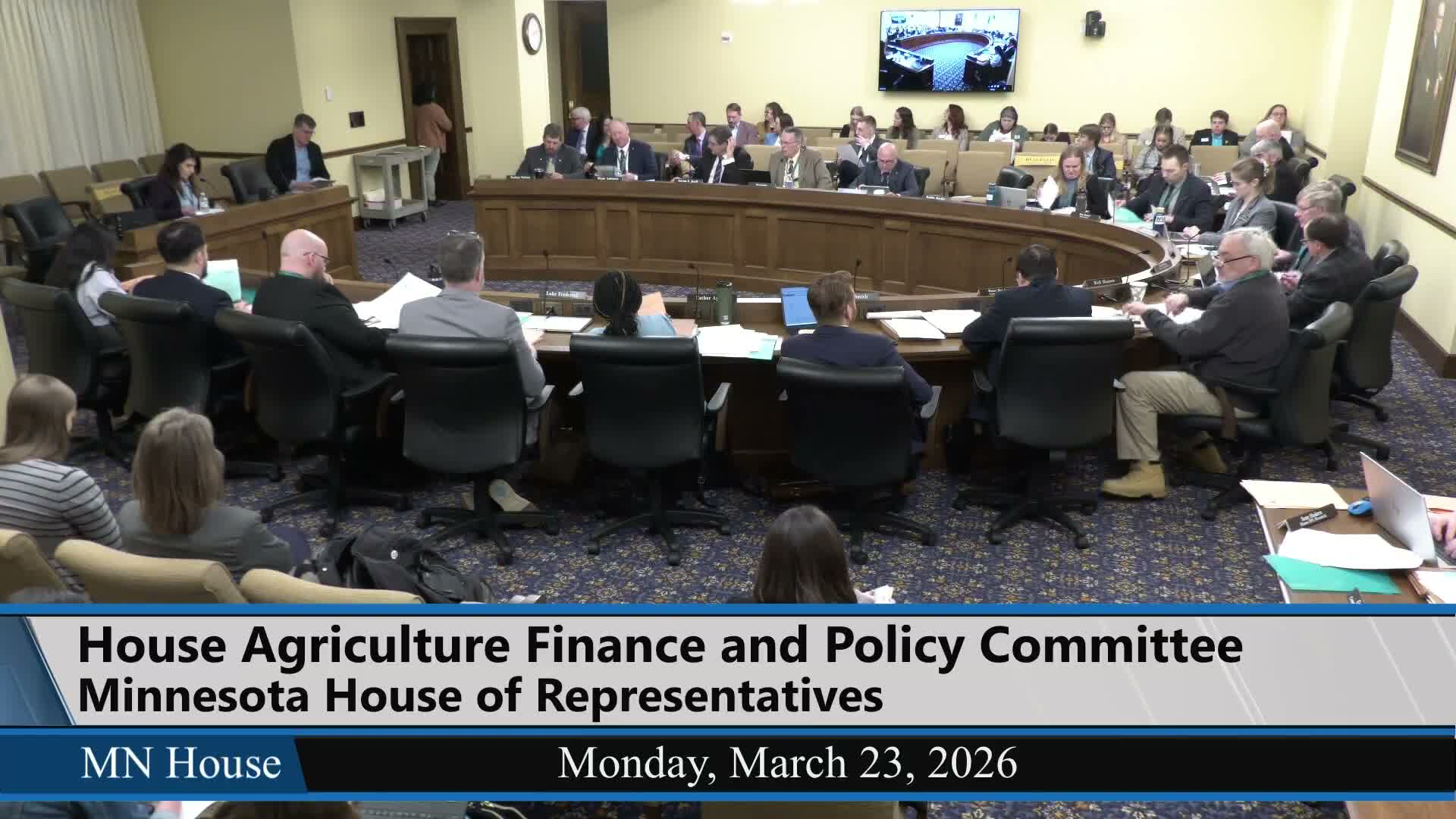
Vice Chair Harter introduced an informational proposal to revise Minnesota’s labeling requirements for plant and soil amendments so manufacturers list active ingredients on the product label while submitting a confidential certificate of composition for inert ingredients to the Minnesota Department of Agriculture.
Industry representatives told the committee current Minnesota law, which requires listing inert ingredients on labels, creates business and regulatory burdens that are out of step with other states and with the American Association of Plant Food Control Officials (APFCO) model. Lee Heligan (speaker 21) said the change would preserve active‑ingredient disclosure and allow manufacturers to submit confidential composition certificates to MDA so the agency retains full knowledge of inert ingredients and can flag any hazards.
David Boudreau (speaker 22), representing trade groups, said the model bill has been adopted in more than a dozen states and that confidential composition certificates would speed registration and reduce back‑and‑forth with registrants.
Assistant Commissioner Peter Chesson (speaker 23) told the committee the department had provided feedback on the language, does not take a formal position, and would receive confidential certificates under the proposal. A program manager (speaker 24) explained that submitted inert ingredients would continue to be reviewed and that manufacturers are required to notify the department if intentionally added PFAS are present.
Representative Hansen cautioned that labeling inert ingredients publicly provides transparency; the department and testifiers said the public label would still contain active‑ingredient information and the agency would keep confidential composition records for safety review.
Because this was an informational hearing, no committee motion was taken. Committee members asked technical questions about oversight, PFAS disclosure, and how the certificate-of-composition process would work in practice; MDA staff described existing review processes and how they would be applied.
Industry representatives told the committee current Minnesota law, which requires listing inert ingredients on labels, creates business and regulatory burdens that are out of step with other states and with the American Association of Plant Food Control Officials (APFCO) model. Lee Heligan (speaker 21) said the change would preserve active‑ingredient disclosure and allow manufacturers to submit confidential composition certificates to MDA so the agency retains full knowledge of inert ingredients and can flag any hazards.
David Boudreau (speaker 22), representing trade groups, said the model bill has been adopted in more than a dozen states and that confidential composition certificates would speed registration and reduce back‑and‑forth with registrants.
Assistant Commissioner Peter Chesson (speaker 23) told the committee the department had provided feedback on the language, does not take a formal position, and would receive confidential certificates under the proposal. A program manager (speaker 24) explained that submitted inert ingredients would continue to be reviewed and that manufacturers are required to notify the department if intentionally added PFAS are present.
Representative Hansen cautioned that labeling inert ingredients publicly provides transparency; the department and testifiers said the public label would still contain active‑ingredient information and the agency would keep confidential composition records for safety review.
Because this was an informational hearing, no committee motion was taken. Committee members asked technical questions about oversight, PFAS disclosure, and how the certificate-of-composition process would work in practice; MDA staff described existing review processes and how they would be applied.
View the Full Meeting & All Its Details
This article offers just a summary. Unlock complete video, transcripts, and insights as a Founder Member.
✓
Watch full, unedited meeting videos
✓
Search every word spoken in unlimited transcripts
✓
AI summaries & real-time alerts (all government levels)
✓
Permanent access to expanding government content
30-day money-back guarantee
