Rochester committee hears plan to restore surface water plant capacity and address PFAS detection
March 19, 2026 | Rochester Boards & Committees, Rochester City , Strafford County, New Hampshire
This article was created by AI summarizing key points discussed. AI makes mistakes, so for full details and context, please refer to the video of the full meeting. Please report any errors so we can fix them. Report an error »
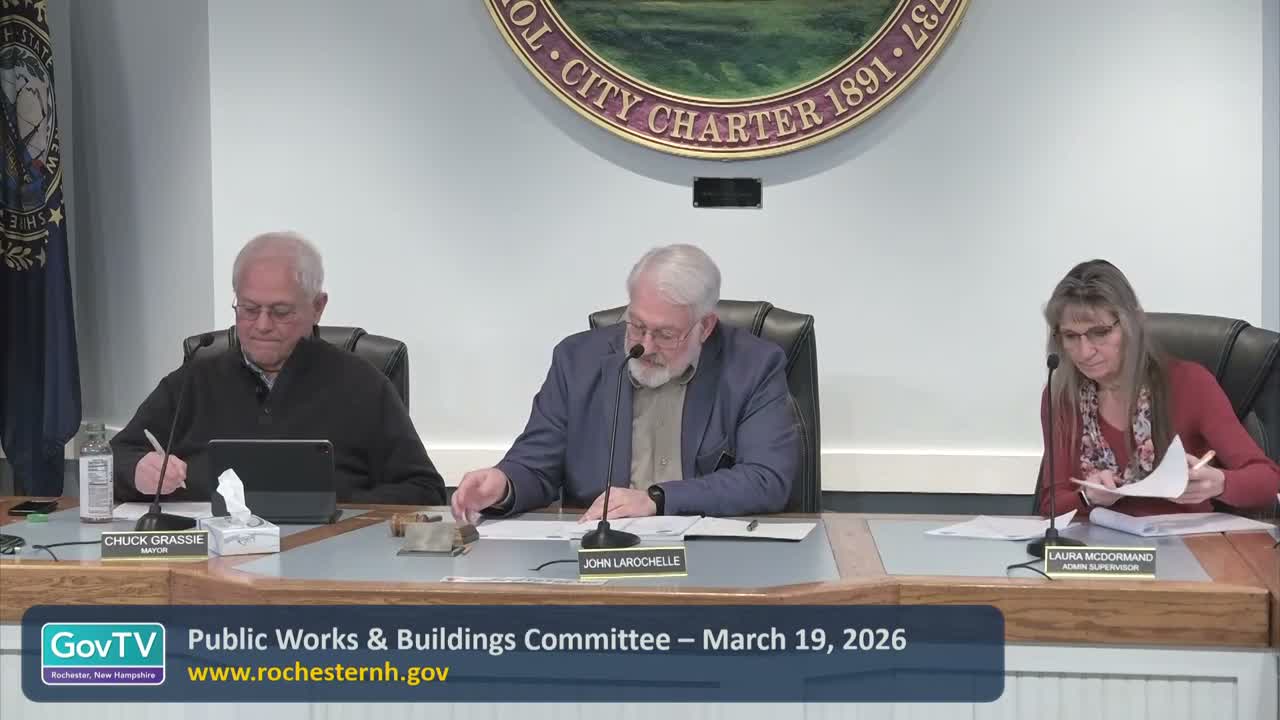
Tom Page, an engineer with Underwood Engineers, told the Rochester Public Works and Billing Committee on March 19 that a series of near‑term and long‑term upgrades are needed to restore the city’s surface water treatment plant to its original design capacity and to address emerging water‑quality concerns.
Page said the plant — originally designed in 1984 for 5 million gallons per day (MGD) — currently operates with a firm capacity of roughly 2.3 MGD because of hydraulic restrictions. He described identified “pinch points” in raw‑water piping, the clear well and filter train and recommended near‑term piping and pumping work to raise firm capacity to about 3.4 MGD, followed by filter and electrical upgrades to reach long‑term targets.
Why it matters: Average daily demand is about 2.1 MGD but maximum day demand has reached about 3.5 MGD (in 2020); engineers say future planning anticipates higher peak needs. Restoring firm capacity reduces the city’s reliance on a single source and improves resilience during droughts or plant outages.
“It’s all about having alternatives and choices there,” Page said, describing the Cochico Well as an important redundancy even if the plant is returned to higher capacity.
Page also reviewed residuals (alum sludge and filter backwash) that the plant currently sends via a six‑mile transmission main to the wastewater facility. He said a 30% design is under way for new residuals handling at the water plant to reduce reliance on the undersized pipeline and to support future capacity increases. He estimated the near‑term CIP items at about $5,300,000 and a longer‑term residuals project at roughly $8,000,000.
PFAS and groundwater: Page and staff discussed the Cochico Well, permitted for 700 gallons per minute but typically run at about half that rate, with seasonal limits on withdrawal. Staff reported monitored PFAS concentrations “around 38 to 42” parts per trillion (ppt) and noted the EPA has proposed a guidance value near 4 ppt; the laboratory detection limit was cited at about 2 ppt.
“You’re right on the edge,” Page said, referring to the comparison between measured values and proposed federal guidance.
Funding and next steps: Page said design work — including a 60% design for greensand filtration plus granular activated carbon for PFAS removal at the Cochico Well — has advanced using ARPA and Drinking Water Trust Fund dollars, but that available funds are insufficient for full construction. He said the city will refine long‑term cost estimates as further study and filter design progress.
Committee members asked whether improving the plant would reduce dependence on the Cochico Well; Page and staff said the well remains a vital redundant source on a separate power supply and that blending sources has operational benefits. Members also cautioned about committing large construction dollars while PFAS detections sit near analytical limits.
The committee did not take a vote on construction funding. Staff said near‑term funded work would proceed through the calendar year and further CIP decisions will be tied to budget deliberations.
Page said the plant — originally designed in 1984 for 5 million gallons per day (MGD) — currently operates with a firm capacity of roughly 2.3 MGD because of hydraulic restrictions. He described identified “pinch points” in raw‑water piping, the clear well and filter train and recommended near‑term piping and pumping work to raise firm capacity to about 3.4 MGD, followed by filter and electrical upgrades to reach long‑term targets.
Why it matters: Average daily demand is about 2.1 MGD but maximum day demand has reached about 3.5 MGD (in 2020); engineers say future planning anticipates higher peak needs. Restoring firm capacity reduces the city’s reliance on a single source and improves resilience during droughts or plant outages.
“It’s all about having alternatives and choices there,” Page said, describing the Cochico Well as an important redundancy even if the plant is returned to higher capacity.
Page also reviewed residuals (alum sludge and filter backwash) that the plant currently sends via a six‑mile transmission main to the wastewater facility. He said a 30% design is under way for new residuals handling at the water plant to reduce reliance on the undersized pipeline and to support future capacity increases. He estimated the near‑term CIP items at about $5,300,000 and a longer‑term residuals project at roughly $8,000,000.
PFAS and groundwater: Page and staff discussed the Cochico Well, permitted for 700 gallons per minute but typically run at about half that rate, with seasonal limits on withdrawal. Staff reported monitored PFAS concentrations “around 38 to 42” parts per trillion (ppt) and noted the EPA has proposed a guidance value near 4 ppt; the laboratory detection limit was cited at about 2 ppt.
“You’re right on the edge,” Page said, referring to the comparison between measured values and proposed federal guidance.
Funding and next steps: Page said design work — including a 60% design for greensand filtration plus granular activated carbon for PFAS removal at the Cochico Well — has advanced using ARPA and Drinking Water Trust Fund dollars, but that available funds are insufficient for full construction. He said the city will refine long‑term cost estimates as further study and filter design progress.
Committee members asked whether improving the plant would reduce dependence on the Cochico Well; Page and staff said the well remains a vital redundant source on a separate power supply and that blending sources has operational benefits. Members also cautioned about committing large construction dollars while PFAS detections sit near analytical limits.
The committee did not take a vote on construction funding. Staff said near‑term funded work would proceed through the calendar year and further CIP decisions will be tied to budget deliberations.
Don't Miss a Word: See the Full Meeting!
Go beyond summaries. Unlock every video, transcript, and key insight with a Founder Membership.
✓
Get instant access to full meeting videos
✓
Search and clip any phrase from complete transcripts
✓
Receive AI-powered summaries & custom alerts
✓
Enjoy lifetime, unrestricted access to government data
30-day money-back guarantee
