City updates committee on MS4 stormwater compliance; 52% of outfalls investigated
March 19, 2026 | Rochester Boards & Committees, Rochester City , Strafford County, New Hampshire
This article was created by AI summarizing key points discussed. AI makes mistakes, so for full details and context, please refer to the video of the full meeting. Please report any errors so we can fix them. Report an error »
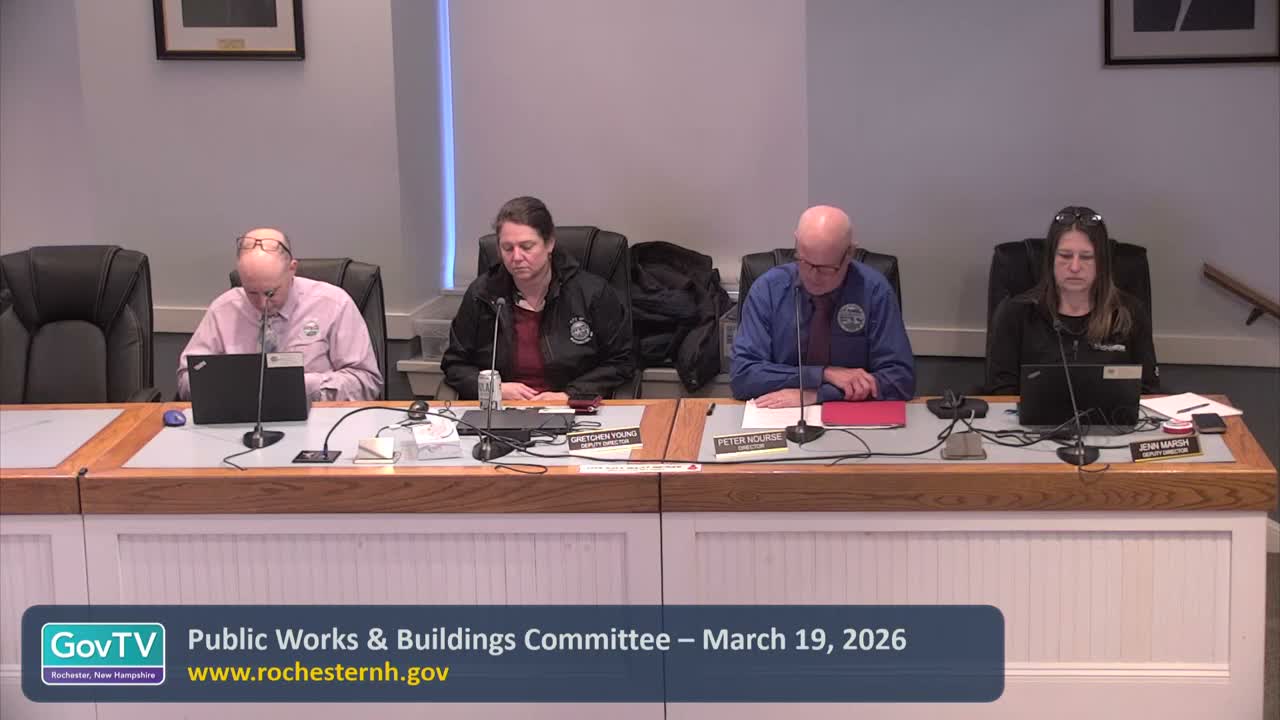
Renee Bordeaux, the city’s stormwater engineer with Geosyntec Engineers, gave the committee an annual refresher on Rochester’s obligations under the NPDES/MS4 program and summarized recent progress on compliance work.
Bordeaux said the current MS4 general permit (finalized in 2017 and effective July 1, 2018) has been administratively continued while a replacement is pending, and that the permit imposes six minimum control measures including public education, illicit discharge detection and elimination (IDDE), construction runoff controls and post‑construction stormwater management.
She reported the city inventories roughly 5,000 catch basins, about 860 manholes, 198 outfalls, 35 culverts and roughly 800,000 linear feet of drain pipe. Of the 198 outfalls that require investigation, Bordeaux said 104 have been completed (about 52%) and another 32 have been started; the city plans CCTV or additional data review where necessary.
Wet‑weather sampling — which requires collecting samples during rain events during lab hours — has lagged in dry periods, she said, but the city will continue catchment investigations, map updates and maintenance to meet the IDDE schedule and reduce illicit discharges.
“These requirements are designed to reduce pollutant loads over time and improve overall water quality from these outfalls,” Bordeaux said, describing the benefits of public education and targeted maintenance.
Bordeaux also highlighted recent maintenance on BMPs and outfalls (riprap stabilization, vegetation management and removal of debris) to restore hydraulic capacity and reduce local flooding. She said future permits may expand requirements in impaired watersheds and that routine cleaning and sweeping remain cost‑effective mitigation measures.
The committee asked no substantive questions; members thanked Bordeaux for the update.
Bordeaux said the current MS4 general permit (finalized in 2017 and effective July 1, 2018) has been administratively continued while a replacement is pending, and that the permit imposes six minimum control measures including public education, illicit discharge detection and elimination (IDDE), construction runoff controls and post‑construction stormwater management.
She reported the city inventories roughly 5,000 catch basins, about 860 manholes, 198 outfalls, 35 culverts and roughly 800,000 linear feet of drain pipe. Of the 198 outfalls that require investigation, Bordeaux said 104 have been completed (about 52%) and another 32 have been started; the city plans CCTV or additional data review where necessary.
Wet‑weather sampling — which requires collecting samples during rain events during lab hours — has lagged in dry periods, she said, but the city will continue catchment investigations, map updates and maintenance to meet the IDDE schedule and reduce illicit discharges.
“These requirements are designed to reduce pollutant loads over time and improve overall water quality from these outfalls,” Bordeaux said, describing the benefits of public education and targeted maintenance.
Bordeaux also highlighted recent maintenance on BMPs and outfalls (riprap stabilization, vegetation management and removal of debris) to restore hydraulic capacity and reduce local flooding. She said future permits may expand requirements in impaired watersheds and that routine cleaning and sweeping remain cost‑effective mitigation measures.
The committee asked no substantive questions; members thanked Bordeaux for the update.
Don't Miss a Word: See the Full Meeting!
Go beyond summaries. Unlock every video, transcript, and key insight with a Founder Membership.
✓
Get instant access to full meeting videos
✓
Search and clip any phrase from complete transcripts
✓
Receive AI-powered summaries & custom alerts
✓
Enjoy lifetime, unrestricted access to government data
30-day money-back guarantee
