Council approves Martin Manor redevelopment with condition to preserve at least one 1940s building if outside funding is secured
May 14, 2024 | Boca Raton, Palm Beach County, Florida
This article was created by AI summarizing key points discussed. AI makes mistakes, so for full details and context, please refer to the video of the full meeting. Please report any errors so we can fix them. Report an error »
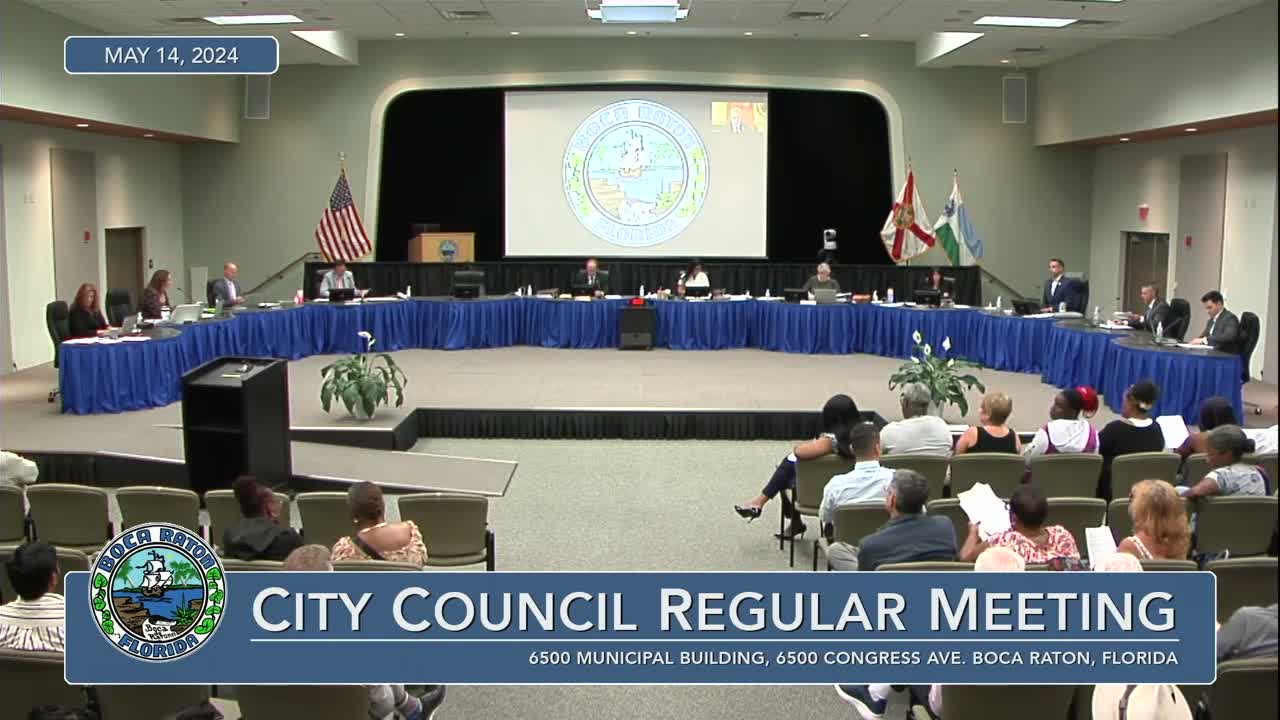
Deputy Mayor Yvette Trucker presided over a heated public hearing Tuesday that ended with the Boca Raton City Council approving the land‑use package to redevelop Dixie Manor as the 95‑unit "Residences at Martin Manor." The vote was 5‑0 after councilmembers added an amendment requiring the applicant to make good‑faith efforts to secure third‑party funding to preserve at least one of the existing 1940s buildings for historical purposes.
The council considered a universal conditional future‑land‑use amendment, rezoning from R‑3 to R‑5A, site‑plan approval for three three‑story buildings totaling 95 low‑income units (about 99,926 square feet of residential space), a 4,265‑square‑foot clubhouse and reductions in vehicular parking and EV‑installed spaces. Jacob German, planner for the city, told the council staff supports the variances and technical deviations because the project replaces 95 substandard units with new affordable housing and includes conditions to protect tenant rights during construction.
The nut graf: the developer and the Boca Raton Housing Authority pitched the project as an urgent opportunity to deliver modern affordable housing to long‑term Dixie Manor residents and meet state funding milestones; opponents pressed for stronger preservation and accessibility commitments. In response the council accepted a narrowly written preservation condition and approved revised site‑plan sheets that relocated the trash compactor and added two dumpster locations and 23 parking spaces retained on the south side of the site.
Staff and applicant details: City planner Jacob German summarized the application as a ~10.04‑acre redevelopment at 1350 North Dixie Highway that would demolish existing buildings in phases while preserving the community center and maintenance building. The site plan calls for a new six‑foot meandering sidewalk and street trees along North Dixie Highway, a phased tenant relocation plan, and two variances to reduce front/side setbacks. Staff recommended approval and noted the Planning & Zoning Board had recommended the project 6‑0.
Applicant counsel Ellie Zecharitis said the project will provide 95 low‑income units, each equipped with a washer and dryer and a dishwasher, and described an amended playground and a temporary/then‑permanent parking plan. Zecharitis told the council the developer had pursued and, after a challenge, secured state funding that creates tight construction milestones. “This is our moment,” she said, urging the council to approve the site plan and rezoning so the developer can proceed.
Public comment split sharply. Residents who live at Dixie Manor testified they want the new buildings and improved living conditions — citing broken air conditioning, aging roofs and daily safety concerns — and urged the council to move forward quickly. Preservation advocates and Pearl City descendants urged the council to save at least one of the World War II‑era barracks, saying the structures embody local Black history and should be preserved or memorialized. “Do not allow these barracks to be torn down,” one speaker said, calling demolition an erasure of local history.
Historic‑preservation process and MOA: Ashley Whitby, executive director of the Boca Raton Housing Authority, said the Housing Authority is negotiating a memorandum of agreement with the State Historic Preservation Office (SHPO). Whitby said the MOA and related approvals are required before any demolition may occur and that mitigation measures — including lesson plans and an interactive exhibit — are part of the process.
Preservation amendment: After a short recess the council approved amended language to the site‑plan condition requiring that at least one of the existing 1940s buildings be preserved if the applicant secures third‑party funding (not Housing Authority funds) to restore and maintain it for historical purposes; the preserved structure would not be used for residential occupancy. If funding is not secured, the applicant must consult with the Boca Raton Historical Society and pursue mitigation such as interactive exhibits and oral histories.
Votes and next steps: The council voted 5‑0 to adopt the comp‑plan amendment and the related ordinances and resolutions with the amendment and with the revised site‑plan sheets attached as the official exhibit. Staff said the site‑plan resolution will require demolition of the remaining south‑side buildings within 180 days of certificate of occupancy for the new units unless other conditions are met; the approved amendment and the MOA process were specifically referenced as constraints on demolition.
What remains unresolved: Councilmembers asked staff to continue work on Phase 2 preservation options, enforcement of the MOA and permanent funding strategies for preservation. Several residents asked the council to require elevators and more on‑site EV chargers; staff and applicant said elevators are not required by code for the proposed garden‑style 3‑story buildings and that the plan includes 20 EV‑ready spaces that can be converted later.
The council’s action transmits and approves the required comp‑plan and rezoning changes and clears the applicant to pursue building permits and demolition only after the conditions — including the preservation/mitigation steps — are met. The developer and housing authority said they will continue resident outreach and coordinate relocation activities consistent with HUD repositioning rules.
The council considered a universal conditional future‑land‑use amendment, rezoning from R‑3 to R‑5A, site‑plan approval for three three‑story buildings totaling 95 low‑income units (about 99,926 square feet of residential space), a 4,265‑square‑foot clubhouse and reductions in vehicular parking and EV‑installed spaces. Jacob German, planner for the city, told the council staff supports the variances and technical deviations because the project replaces 95 substandard units with new affordable housing and includes conditions to protect tenant rights during construction.
The nut graf: the developer and the Boca Raton Housing Authority pitched the project as an urgent opportunity to deliver modern affordable housing to long‑term Dixie Manor residents and meet state funding milestones; opponents pressed for stronger preservation and accessibility commitments. In response the council accepted a narrowly written preservation condition and approved revised site‑plan sheets that relocated the trash compactor and added two dumpster locations and 23 parking spaces retained on the south side of the site.
Staff and applicant details: City planner Jacob German summarized the application as a ~10.04‑acre redevelopment at 1350 North Dixie Highway that would demolish existing buildings in phases while preserving the community center and maintenance building. The site plan calls for a new six‑foot meandering sidewalk and street trees along North Dixie Highway, a phased tenant relocation plan, and two variances to reduce front/side setbacks. Staff recommended approval and noted the Planning & Zoning Board had recommended the project 6‑0.
Applicant counsel Ellie Zecharitis said the project will provide 95 low‑income units, each equipped with a washer and dryer and a dishwasher, and described an amended playground and a temporary/then‑permanent parking plan. Zecharitis told the council the developer had pursued and, after a challenge, secured state funding that creates tight construction milestones. “This is our moment,” she said, urging the council to approve the site plan and rezoning so the developer can proceed.
Public comment split sharply. Residents who live at Dixie Manor testified they want the new buildings and improved living conditions — citing broken air conditioning, aging roofs and daily safety concerns — and urged the council to move forward quickly. Preservation advocates and Pearl City descendants urged the council to save at least one of the World War II‑era barracks, saying the structures embody local Black history and should be preserved or memorialized. “Do not allow these barracks to be torn down,” one speaker said, calling demolition an erasure of local history.
Historic‑preservation process and MOA: Ashley Whitby, executive director of the Boca Raton Housing Authority, said the Housing Authority is negotiating a memorandum of agreement with the State Historic Preservation Office (SHPO). Whitby said the MOA and related approvals are required before any demolition may occur and that mitigation measures — including lesson plans and an interactive exhibit — are part of the process.
Preservation amendment: After a short recess the council approved amended language to the site‑plan condition requiring that at least one of the existing 1940s buildings be preserved if the applicant secures third‑party funding (not Housing Authority funds) to restore and maintain it for historical purposes; the preserved structure would not be used for residential occupancy. If funding is not secured, the applicant must consult with the Boca Raton Historical Society and pursue mitigation such as interactive exhibits and oral histories.
Votes and next steps: The council voted 5‑0 to adopt the comp‑plan amendment and the related ordinances and resolutions with the amendment and with the revised site‑plan sheets attached as the official exhibit. Staff said the site‑plan resolution will require demolition of the remaining south‑side buildings within 180 days of certificate of occupancy for the new units unless other conditions are met; the approved amendment and the MOA process were specifically referenced as constraints on demolition.
What remains unresolved: Councilmembers asked staff to continue work on Phase 2 preservation options, enforcement of the MOA and permanent funding strategies for preservation. Several residents asked the council to require elevators and more on‑site EV chargers; staff and applicant said elevators are not required by code for the proposed garden‑style 3‑story buildings and that the plan includes 20 EV‑ready spaces that can be converted later.
The council’s action transmits and approves the required comp‑plan and rezoning changes and clears the applicant to pursue building permits and demolition only after the conditions — including the preservation/mitigation steps — are met. The developer and housing authority said they will continue resident outreach and coordinate relocation activities consistent with HUD repositioning rules.
Don't Miss a Word: See the Full Meeting!
Go beyond summaries. Unlock every video, transcript, and key insight with a Founder Membership.
✓
Get instant access to full meeting videos
✓
Search and clip any phrase from complete transcripts
✓
Receive AI-powered summaries & custom alerts
✓
Enjoy lifetime, unrestricted access to government data
30-day money-back guarantee
