Boca Raton council approves Circuit Transit pilot for downtown on‑demand mobility
April 09, 2024 | Boca Raton, Palm Beach County, Florida
This article was created by AI summarizing key points discussed. AI makes mistakes, so for full details and context, please refer to the video of the full meeting. Please report any errors so we can fix them. Report an error »
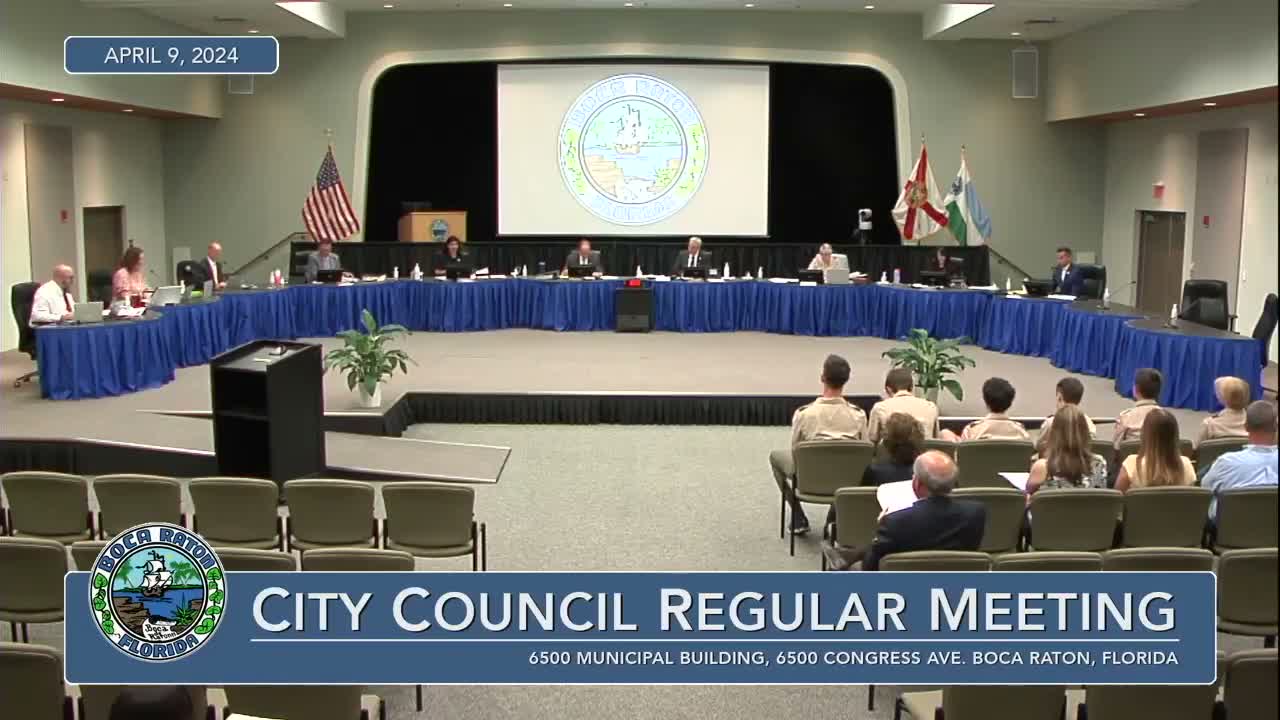
The Boca Raton City Council voted unanimously April 9 to authorize a pilot downtown on‑demand mobility contract with Circuit Transit Inc., approving a contract that sets service hours, vehicle types and performance standards for a yearlong evaluation.
Municipal Services Director Zach Beer told the council the pilot would focus on the city’s defined downtown core and operate roughly Monday–Thursday 7 a.m.–11 p.m., Friday 7 a.m.–2 a.m., Saturday 9 a.m.–2 a.m. and Sunday 9 a.m.–11 p.m., with the contractor required to meet a maximum wait time target of 10 minutes. Beer said the contract’s base service area requires trips to begin and end in the downtown core; optional service expansions and pricing for outlying stops would be negotiated after staff collects operational data.
“This is a pilot program where staff is going to be collecting a significant amount of data,” Beer said, describing the vendor’s app, vehicle mix (small electric vehicles and ADA‑capable vans) and simulations used during the procurement.
Deputy Mayor Drucker, a longstanding transit proponent, welcomed the selection and urged a promotional push when service begins: “I would like to add some fun to it so people could start using the services … let’s make sure we promote it.” Other council members pressed staff on funding and revenue flows; Beer said the pilot is funded from the CRA and that most of a nominal $2 trip fee will cover payment processing and contractor administration, with a marginal credit back to the city.
Council members discussed operational constraints—chiefly bridge openings and train crossings—that could affect headways and agreed the pilot’s data collection and built‑in flexibility will allow subsequent contract amendments. Staff estimated the service could launch in about six weeks after final setup.
Two residents who spoke during the public comment period expressed support: “I hate looking for parking when we head downtown,” one told council members, backing the proposal to improve connectivity.
The council approved Resolution 29‑2024 by roll call vote 5–0. Staff will monitor ridership and operational metrics and may amend the contract to add optional stops or adjust hours based on observed demand and performance.
Municipal Services Director Zach Beer told the council the pilot would focus on the city’s defined downtown core and operate roughly Monday–Thursday 7 a.m.–11 p.m., Friday 7 a.m.–2 a.m., Saturday 9 a.m.–2 a.m. and Sunday 9 a.m.–11 p.m., with the contractor required to meet a maximum wait time target of 10 minutes. Beer said the contract’s base service area requires trips to begin and end in the downtown core; optional service expansions and pricing for outlying stops would be negotiated after staff collects operational data.
“This is a pilot program where staff is going to be collecting a significant amount of data,” Beer said, describing the vendor’s app, vehicle mix (small electric vehicles and ADA‑capable vans) and simulations used during the procurement.
Deputy Mayor Drucker, a longstanding transit proponent, welcomed the selection and urged a promotional push when service begins: “I would like to add some fun to it so people could start using the services … let’s make sure we promote it.” Other council members pressed staff on funding and revenue flows; Beer said the pilot is funded from the CRA and that most of a nominal $2 trip fee will cover payment processing and contractor administration, with a marginal credit back to the city.
Council members discussed operational constraints—chiefly bridge openings and train crossings—that could affect headways and agreed the pilot’s data collection and built‑in flexibility will allow subsequent contract amendments. Staff estimated the service could launch in about six weeks after final setup.
Two residents who spoke during the public comment period expressed support: “I hate looking for parking when we head downtown,” one told council members, backing the proposal to improve connectivity.
The council approved Resolution 29‑2024 by roll call vote 5–0. Staff will monitor ridership and operational metrics and may amend the contract to add optional stops or adjust hours based on observed demand and performance.
View the Full Meeting & All Its Details
This article offers just a summary. Unlock complete video, transcripts, and insights as a Founder Member.
✓
Watch full, unedited meeting videos
✓
Search every word spoken in unlimited transcripts
✓
AI summaries & real-time alerts (all government levels)
✓
Permanent access to expanding government content
30-day money-back guarantee
