Joint Ways and Means hearing in Mattapan reviews FY27 health and human services budget; members press agencies on cuts, staffing and service access
March 20, 2026 | 2026 Legislature MA, Massachusetts
This article was created by AI summarizing key points discussed. AI makes mistakes, so for full details and context, please refer to the video of the full meeting. Please report any errors so we can fix them. Report an error »
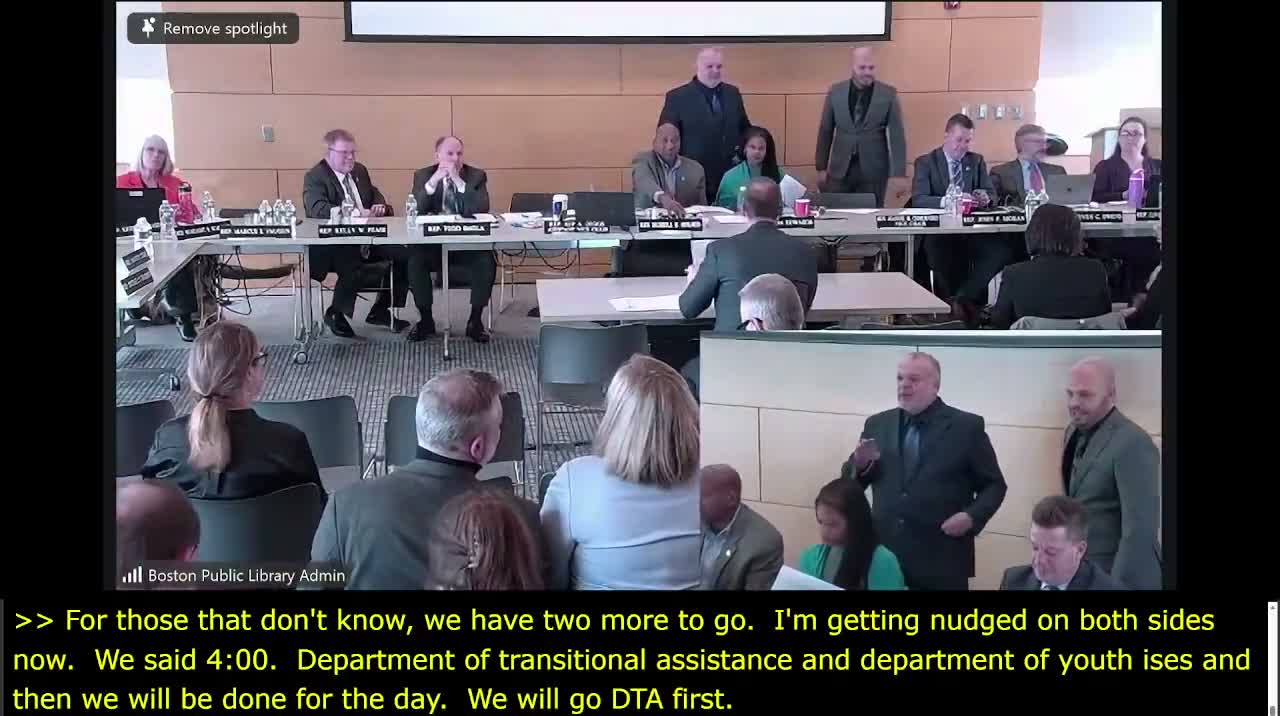
Sen. Lydia Edwards and Rep. Brandy Fluker Reid opened a Ways and Means FY27 budget hearing in Mattapan, saying the in-person forum was intended to center communities served by state health and human services programs.
The hearing gathered a sequence of agency presentations and member questions about funding, staffing and program design across disability services, communication access, refugee legal support, veterans care, child welfare, developmental services, transitional assistance, and juvenile justice.
MassAbility told the committee the governor’s FY27 House 2 budget would fund the agency at $93.3 million and described an agency-wide review to prioritize supports for people with the greatest needs. Representatives on the committee raised concerns about a $1.3 million line change tied to the home-care program, recent staffing declines and rising caseloads; MassAbility officials said providers would not lose service dollars but that the agency intended to redesign internal operations and invest in provider networks and referral tools.
Doctor Opelua Sotonwa, commissioner of the Massachusetts Commission for the Deaf, Deafblind and Hard of Hearing, urged investments to expand sign-language and captioning workforce capacity and to modernize referral software, saying those steps reduce health and safety risks caused by communication failures. He described a mentorship pipeline and targeted training for first responders.
John Olivera, commissioner of the Massachusetts Commission for the Blind, described an FY27 H2 recommendation of $30.8 million to sustain social rehabilitation, vocational services and the Turning‑22 transition program. He said recent federal funding timing produced planning uncertainty but that the agency has trimmed overhead and leveraged partnerships to maintain services.
Christina Aguilera Sandoval, executive director of the Office for Refugees and Immigrants, outlined a portfolio of legal and community supports created after major federal policy shifts, including a new Massachusetts Access to Counsel (MACE) initiative. Her staff said MACE had obligated several million dollars in contracts and that the program had assigned attorneys to roughly 460 cases and intaked about 697 eligible individuals to date; ORI staff estimated roughly $4.1 million in planned spending for the full program year, but explained contract timing delayed full invoicing through December and January.
Secretary Eric Rellnick of the Executive Office of Veterans Services described a $210.9 million FY27 request that preserves Chapter 115 benefits and supports veterans homes operations. Directors of the Chelsea and Holyoke veterans homes highlighted progress on licensure, staffing and capital investments; members pressed for demographic data on residents, timeliness of municipal reimbursements and shelter/housing coordination.
Bob Notch, the state veteran advocate, asked for modest budget growth so OVA can continue data, liaison and investigative work; he also flagged companion bills to update the statutory definition of “veteran” and to strengthen transition supports for service members.
Department of Children and Families Commissioner Devar Miller summarized a roughly $1.5 billion request to protect prevention services, family resource centers and evidence‑based supports that keep children safely at home. He said DCF now serves about 28,000 children and emphasized kin‑first placement gains and an increased use of structured risk assessment.
DDS Commissioner Sarah Peterson described steps to expand less‑restrictive supported living models, capture Medicaid waiver revenues (over $20 million annually identified so far), and prepare a growing Turning‑22 cohort; she said autism‑specific supports and workforce investments remain priorities.
New DTA Commissioner Michael Cole outlined the department’s response to sweeping federal changes to SNAP, including expanded documentation and work requirements, tighter payment‑error tolerances and the need to lower the state’s payment‑error rate (state error rates had risen during the public‑health emergency). Cole said DTA added nearly 80 front‑line SNAP caseworkers in January and planned additional call‑center and IT upgrades, including a rollout of chip‑enabled EBT cards to reduce skimming vulnerabilities.
DYS Commissioner Cecily Reardon described a smaller overall juvenile census than a decade ago and emphasized diversion, education completion and vocational training as core strategies that reduce reliance on residential placements. She said young people entering DYS have higher acuity and that the agency is investing in training, trauma‑informed care and a girls’ continuum that includes staff‑secure and hardware‑secure placements.
What legislators focused on
Throughout the hearing lawmakers sought detail on how allotted dollars translate to front‑line services. Recurring member concerns included: the effect of small line‑item reductions for high‑need programs (for example, home‑care lines cited in the MassAbility exchange); interpreter shortages at MCDHH and how the state will grow that workforce; the pace and early contract timing for ORI’s legal defense deployment; the DTA payment‑error rate (federal penalties escalate if the state does not return below a 6% error rate) and access to call‑center help; and demographic, access and reimbursement questions for veterans programs.
Several members urged additional data and follow‑up briefings — for instance, requests for the number of veterans served at each veterans home by race, gender and income; precise counts of MACE spending and client outcomes; and further modeling from DTA on how proposed asset or transitional provisions would affect families.
The next steps
Committee chairs said they would continue follow‑up with agencies and requested additional fiscal and programmatic materials. No formal votes were taken at the hearing; members deferred program decisions to upcoming budget deliberations.
Representative Russell Holmes, Senator Lydia Edwards and staff asked agency teams to return with more detailed expenditure rules, staffing plans and precise outcome metrics to inform appropriation choices.
The hearing gathered a sequence of agency presentations and member questions about funding, staffing and program design across disability services, communication access, refugee legal support, veterans care, child welfare, developmental services, transitional assistance, and juvenile justice.
MassAbility told the committee the governor’s FY27 House 2 budget would fund the agency at $93.3 million and described an agency-wide review to prioritize supports for people with the greatest needs. Representatives on the committee raised concerns about a $1.3 million line change tied to the home-care program, recent staffing declines and rising caseloads; MassAbility officials said providers would not lose service dollars but that the agency intended to redesign internal operations and invest in provider networks and referral tools.
Doctor Opelua Sotonwa, commissioner of the Massachusetts Commission for the Deaf, Deafblind and Hard of Hearing, urged investments to expand sign-language and captioning workforce capacity and to modernize referral software, saying those steps reduce health and safety risks caused by communication failures. He described a mentorship pipeline and targeted training for first responders.
John Olivera, commissioner of the Massachusetts Commission for the Blind, described an FY27 H2 recommendation of $30.8 million to sustain social rehabilitation, vocational services and the Turning‑22 transition program. He said recent federal funding timing produced planning uncertainty but that the agency has trimmed overhead and leveraged partnerships to maintain services.
Christina Aguilera Sandoval, executive director of the Office for Refugees and Immigrants, outlined a portfolio of legal and community supports created after major federal policy shifts, including a new Massachusetts Access to Counsel (MACE) initiative. Her staff said MACE had obligated several million dollars in contracts and that the program had assigned attorneys to roughly 460 cases and intaked about 697 eligible individuals to date; ORI staff estimated roughly $4.1 million in planned spending for the full program year, but explained contract timing delayed full invoicing through December and January.
Secretary Eric Rellnick of the Executive Office of Veterans Services described a $210.9 million FY27 request that preserves Chapter 115 benefits and supports veterans homes operations. Directors of the Chelsea and Holyoke veterans homes highlighted progress on licensure, staffing and capital investments; members pressed for demographic data on residents, timeliness of municipal reimbursements and shelter/housing coordination.
Bob Notch, the state veteran advocate, asked for modest budget growth so OVA can continue data, liaison and investigative work; he also flagged companion bills to update the statutory definition of “veteran” and to strengthen transition supports for service members.
Department of Children and Families Commissioner Devar Miller summarized a roughly $1.5 billion request to protect prevention services, family resource centers and evidence‑based supports that keep children safely at home. He said DCF now serves about 28,000 children and emphasized kin‑first placement gains and an increased use of structured risk assessment.
DDS Commissioner Sarah Peterson described steps to expand less‑restrictive supported living models, capture Medicaid waiver revenues (over $20 million annually identified so far), and prepare a growing Turning‑22 cohort; she said autism‑specific supports and workforce investments remain priorities.
New DTA Commissioner Michael Cole outlined the department’s response to sweeping federal changes to SNAP, including expanded documentation and work requirements, tighter payment‑error tolerances and the need to lower the state’s payment‑error rate (state error rates had risen during the public‑health emergency). Cole said DTA added nearly 80 front‑line SNAP caseworkers in January and planned additional call‑center and IT upgrades, including a rollout of chip‑enabled EBT cards to reduce skimming vulnerabilities.
DYS Commissioner Cecily Reardon described a smaller overall juvenile census than a decade ago and emphasized diversion, education completion and vocational training as core strategies that reduce reliance on residential placements. She said young people entering DYS have higher acuity and that the agency is investing in training, trauma‑informed care and a girls’ continuum that includes staff‑secure and hardware‑secure placements.
What legislators focused on
Throughout the hearing lawmakers sought detail on how allotted dollars translate to front‑line services. Recurring member concerns included: the effect of small line‑item reductions for high‑need programs (for example, home‑care lines cited in the MassAbility exchange); interpreter shortages at MCDHH and how the state will grow that workforce; the pace and early contract timing for ORI’s legal defense deployment; the DTA payment‑error rate (federal penalties escalate if the state does not return below a 6% error rate) and access to call‑center help; and demographic, access and reimbursement questions for veterans programs.
Several members urged additional data and follow‑up briefings — for instance, requests for the number of veterans served at each veterans home by race, gender and income; precise counts of MACE spending and client outcomes; and further modeling from DTA on how proposed asset or transitional provisions would affect families.
The next steps
Committee chairs said they would continue follow‑up with agencies and requested additional fiscal and programmatic materials. No formal votes were taken at the hearing; members deferred program decisions to upcoming budget deliberations.
Representative Russell Holmes, Senator Lydia Edwards and staff asked agency teams to return with more detailed expenditure rules, staffing plans and precise outcome metrics to inform appropriation choices.
View the Full Meeting & All Its Details
This article offers just a summary. Unlock complete video, transcripts, and insights as a Founder Member.
✓
Watch full, unedited meeting videos
✓
Search every word spoken in unlimited transcripts
✓
AI summaries & real-time alerts (all government levels)
✓
Permanent access to expanding government content
30-day money-back guarantee
