California assembly select committee hears LA County report showing near‑record hate incidents; advocates urge funding for anti‑hate programs
March 20, 2026 | California State Assembly, House, Legislative, California
This article was created by AI summarizing key points discussed. AI makes mistakes, so for full details and context, please refer to the video of the full meeting. Please report any errors so we can fix them. Report an error »
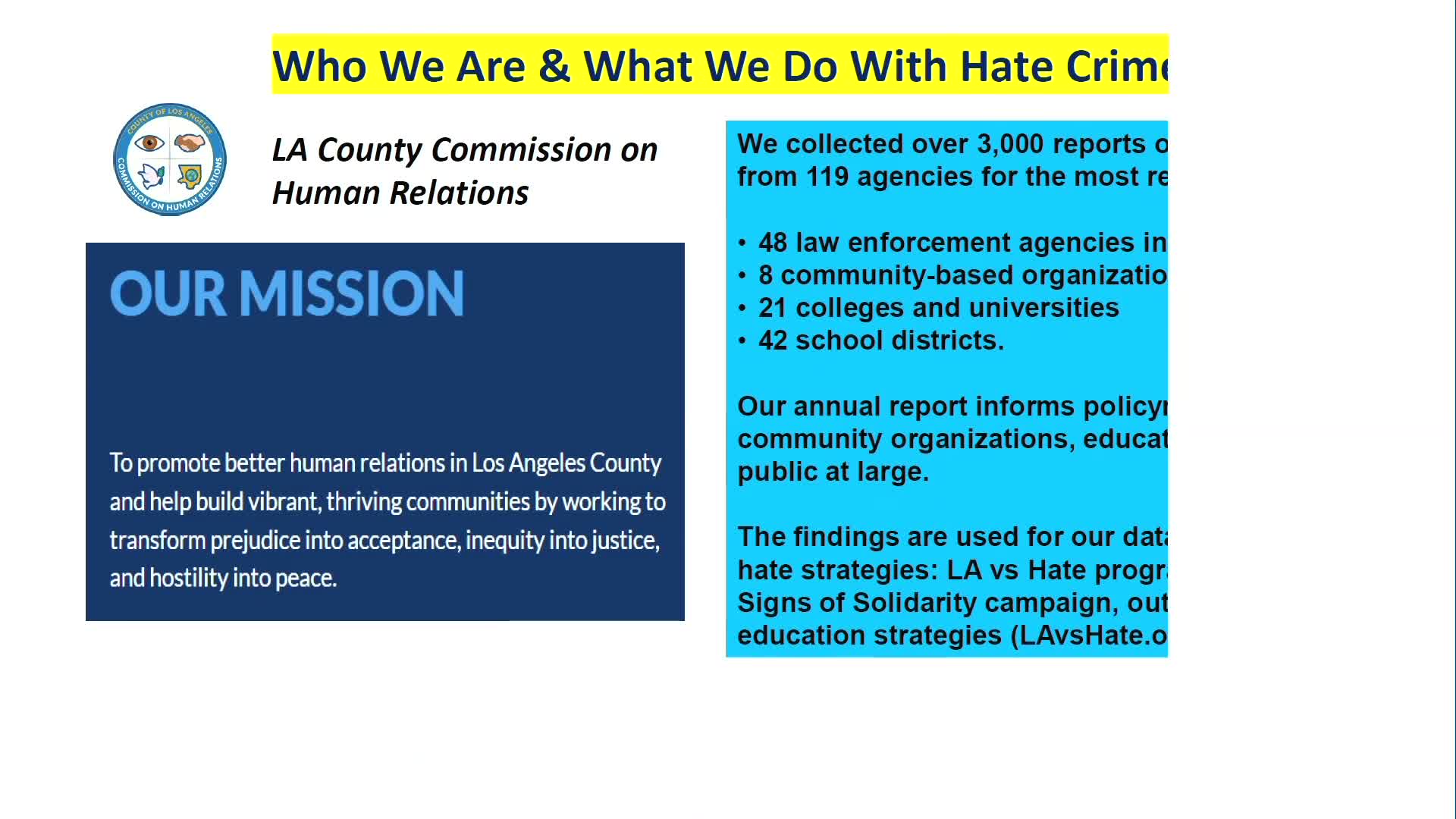
Chair Jackson convened the California State Assembly’s Select Committee on Racism, Hate, and Xenophobia for a Los Angeles hearing where county officials and community groups laid out data and policy requests to stem rising hate and improve victim support.
Robin Toma, executive director of the Los Angeles County Commission on Human Relations, told lawmakers the commission’s report is based on more than 3,000 reports from 119 agencies and community sources and shows 2024 near‑record totals for hate crimes and incidents across the county. “This report … is a result of over 3,000 reports that have been received from a 119 agencies,” Toma said, and he emphasized that racial motivations remain the single largest category of hate crime in the county. Toma said anti‑Black incidents accounted for 51% of racially motivated hate crimes in 2024 — 345 reported incidents — while Black residents make up roughly 9% of the county’s population.
Toma described LA Versus Hate, the county’s data and victim‑support system, and said the program has documented 8,599 referrals for legal aid, housing help and other services since 2019. He also read illustrative case narratives from the report, citing a December incident in Long Beach in which a Black woman was subjected to racial slurs and a suspect reportedly pointed a handgun at her multiple times.
Anne Tremblay, constitutional policing adviser for the Los Angeles County Sheriff’s Department, said the department has seen similar trends in its jurisdiction and provided preliminary 2025 figures: “a total of 171 hate crimes and hate incidents” reported to the sheriff’s department (92 crimes, 79 incidents). She described efforts to increase reporting and investigative capacity — hate‑crime coordinators at patrol stations, departmentwide coordinators, and training on the evidence needed to support a statutory hate‑crime charge — and urged deeper community partnerships to overcome underreporting.
Panelists from community organizations said the state must sustain and expand investments in non‑policing reporting options, victim services and prevention. Jose Barrera, national vice president of LULAC, urged accessible, multilingual reporting systems and funding to expand community‑based legal and mental‑health services. Joanna Mendelsohn of the Jewish Federation of Los Angeles highlighted a sharp rise in antisemitic incidents and called for expanded nonprofit security grants and safe‑worship protections; she cited an Assembly bill referenced in the hearing (AB 2664) as part of that agenda.
Janette (transcript: Janette Smitpatine) of the Coalition for Humane Immigrant Rights of Los Angeles described immigrant reluctance to report crimes because of fear of immigration enforcement and urged continued funding for Stop the Hate programs; she cited a Stop the Hate budget request discussed by panelists of $100,000,000 over three years. Joey Hernandez of the Los Angeles LGBT Center pressed for $26 million in funding for gender‑affirming care and $35 million for an LGBTQ community center fund, and asked the legislature to reauthorize California versus Hate.
Advocates and civil‑rights groups reading statements into the record also urged better workplace protections and implementation of recently enacted data‑collection measures. A written statement read by Latifa Alexander representing CARE/CAIR cited a national total of 8,683 civil‑rights complaints in 2025 and urged full implementation of AB 91 (the MENA Inclusion Act as cited in the record).
Committee members and panelists discussed legislative options including diversion programs for lower‑level hate offenders, expanded training for law enforcement to identify hate crimes, nonprofit security grants for vulnerable institutions, and statutory limits on law‑enforcement cooperation with federal immigration authorities to rebuild trust with immigrant communities.
No formal votes or bills were adopted at the hearing; Chair Jackson said the select committee has a three‑bill package underway and announced a follow‑up committee session to be held in Sacramento. The hearing record includes panel reports, case excerpts and written statements to inform the committee’s next steps.
The committee is expected to carry forward the testimony into bill drafting and budget advocacy, and members said they will coordinate additional hearings and statewide convenings to refine recommended language and funding levels.
Robin Toma, executive director of the Los Angeles County Commission on Human Relations, told lawmakers the commission’s report is based on more than 3,000 reports from 119 agencies and community sources and shows 2024 near‑record totals for hate crimes and incidents across the county. “This report … is a result of over 3,000 reports that have been received from a 119 agencies,” Toma said, and he emphasized that racial motivations remain the single largest category of hate crime in the county. Toma said anti‑Black incidents accounted for 51% of racially motivated hate crimes in 2024 — 345 reported incidents — while Black residents make up roughly 9% of the county’s population.
Toma described LA Versus Hate, the county’s data and victim‑support system, and said the program has documented 8,599 referrals for legal aid, housing help and other services since 2019. He also read illustrative case narratives from the report, citing a December incident in Long Beach in which a Black woman was subjected to racial slurs and a suspect reportedly pointed a handgun at her multiple times.
Anne Tremblay, constitutional policing adviser for the Los Angeles County Sheriff’s Department, said the department has seen similar trends in its jurisdiction and provided preliminary 2025 figures: “a total of 171 hate crimes and hate incidents” reported to the sheriff’s department (92 crimes, 79 incidents). She described efforts to increase reporting and investigative capacity — hate‑crime coordinators at patrol stations, departmentwide coordinators, and training on the evidence needed to support a statutory hate‑crime charge — and urged deeper community partnerships to overcome underreporting.
Panelists from community organizations said the state must sustain and expand investments in non‑policing reporting options, victim services and prevention. Jose Barrera, national vice president of LULAC, urged accessible, multilingual reporting systems and funding to expand community‑based legal and mental‑health services. Joanna Mendelsohn of the Jewish Federation of Los Angeles highlighted a sharp rise in antisemitic incidents and called for expanded nonprofit security grants and safe‑worship protections; she cited an Assembly bill referenced in the hearing (AB 2664) as part of that agenda.
Janette (transcript: Janette Smitpatine) of the Coalition for Humane Immigrant Rights of Los Angeles described immigrant reluctance to report crimes because of fear of immigration enforcement and urged continued funding for Stop the Hate programs; she cited a Stop the Hate budget request discussed by panelists of $100,000,000 over three years. Joey Hernandez of the Los Angeles LGBT Center pressed for $26 million in funding for gender‑affirming care and $35 million for an LGBTQ community center fund, and asked the legislature to reauthorize California versus Hate.
Advocates and civil‑rights groups reading statements into the record also urged better workplace protections and implementation of recently enacted data‑collection measures. A written statement read by Latifa Alexander representing CARE/CAIR cited a national total of 8,683 civil‑rights complaints in 2025 and urged full implementation of AB 91 (the MENA Inclusion Act as cited in the record).
Committee members and panelists discussed legislative options including diversion programs for lower‑level hate offenders, expanded training for law enforcement to identify hate crimes, nonprofit security grants for vulnerable institutions, and statutory limits on law‑enforcement cooperation with federal immigration authorities to rebuild trust with immigrant communities.
No formal votes or bills were adopted at the hearing; Chair Jackson said the select committee has a three‑bill package underway and announced a follow‑up committee session to be held in Sacramento. The hearing record includes panel reports, case excerpts and written statements to inform the committee’s next steps.
The committee is expected to carry forward the testimony into bill drafting and budget advocacy, and members said they will coordinate additional hearings and statewide convenings to refine recommended language and funding levels.
Don't Miss a Word: See the Full Meeting!
Go beyond summaries. Unlock every video, transcript, and key insight with a Founder Membership.
✓
Get instant access to full meeting videos
✓
Search and clip any phrase from complete transcripts
✓
Receive AI-powered summaries & custom alerts
✓
Enjoy lifetime, unrestricted access to government data
30-day money-back guarantee
