Senate committee advances bill to raise library construction grant cap to $2 million
March 18, 2026 | 2026 Legislature MN, Minnesota
This article was created by AI summarizing key points discussed. AI makes mistakes, so for full details and context, please refer to the video of the full meeting. Please report any errors so we can fix them. Report an error »
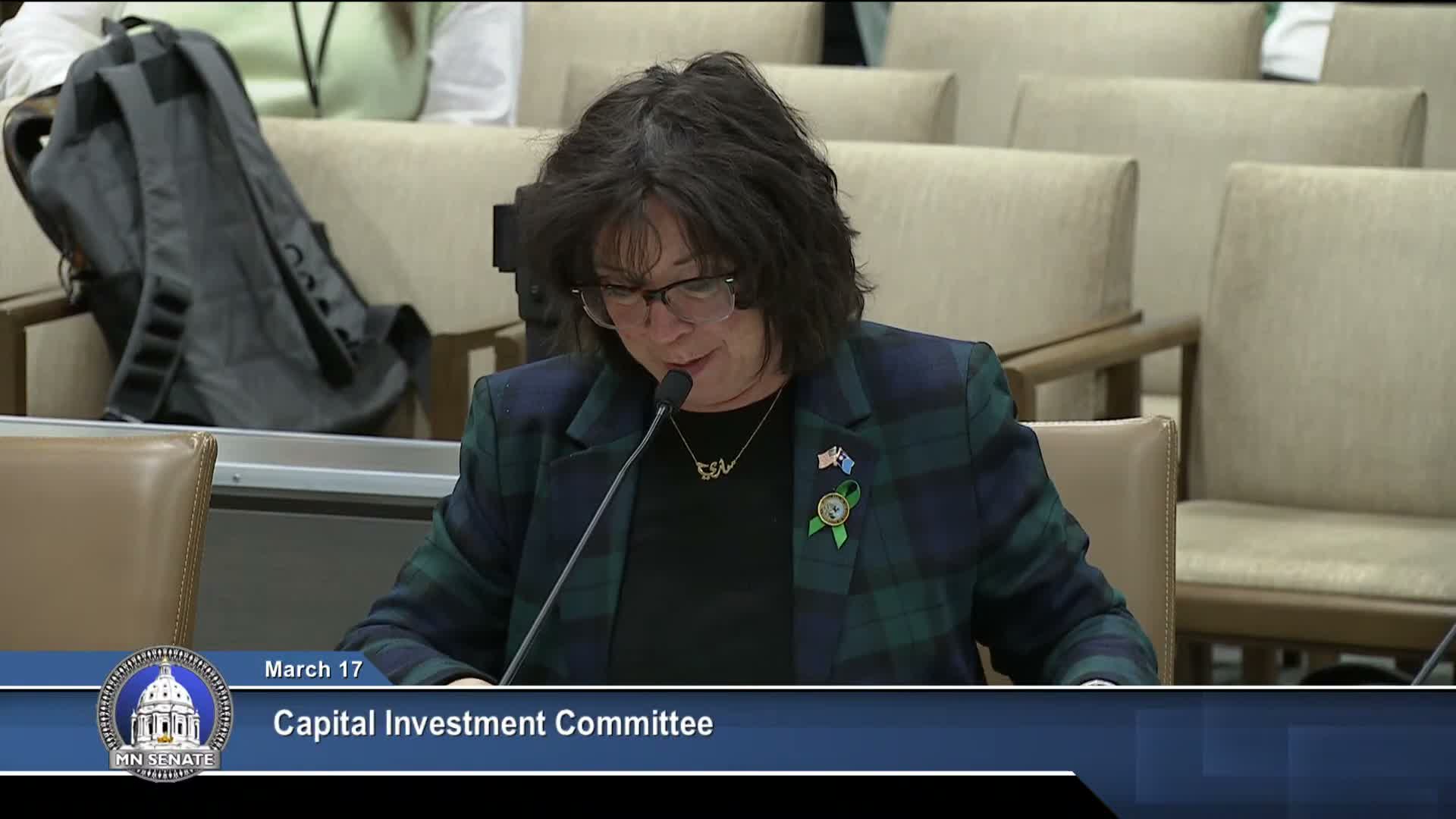
Sen. Kunish introduced Senate File 3684 on March 17, asking the Capital Investment Committee to increase the maximum Mary C. Murphy Library Construction Grant from $1,000,000 to $2,000,000 and to clarify that community matches may be "non-state" rather than strictly "local." The sponsor said the change would help communities, especially rural ones, meet growing construction and accessibility needs.
Karen Lemke, director of Rochester Public Library and president-elect of the Minnesota Library Association, testified that Rochesters downtown library (built in 1995) needs an upgraded elevator and other accessibility improvements. "Elevator replacement is just one of several facility updates our community has identified as top priorities," Lemke said, noting the library's second-floor tutoring rooms and a seed library that circulated more than 25,000 seed packets last year.
Elizabeth Hoffman, regional public library director for the Plum Creek Library System, and Erin Smith, director of the Viking Library System, described similar pressures in Worthington and Fergus Falls. Hoffman said a $1,000,000 state grant helped leverage a roughly $4,000,000 project at Redwood Falls Public Library. Smith told the committee that more than 45 public libraries have identified repair, expansion or new-construction needs totaling more than $218,000,000 across Minnesota.
During questioning, Sen. John Rasmussen expressed concern that increasing the cap or loosening match requirements without increasing the program appropriation could concentrate funds among fewer projects. "If we increase the cap... the limited funds that we have had going into this program will actually touch fewer communities, not more," Rasmussen said. Sen. Kunish and other sponsors said higher caps reflect rising construction costs and that not every grantee would receive the full $2,000,000.
The committee adopted an A1 amendment that removed the appropriations language and then, by voice vote, moved to recommend Senate File 3684 as amended to the Finance Committee.
The bill now goes to the Senate Finance Committee for further consideration; supporters said they will seek higher appropriations in future negotiations to ensure broader program reach.
Karen Lemke, director of Rochester Public Library and president-elect of the Minnesota Library Association, testified that Rochesters downtown library (built in 1995) needs an upgraded elevator and other accessibility improvements. "Elevator replacement is just one of several facility updates our community has identified as top priorities," Lemke said, noting the library's second-floor tutoring rooms and a seed library that circulated more than 25,000 seed packets last year.
Elizabeth Hoffman, regional public library director for the Plum Creek Library System, and Erin Smith, director of the Viking Library System, described similar pressures in Worthington and Fergus Falls. Hoffman said a $1,000,000 state grant helped leverage a roughly $4,000,000 project at Redwood Falls Public Library. Smith told the committee that more than 45 public libraries have identified repair, expansion or new-construction needs totaling more than $218,000,000 across Minnesota.
During questioning, Sen. John Rasmussen expressed concern that increasing the cap or loosening match requirements without increasing the program appropriation could concentrate funds among fewer projects. "If we increase the cap... the limited funds that we have had going into this program will actually touch fewer communities, not more," Rasmussen said. Sen. Kunish and other sponsors said higher caps reflect rising construction costs and that not every grantee would receive the full $2,000,000.
The committee adopted an A1 amendment that removed the appropriations language and then, by voice vote, moved to recommend Senate File 3684 as amended to the Finance Committee.
The bill now goes to the Senate Finance Committee for further consideration; supporters said they will seek higher appropriations in future negotiations to ensure broader program reach.
View the Full Meeting & All Its Details
This article offers just a summary. Unlock complete video, transcripts, and insights as a Founder Member.
✓
Watch full, unedited meeting videos
✓
Search every word spoken in unlimited transcripts
✓
AI summaries & real-time alerts (all government levels)
✓
Permanent access to expanding government content
30-day money-back guarantee
