Women in Agriculture testify to Senate committee as bill seeks to expand incubator farms
March 19, 2026 | 2026 Legislature MN, Minnesota
This article was created by AI summarizing key points discussed. AI makes mistakes, so for full details and context, please refer to the video of the full meeting. Please report any errors so we can fix them. Report an error »
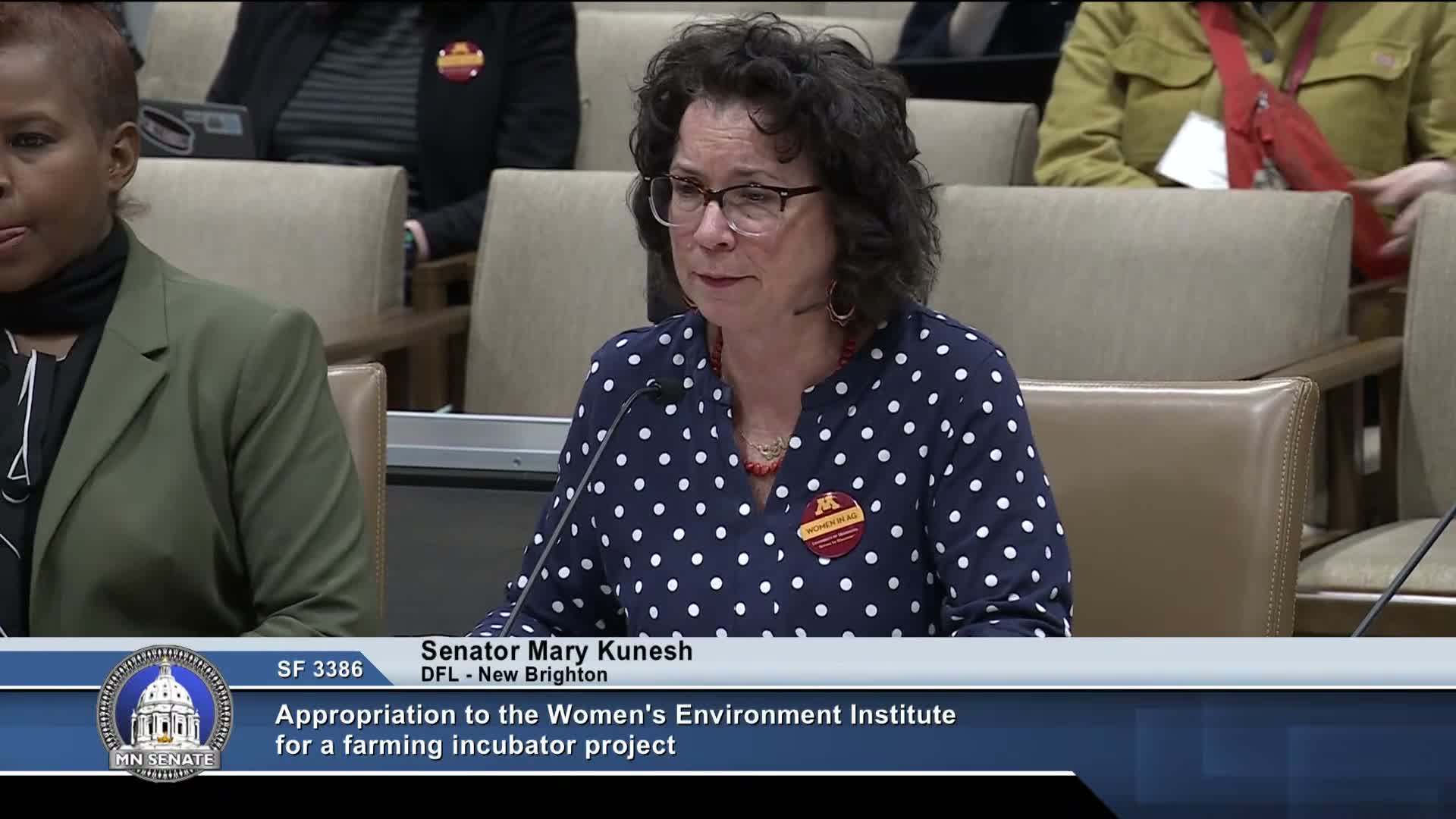
Members of the Minnesota Senate Committee on Agriculture began their March 18 hearing with a Women in Agriculture program featuring University of Minnesota Extension educators, multi‑generation farmers and tribal producers, then turned to a funding bill for a farming incubator.
Suzanne Henricks, an extension educator with the University of Minnesota Extension, described Extension’s statewide agricultural business management work and the Extension Women in Agriculture network; she noted roughly 35,000 of Minnesota’s roughly 110,000 farmers are women and highlighted training on business succession and land‑rental negotiations. "We also lead the extension women in agriculture network," she said, urging the committee to consult the packet materials.
Farmers who testified included Hillary Pablo of Graff feedlots, who described a multi‑generation feedlot and the operation’s use of cloud‑based feed and animal‑health monitoring systems, and Aubrey Pablo, a high‑school senior and Minnesota state beef ambassador, who recounted 4‑H and FFA experiences and plans to study agricultural communications. Elizabeth Golubeky Anderson, a dairy farmer near Morris, credited MDA programs such as the Minnesota Dairy Initiative and Livestock Investment grants with helping her expand and plan for water‑quality and barn upgrades. "The rural broadband in our area was actually one of the first telephone cooperatives to get fiber optic cable to every premise," she told senators, noting the technology's value.
Sherilyn Spears of the Red Lake Nation described work funded by an RFSI (rural food systems infrastructure) grant and an American Indian Food Sovereignty grant to build a commercial kitchen, distribute fresh produce and develop a buffalo processing facility and refrigerated trucks for tribal food distribution. Spears thanked the committee for grant support but cautioned that reporting and match requirements can be burdensome for small communities.
After the panel, the committee took up Senate File 3386, a bill to appropriate funds for the Women’s Environmental Institute (WEI) to expand a farming incubator that provides affordable land access, training, equipment and direct grants to incubator farmers. Senator Kunish offered the A1 amendment (technical updates and insertion of the funding request), which the committee adopted. Karen Clark, WEI’s executive director, told the committee WEI has been unable to access certain Department of Agriculture RFP grants because of restrictive definitions that exclude culturally important specialty crops or small‑scale enterprises; the appropriation would allow direct grants to incubator farmers for land rental, seeds, compost, irrigation, marketing and other production costs.
Incubator farmer Farhi Al Khalif, who testified in support, called the program an essential pathway for immigrant, Black and Indigenous beginning farmers who otherwise lack affordable access to land and equipment. "This support will give us the opportunity to continue farming," she said, urging committee support for SF3386.
Members pressed for details about eligibility, distribution methods and whether the funds should be awarded via an RFP or as a direct appropriation to WEI. Karen Clark said that some federally funded programs impose crop‑type or income thresholds that have left some incubator farmers ineligible; the appropriation and the bill’s definitions are intended to preserve culturally relevant crops and extend incubator participation beyond a three‑year limit.
The committee laid SF3386, as amended, over for possible inclusion. The chair said budget details and a program budget could be shared with members if the committee pursues funding.
Next steps: SF3386 was laid over; proponents said they would provide more budget detail and administrative clarifications if the committee requests them.
Suzanne Henricks, an extension educator with the University of Minnesota Extension, described Extension’s statewide agricultural business management work and the Extension Women in Agriculture network; she noted roughly 35,000 of Minnesota’s roughly 110,000 farmers are women and highlighted training on business succession and land‑rental negotiations. "We also lead the extension women in agriculture network," she said, urging the committee to consult the packet materials.
Farmers who testified included Hillary Pablo of Graff feedlots, who described a multi‑generation feedlot and the operation’s use of cloud‑based feed and animal‑health monitoring systems, and Aubrey Pablo, a high‑school senior and Minnesota state beef ambassador, who recounted 4‑H and FFA experiences and plans to study agricultural communications. Elizabeth Golubeky Anderson, a dairy farmer near Morris, credited MDA programs such as the Minnesota Dairy Initiative and Livestock Investment grants with helping her expand and plan for water‑quality and barn upgrades. "The rural broadband in our area was actually one of the first telephone cooperatives to get fiber optic cable to every premise," she told senators, noting the technology's value.
Sherilyn Spears of the Red Lake Nation described work funded by an RFSI (rural food systems infrastructure) grant and an American Indian Food Sovereignty grant to build a commercial kitchen, distribute fresh produce and develop a buffalo processing facility and refrigerated trucks for tribal food distribution. Spears thanked the committee for grant support but cautioned that reporting and match requirements can be burdensome for small communities.
After the panel, the committee took up Senate File 3386, a bill to appropriate funds for the Women’s Environmental Institute (WEI) to expand a farming incubator that provides affordable land access, training, equipment and direct grants to incubator farmers. Senator Kunish offered the A1 amendment (technical updates and insertion of the funding request), which the committee adopted. Karen Clark, WEI’s executive director, told the committee WEI has been unable to access certain Department of Agriculture RFP grants because of restrictive definitions that exclude culturally important specialty crops or small‑scale enterprises; the appropriation would allow direct grants to incubator farmers for land rental, seeds, compost, irrigation, marketing and other production costs.
Incubator farmer Farhi Al Khalif, who testified in support, called the program an essential pathway for immigrant, Black and Indigenous beginning farmers who otherwise lack affordable access to land and equipment. "This support will give us the opportunity to continue farming," she said, urging committee support for SF3386.
Members pressed for details about eligibility, distribution methods and whether the funds should be awarded via an RFP or as a direct appropriation to WEI. Karen Clark said that some federally funded programs impose crop‑type or income thresholds that have left some incubator farmers ineligible; the appropriation and the bill’s definitions are intended to preserve culturally relevant crops and extend incubator participation beyond a three‑year limit.
The committee laid SF3386, as amended, over for possible inclusion. The chair said budget details and a program budget could be shared with members if the committee pursues funding.
Next steps: SF3386 was laid over; proponents said they would provide more budget detail and administrative clarifications if the committee requests them.
View the Full Meeting & All Its Details
This article offers just a summary. Unlock complete video, transcripts, and insights as a Founder Member.
✓
Watch full, unedited meeting videos
✓
Search every word spoken in unlimited transcripts
✓
AI summaries & real-time alerts (all government levels)
✓
Permanent access to expanding government content
30-day money-back guarantee
