ALPR privacy bill tied 7‑7 in committee after sharp split between privacy advocates and police
March 17, 2026 | 2026 Legislature MN, Minnesota
This article was created by AI summarizing key points discussed. AI makes mistakes, so for full details and context, please refer to the video of the full meeting. Please report any errors so we can fix them. Report an error »
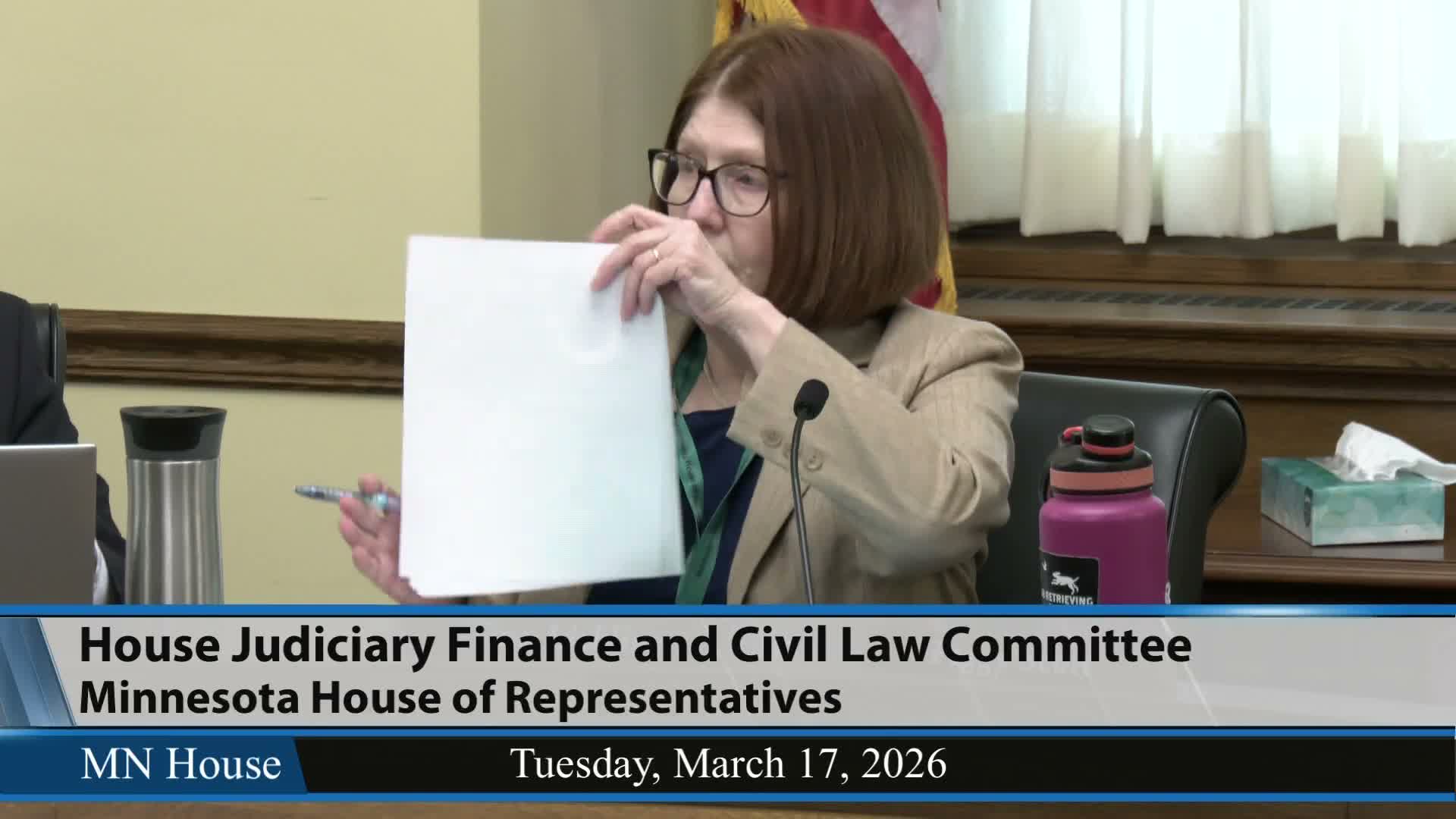
Representative Tabke introduced House File 4205 as a data‑privacy bill aimed at limiting broad access to automatic license‑plate reader (ALPR) data and increasing public reporting and vendor accountability. She told the committee the proposal would, among other changes, require out‑of‑state requests for data to be supported by a warrant and tighten how private vendors may store and share ALPR data.
John Bealer, policy counsel for the ACLU of Minnesota, testified in support and said technological changes since the statute’s 2015 enactment have expanded access and outsourcing to private vendors. "The data collected by our local law enforcement ALPRs is stored in servers managed by these companies," Bealer said, and those firms now "grant themselves relatively broad contractual exemptions" that obscure data‑practice obligations. He told members his office found large disparities in search volumes across agencies, including one agency that reported roughly 425,000 searches in a multiweek period.
Jeff Potts, executive director of the Minnesota Chiefs of Police Association, urged caution and opposed the bill as written. Potts recounted a case in January in which ALPR data helped locate an abducted child and said the technology has demonstrable public‑safety benefits: "ALPR was a critical component in that investigation." Potts said the bill’s requirement for annual audits (estimated at about $2,500 each) would be costly for many small departments and could force them to discontinue ALPR use.
Members questioned technical details about what data an ALPR query returns. Representative Duran pressed whether plate‑reader queries immediately return home addresses and other private information or only registration data; Representative Tabke and witnesses explained that some queries return public registration details while other combined queries can lead to private identifying information when matched with other systems.
Committee debate showed cross‑cutting concerns: privacy advocates and some members urged stronger transparency and limits on national searches and vendor practices, while law‑enforcement representatives and other lawmakers warned the bill’s compliance costs and broad vendor obligations risked impeding investigations.
Clerk roll call recorded seven ayes and seven nays on the motion to re‑refer HF4205 as amended. Recorded ayes were Chair Liebling, Vice Chair Finke, Representative Curran, Representative Feist, Representative Frazier, Representative Mahamud and Representative Mueller. Recorded nays were Chair Scott, Vice Chair Hudson, Representative Bliss, Representative Duran, Representative Engin, Representative Steer and Representative Ben Vinsbergen. With the 7–7 tie the motion did not prevail and HF4205 did not advance out of committee.
The dispute leaves the substantive policy questions unresolved: supporters said the state must update statutory protections to reflect private vendor involvement and national search tools; opponents said the bill as drafted imposes costs and could constrain legitimate investigative uses. Members and the author signaled willingness to continue discussions if the bill were to be refiled or reintroduced through other committee channels.
John Bealer, policy counsel for the ACLU of Minnesota, testified in support and said technological changes since the statute’s 2015 enactment have expanded access and outsourcing to private vendors. "The data collected by our local law enforcement ALPRs is stored in servers managed by these companies," Bealer said, and those firms now "grant themselves relatively broad contractual exemptions" that obscure data‑practice obligations. He told members his office found large disparities in search volumes across agencies, including one agency that reported roughly 425,000 searches in a multiweek period.
Jeff Potts, executive director of the Minnesota Chiefs of Police Association, urged caution and opposed the bill as written. Potts recounted a case in January in which ALPR data helped locate an abducted child and said the technology has demonstrable public‑safety benefits: "ALPR was a critical component in that investigation." Potts said the bill’s requirement for annual audits (estimated at about $2,500 each) would be costly for many small departments and could force them to discontinue ALPR use.
Members questioned technical details about what data an ALPR query returns. Representative Duran pressed whether plate‑reader queries immediately return home addresses and other private information or only registration data; Representative Tabke and witnesses explained that some queries return public registration details while other combined queries can lead to private identifying information when matched with other systems.
Committee debate showed cross‑cutting concerns: privacy advocates and some members urged stronger transparency and limits on national searches and vendor practices, while law‑enforcement representatives and other lawmakers warned the bill’s compliance costs and broad vendor obligations risked impeding investigations.
Clerk roll call recorded seven ayes and seven nays on the motion to re‑refer HF4205 as amended. Recorded ayes were Chair Liebling, Vice Chair Finke, Representative Curran, Representative Feist, Representative Frazier, Representative Mahamud and Representative Mueller. Recorded nays were Chair Scott, Vice Chair Hudson, Representative Bliss, Representative Duran, Representative Engin, Representative Steer and Representative Ben Vinsbergen. With the 7–7 tie the motion did not prevail and HF4205 did not advance out of committee.
The dispute leaves the substantive policy questions unresolved: supporters said the state must update statutory protections to reflect private vendor involvement and national search tools; opponents said the bill as drafted imposes costs and could constrain legitimate investigative uses. Members and the author signaled willingness to continue discussions if the bill were to be refiled or reintroduced through other committee channels.
Don't Miss a Word: See the Full Meeting!
Go beyond summaries. Unlock every video, transcript, and key insight with a Founder Membership.
✓
Get instant access to full meeting videos
✓
Search and clip any phrase from complete transcripts
✓
Receive AI-powered summaries & custom alerts
✓
Enjoy lifetime, unrestricted access to government data
30-day money-back guarantee
