Committee advances bill limiting addictive social‑media features for minors after broad testimony
March 17, 2026 | 2026 Legislature MN, Minnesota
This article was created by AI summarizing key points discussed. AI makes mistakes, so for full details and context, please refer to the video of the full meeting. Please report any errors so we can fix them. Report an error »
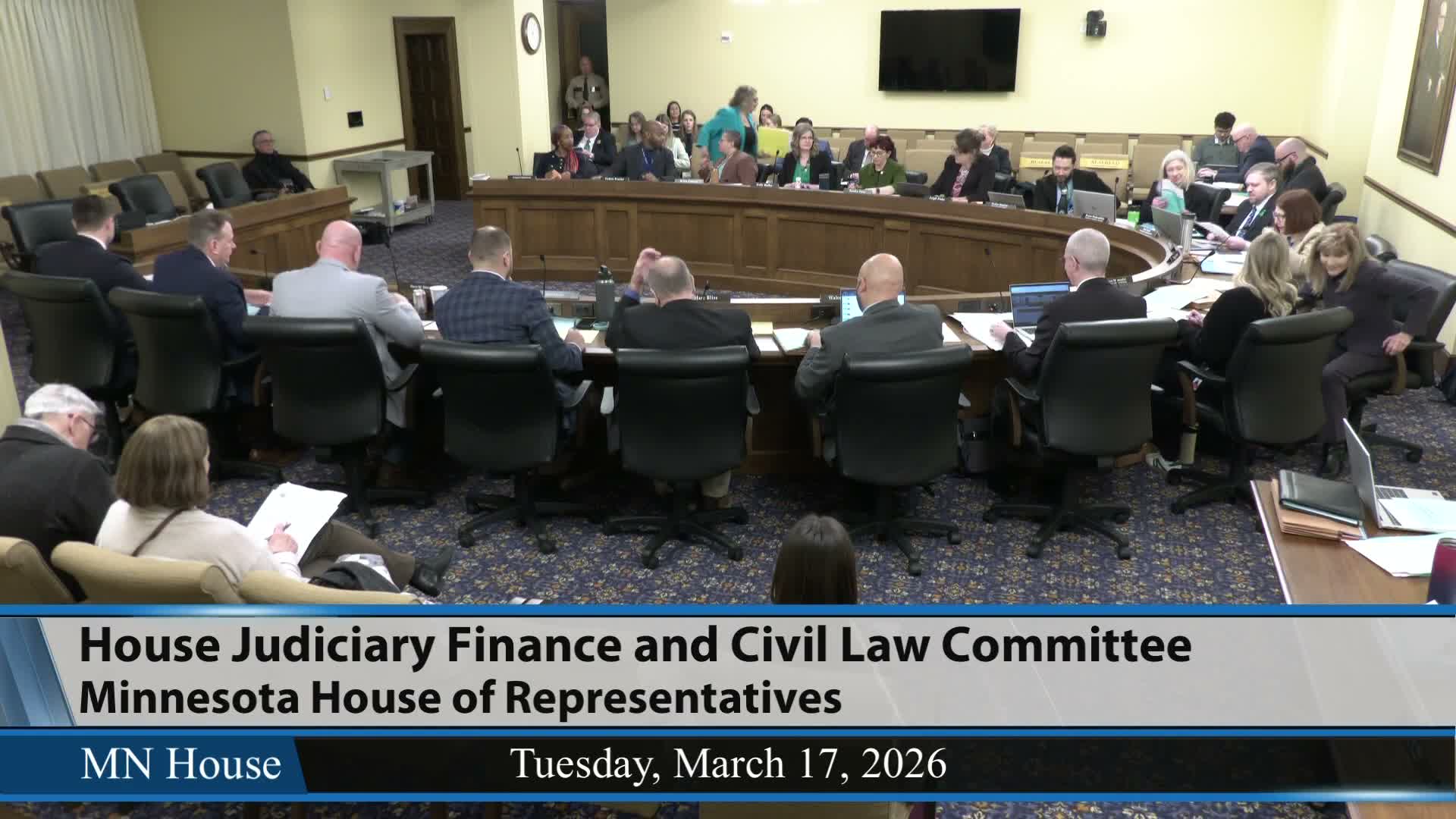
Chair Scott framed House File 4138 as a twofold consumer‑protection measure: require large platforms to estimate age and, where parental consent is given, provide a different, less‑addictive experience for youth accounts (no targeted commercial ads, and no infinite scroll or autoplay features). She opened the hearing by citing statistics on teen social‑media use and arguing Minnesota should require platforms to design more protective experiences for children.
Supporters included faith‑based groups, parents and students. Maggie Haney of the Minnesota Catholic Conference said the bill would "ensure a safer digital environment for kids," arguing platforms are designed to be addictive and that parental controls alone are insufficient. Parent Jerry Cox and his daughter Gianna described personal experiences with early, unmonitored accounts; Gianna said unrestricted access can lead to "screen addiction, self comparison and depression." High‑school students testifying in support said social media shortens attention spans and harms self‑worth.
Industry witnesses urged caution. Megan Stokes (Computer & Communications Industry Association) and Nathan Traud (Information Technology Industry Council) said the bill’s definitions ("primary purpose," "addictive features") are vague and could create patchwork coverage across services. Amy Boss of NetChoice warned the bill’s age‑estimation and parental‑consent mechanics could force platforms into intrusive verification systems and raised First Amendment and safety concerns: "The only way to meet these thresholds... would be a digital ID system for every Minnesota user," she said, arguing that requirement would create privacy and constitutional risks.
Committee members expressed strong concern for youth mental health and diverged on remedies. Several members urged continued work and technical fixes (including using existing statutory definitions and clarifying age‑estimation standards). Chair Scott agreed to adjust statutory references and noted staff would correct minor drafting issues in the committee report.
After discussion and a small oral amendment to wording, the committee voted by voice to re‑refer HF4138 as amended to the Commerce Finance and Policy Committee. Members said they expect additional drafting and constitutional review in future committee stages.
Next steps: HF4138 moves to the Commerce committee, where members said they will review definitions, age‑assurance mechanics, privacy tradeoffs and potential constitutional implications before any final action.
Supporters included faith‑based groups, parents and students. Maggie Haney of the Minnesota Catholic Conference said the bill would "ensure a safer digital environment for kids," arguing platforms are designed to be addictive and that parental controls alone are insufficient. Parent Jerry Cox and his daughter Gianna described personal experiences with early, unmonitored accounts; Gianna said unrestricted access can lead to "screen addiction, self comparison and depression." High‑school students testifying in support said social media shortens attention spans and harms self‑worth.
Industry witnesses urged caution. Megan Stokes (Computer & Communications Industry Association) and Nathan Traud (Information Technology Industry Council) said the bill’s definitions ("primary purpose," "addictive features") are vague and could create patchwork coverage across services. Amy Boss of NetChoice warned the bill’s age‑estimation and parental‑consent mechanics could force platforms into intrusive verification systems and raised First Amendment and safety concerns: "The only way to meet these thresholds... would be a digital ID system for every Minnesota user," she said, arguing that requirement would create privacy and constitutional risks.
Committee members expressed strong concern for youth mental health and diverged on remedies. Several members urged continued work and technical fixes (including using existing statutory definitions and clarifying age‑estimation standards). Chair Scott agreed to adjust statutory references and noted staff would correct minor drafting issues in the committee report.
After discussion and a small oral amendment to wording, the committee voted by voice to re‑refer HF4138 as amended to the Commerce Finance and Policy Committee. Members said they expect additional drafting and constitutional review in future committee stages.
Next steps: HF4138 moves to the Commerce committee, where members said they will review definitions, age‑assurance mechanics, privacy tradeoffs and potential constitutional implications before any final action.
Don't Miss a Word: See the Full Meeting!
Go beyond summaries. Unlock every video, transcript, and key insight with a Founder Membership.
✓
Get instant access to full meeting videos
✓
Search and clip any phrase from complete transcripts
✓
Receive AI-powered summaries & custom alerts
✓
Enjoy lifetime, unrestricted access to government data
30-day money-back guarantee
