Experts warn of growing urban wood‑waste crisis as emerald ash borer spreads
March 19, 2026 | 2026 Legislature MN, Minnesota
This article was created by AI summarizing key points discussed. AI makes mistakes, so for full details and context, please refer to the video of the full meeting. Please report any errors so we can fix them. Report an error »
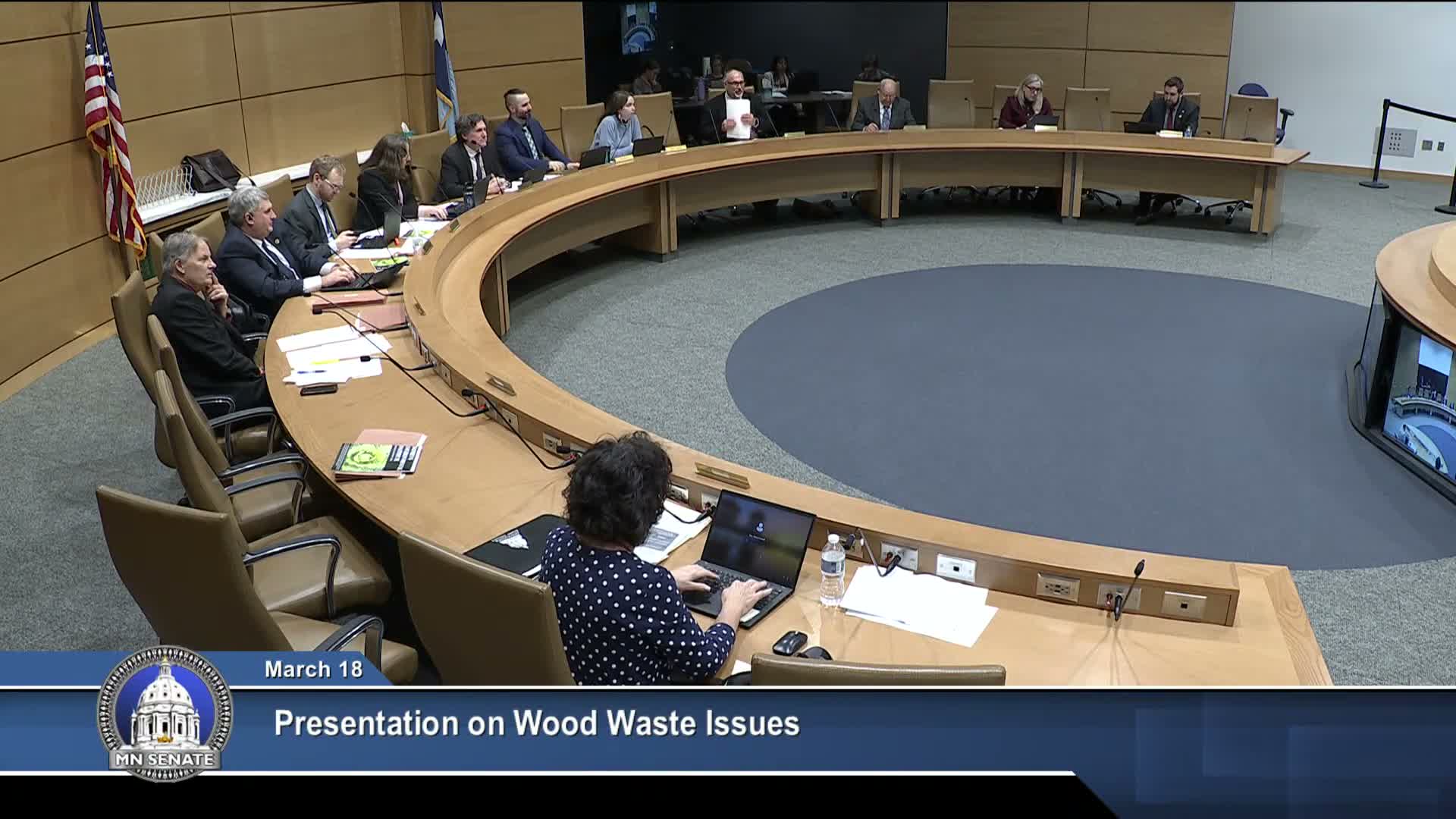
An informational segment late in the March 18 hearing focused on mounting wood waste from emerald ash borer (EAB) and the limits of current processing infrastructure.
Greg Crockstead, CEO of Rainbow Tree Care, said markets and processing capacity have not kept pace with the surge in urban tree removals and described rising costs and uncertainty about dump‑site capacity. "Every day, we don't know if a dump site will close because they're filled or when they'll open," he said, warning that inability to empty trucks could halt work.
Rick Hogan of Davey Tree described the scale in volumetric terms—millions of cubic yards across operators—and called for state investment in regional processing, data collection and incentives for biomass utilization. Karen Zumach, chair of the Minnesota Shade Tree Advisory Committee, said EAB has been found in 59 of 87 counties and described ash as roughly 20% of planted urban trees; she urged the state to prioritize "highest best use" of wood (lumber, engineered wood products, biochar) rather than uncontrolled burning or unregulated disposal.
Witnesses discussed near‑term disposal options, including mulching, compost, biochar and waste‑to‑energy, and said the Saint Paul cogen plant currently serves as a major outlet; they cautioned that loss of that facility would dramatically increase market stress. Committee members asked about short‑term mitigation and long‑term frameworks; testifiers recommended a mix of regional processing infrastructure investment, better statewide data, incentives for high‑value reuse and temporary outlets to avoid illegal dumping.
The committee did not take action but thanked witnesses for an educational briefing.
Greg Crockstead, CEO of Rainbow Tree Care, said markets and processing capacity have not kept pace with the surge in urban tree removals and described rising costs and uncertainty about dump‑site capacity. "Every day, we don't know if a dump site will close because they're filled or when they'll open," he said, warning that inability to empty trucks could halt work.
Rick Hogan of Davey Tree described the scale in volumetric terms—millions of cubic yards across operators—and called for state investment in regional processing, data collection and incentives for biomass utilization. Karen Zumach, chair of the Minnesota Shade Tree Advisory Committee, said EAB has been found in 59 of 87 counties and described ash as roughly 20% of planted urban trees; she urged the state to prioritize "highest best use" of wood (lumber, engineered wood products, biochar) rather than uncontrolled burning or unregulated disposal.
Witnesses discussed near‑term disposal options, including mulching, compost, biochar and waste‑to‑energy, and said the Saint Paul cogen plant currently serves as a major outlet; they cautioned that loss of that facility would dramatically increase market stress. Committee members asked about short‑term mitigation and long‑term frameworks; testifiers recommended a mix of regional processing infrastructure investment, better statewide data, incentives for high‑value reuse and temporary outlets to avoid illegal dumping.
The committee did not take action but thanked witnesses for an educational briefing.
Don't Miss a Word: See the Full Meeting!
Go beyond summaries. Unlock every video, transcript, and key insight with a Founder Membership.
✓
Get instant access to full meeting videos
✓
Search and clip any phrase from complete transcripts
✓
Receive AI-powered summaries & custom alerts
✓
Enjoy lifetime, unrestricted access to government data
30-day money-back guarantee
