City staff outlines how House Bill 1001 changes local planning and impact fees
March 17, 2026 | Fishers City, Hamilton County, Indiana
This article was created by AI summarizing key points discussed. AI makes mistakes, so for full details and context, please refer to the video of the full meeting. Please report any errors so we can fix them. Report an error »
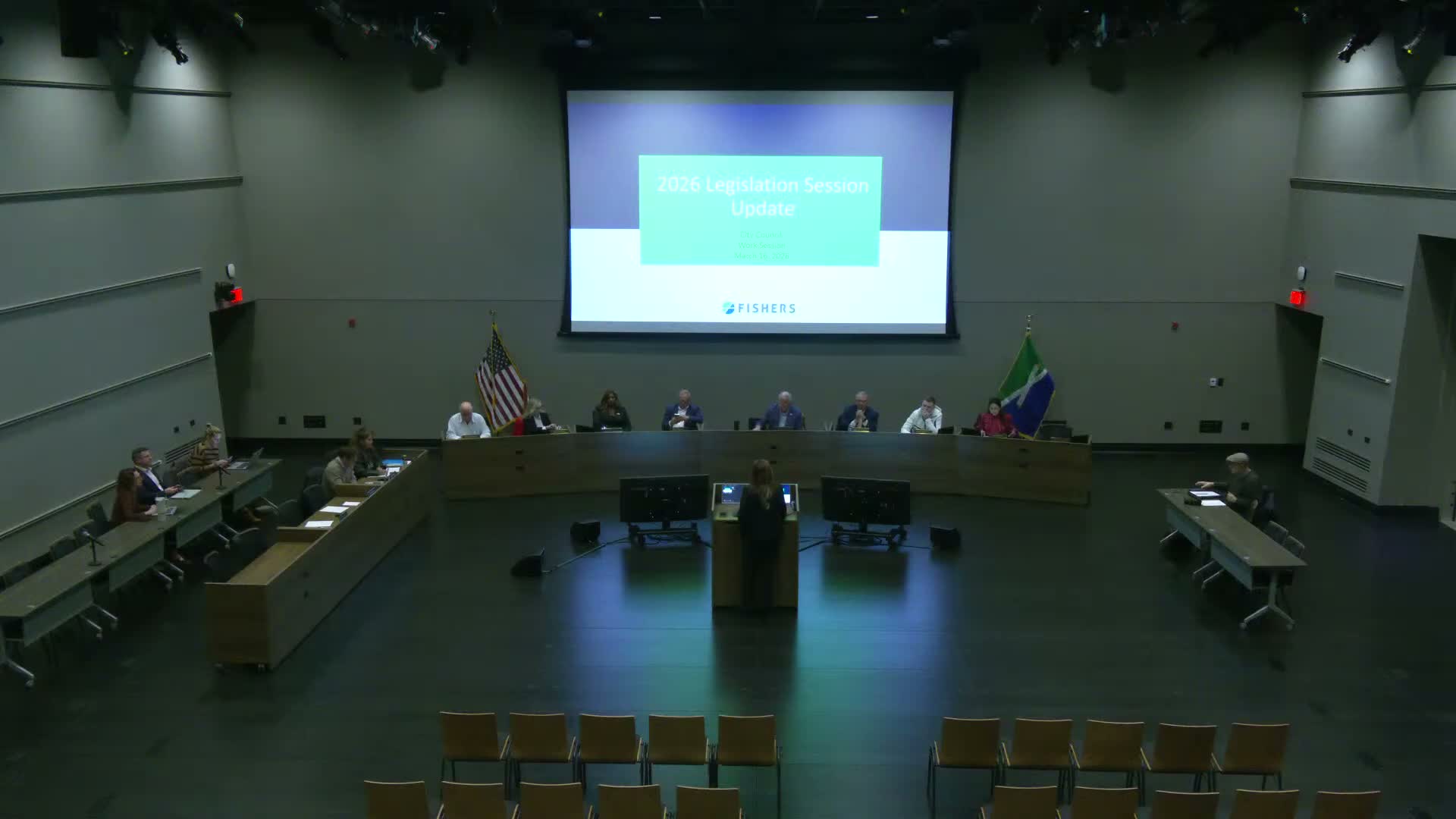
City staff presented a detailed readout of House Bill 1001 and its local implications, telling the Fishers City Council that while the introduced bill had threatened broad preemption of local planning authority, the adopted version now focuses on prescriptive UDO guidance and new impact‑fee procedures.
The presenter said the new law requires cities that wish to impose impact fees after June 30 to create impact‑fee zones that are contiguous, coterminous with utility service where appropriate and show a functional relationship between infrastructure type and zone. "The road and drainage impact fees have to be used within 5 miles of wherever that fee is collected," the presenter said, emphasizing the mileage limit on eligible spending.
The city was also told to complete a UDO review by Jan. 1, 2027 and to submit two annual reports to the Indiana Housing and Community Development Authority and legislative staff describing housing approvals and denials, and local rental and home‑price trends. Staff said the statute also limits building and permit fees to amounts reasonably necessary to cover processing, inspection and plan review costs and restricts fee increases adopted before 01/01/2027 to no more than once every five years unless changed after a public hearing.
Council members pressed staff about how the bill would affect existing review bodies. The presenter said planning commission and the board of zoning appeals remain necessary for rezones, variances and projects that do not fit neatly within base zoning, and that PUDs will continue to function under the city’s standards. A council member flagged scattered unannexed or lower‑zoned parcels he described as "Swiss cheese holes" and asked staff to analyze which parcels might be vulnerable; staff agreed to perform that analysis.
Council members also raised concerns that restricting road and drainage impact‑fee expenditures to a five‑mile zone could prevent the city from using fees to fund systemwide or cross‑city projects. "You're going to put a burden on every road we have in the city if we add more people," one council member said, noting the wastewater plant and other infrastructure may sit outside the five‑mile limit for many developments. Staff said they will analyze the geographic and fiscal effects and incorporate any needed changes into the upcoming UDO update.
The presenter also noted several permissive items in earlier drafts—such as broad ADU allowances and more expansive by‑right provisions—were removed from the adopted version. "Before, ADUs were allowed by right. All of that is gone now," another participant observed. Staff described the adopted bill as an ongoing topic at the Statehouse and said they expect additional legislative discussion and possible study committees next session.
The council asked staff to return with mapping and parcel‑level analysis and to reflect any required changes in the UDO update scheduled for council consideration.
The presenter said the new law requires cities that wish to impose impact fees after June 30 to create impact‑fee zones that are contiguous, coterminous with utility service where appropriate and show a functional relationship between infrastructure type and zone. "The road and drainage impact fees have to be used within 5 miles of wherever that fee is collected," the presenter said, emphasizing the mileage limit on eligible spending.
The city was also told to complete a UDO review by Jan. 1, 2027 and to submit two annual reports to the Indiana Housing and Community Development Authority and legislative staff describing housing approvals and denials, and local rental and home‑price trends. Staff said the statute also limits building and permit fees to amounts reasonably necessary to cover processing, inspection and plan review costs and restricts fee increases adopted before 01/01/2027 to no more than once every five years unless changed after a public hearing.
Council members pressed staff about how the bill would affect existing review bodies. The presenter said planning commission and the board of zoning appeals remain necessary for rezones, variances and projects that do not fit neatly within base zoning, and that PUDs will continue to function under the city’s standards. A council member flagged scattered unannexed or lower‑zoned parcels he described as "Swiss cheese holes" and asked staff to analyze which parcels might be vulnerable; staff agreed to perform that analysis.
Council members also raised concerns that restricting road and drainage impact‑fee expenditures to a five‑mile zone could prevent the city from using fees to fund systemwide or cross‑city projects. "You're going to put a burden on every road we have in the city if we add more people," one council member said, noting the wastewater plant and other infrastructure may sit outside the five‑mile limit for many developments. Staff said they will analyze the geographic and fiscal effects and incorporate any needed changes into the upcoming UDO update.
The presenter also noted several permissive items in earlier drafts—such as broad ADU allowances and more expansive by‑right provisions—were removed from the adopted version. "Before, ADUs were allowed by right. All of that is gone now," another participant observed. Staff described the adopted bill as an ongoing topic at the Statehouse and said they expect additional legislative discussion and possible study committees next session.
The council asked staff to return with mapping and parcel‑level analysis and to reflect any required changes in the UDO update scheduled for council consideration.
View the Full Meeting & All Its Details
This article offers just a summary. Unlock complete video, transcripts, and insights as a Founder Member.
✓
Watch full, unedited meeting videos
✓
Search every word spoken in unlimited transcripts
✓
AI summaries & real-time alerts (all government levels)
✓
Permanent access to expanding government content
30-day money-back guarantee
