Votes at a glance: Terre Haute council adopts ordinances on fire code, fireworks, city legal staffing and two resolutions
March 13, 2026 | Terre Haute City, Vigo County, Indiana
This article was created by AI summarizing key points discussed. AI makes mistakes, so for full details and context, please refer to the video of the full meeting. Please report any errors so we can fix them. Report an error »
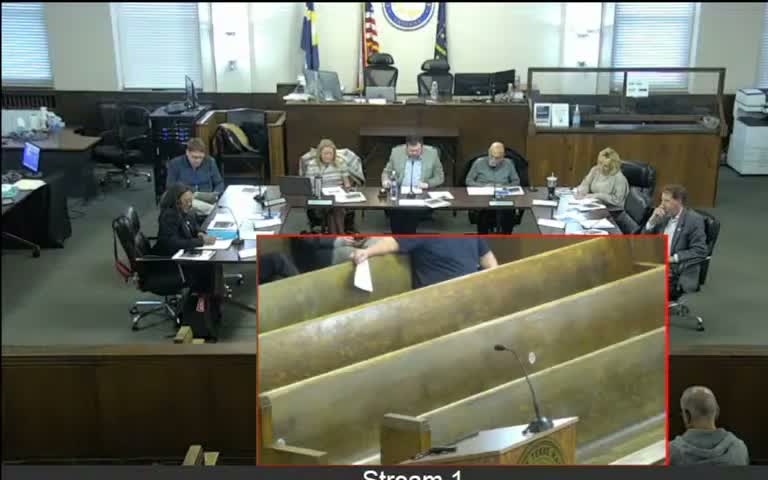
At its March 12 meeting the Terre Haute City Council approved several ordinances and resolutions. Below are the actions taken and key details as recorded on the public record.
General Ordinance 02/2026 — fire prevention code (amendment and adoption)
Council considered a proposed correction to a previously introduced fire prevention amendment after Deputy Chief Bob Malone noted a drafting error: a building-size threshold should read 5,000 square feet, not 50,000. Councilperson Nation moved to amend; Councilperson Loudermilk seconded. The council approved the amendment and then approved the ordinance as amended. (Motion and voice vote; recorded on the public record as passed.)
General Ordinance 04/2026 — fireworks regulation (amendment and adoption)
Deputy Chief Malone outlined permissible dates and hours for consumer fireworks and said permit exceptions can be made for special events. Council debated statutory alignment with state code and moved to add July 6 to the list of allowable dates. The amendment passed and the amended ordinance was approved by voice vote.
Special Ordinance 2/2026 — city hall salaries (legal officer position)
City Attorney Michael Wright presented a request to amend the salary ordinance to create a legal officer position to support the engineering department and ordinance-court workload. Council discussed increased ordinance court dates and departmental needs, then voted to approve the special ordinance.
Resolution 5/2026 — transfer of $30,000 in engineering nonreverting budget
City Attorney Michael Wright and City Engineer Marcus Maurer explained that the department had set aside funds in a nonreverting budget to support legal services; council moved and adopted Resolution 5/2026 to transfer $30,000 for staffing purposes.
Resolution 6/2026 — adopt Safe Streets Terre Haute safety action plan
The council adopted Resolution 6/2026 to approve the Safe Streets action plan developed with Lochmuller Group and funded by USDOT. The plan establishes a Vision Zero-style goal and a toolkit for prioritized safety improvements; staff said implementation will proceed via separate project-level actions.
Voting format and record
Votes on these items were taken by voice; the meeting transcript records motions, seconders and that motions passed, but no roll-call tally of yes/no votes by member name was included in the public transcript. Where a mover or seconder was named in the record, that information is listed above.
What’s next
Most of these approvals were procedural or planning actions; separate capital or budget approvals will be required to implement Safe Streets projects or to fund ongoing programs. The Neighborhood Investment Fund presentation and discussions about warming-center funding will return to staff for follow-up and refinement.
General Ordinance 02/2026 — fire prevention code (amendment and adoption)
Council considered a proposed correction to a previously introduced fire prevention amendment after Deputy Chief Bob Malone noted a drafting error: a building-size threshold should read 5,000 square feet, not 50,000. Councilperson Nation moved to amend; Councilperson Loudermilk seconded. The council approved the amendment and then approved the ordinance as amended. (Motion and voice vote; recorded on the public record as passed.)
General Ordinance 04/2026 — fireworks regulation (amendment and adoption)
Deputy Chief Malone outlined permissible dates and hours for consumer fireworks and said permit exceptions can be made for special events. Council debated statutory alignment with state code and moved to add July 6 to the list of allowable dates. The amendment passed and the amended ordinance was approved by voice vote.
Special Ordinance 2/2026 — city hall salaries (legal officer position)
City Attorney Michael Wright presented a request to amend the salary ordinance to create a legal officer position to support the engineering department and ordinance-court workload. Council discussed increased ordinance court dates and departmental needs, then voted to approve the special ordinance.
Resolution 5/2026 — transfer of $30,000 in engineering nonreverting budget
City Attorney Michael Wright and City Engineer Marcus Maurer explained that the department had set aside funds in a nonreverting budget to support legal services; council moved and adopted Resolution 5/2026 to transfer $30,000 for staffing purposes.
Resolution 6/2026 — adopt Safe Streets Terre Haute safety action plan
The council adopted Resolution 6/2026 to approve the Safe Streets action plan developed with Lochmuller Group and funded by USDOT. The plan establishes a Vision Zero-style goal and a toolkit for prioritized safety improvements; staff said implementation will proceed via separate project-level actions.
Voting format and record
Votes on these items were taken by voice; the meeting transcript records motions, seconders and that motions passed, but no roll-call tally of yes/no votes by member name was included in the public transcript. Where a mover or seconder was named in the record, that information is listed above.
What’s next
Most of these approvals were procedural or planning actions; separate capital or budget approvals will be required to implement Safe Streets projects or to fund ongoing programs. The Neighborhood Investment Fund presentation and discussions about warming-center funding will return to staff for follow-up and refinement.
View the Full Meeting & All Its Details
This article offers just a summary. Unlock complete video, transcripts, and insights as a Founder Member.
✓
Watch full, unedited meeting videos
✓
Search every word spoken in unlimited transcripts
✓
AI summaries & real-time alerts (all government levels)
✓
Permanent access to expanding government content
30-day money-back guarantee
