Committee advances major school‑funding rewrite with three‑year hold‑harmless amendment
March 20, 2026 | 2026 Legislature ME, Maine
This article was created by AI summarizing key points discussed. AI makes mistakes, so for full details and context, please refer to the video of the full meeting. Please report any errors so we can fix them. Report an error »
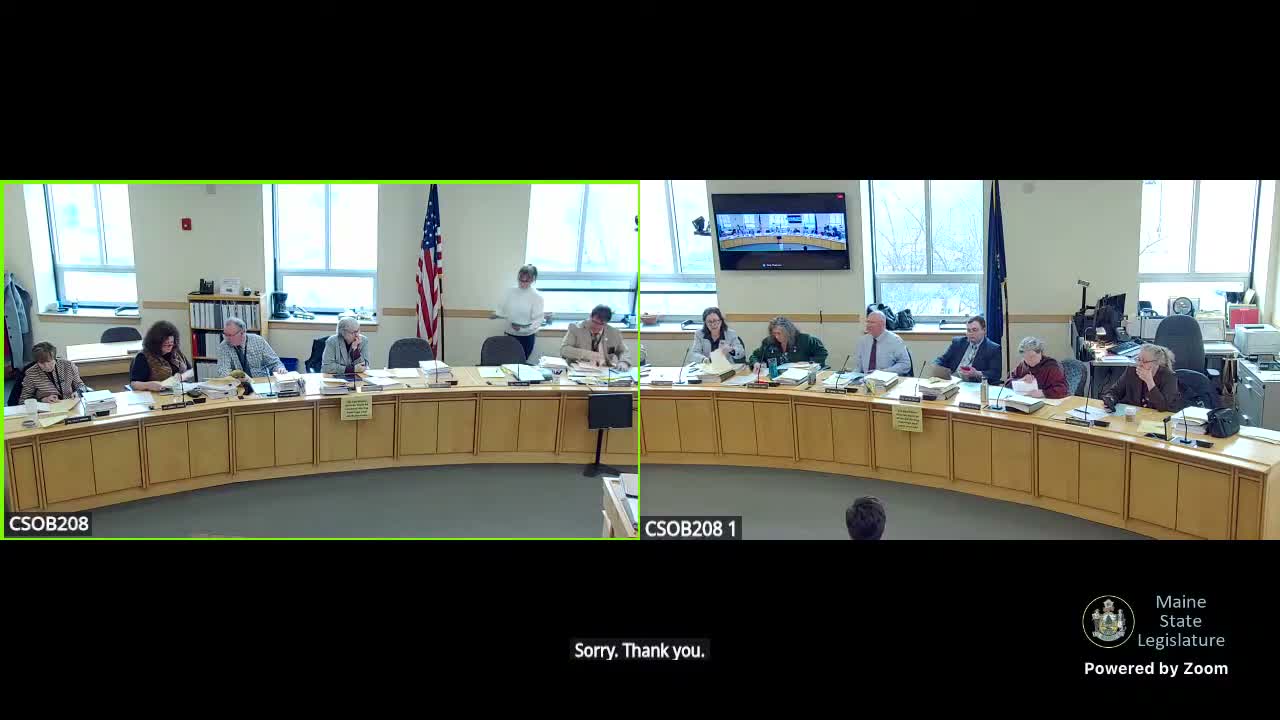
The Joint Standing Committee on Education reviewed LD 22‑26 on March 23, a committee bill that would reshape how Maine calculates state school aid, and approved an amendment to delay harmful budget impacts on districts while the new metrics are phased in.
Rep. Kelly Murphy moved an amendment to implement labor‑market adjustments and a 90/10 poverty‑indicator scenario beginning in fiscal 2028 but to hold every district harmless through FY2030 and phase in actual calculations thereafter. Murphy said the three‑year hold‑harmless and caps—no district subsidy reduced by more than 25% in the first phase year and no more than 50% in the next—give the Legislature time to refine modeling and allow the taxation committee to pursue property‑tax relief work.
"That would allow time for the new formula to play out… and give time, if necessary, for the 130th and 131st legislatures to make refinements based on additional modeling," Murphy said during the work session.
Why it matters: LD 22‑26 would alter several core EPS formula components. Staff described proposals to (a) redefine predicted transportation costs using a pupil‑density, per‑mile model; (b) introduce a variable weight for economically disadvantaged students, increasing the weight from 0.15 up to 0.35 based on an index developed by MEPRI; (c) change the regional adjustment metric to a nationwide cost‑of‑living index aligned with the teacher salary matrix; and (d) add a poverty indicator into local ability‑to‑pay calculations. The combination aims to make state aid more responsive to labor markets and student needs but raises distributional and compliance questions about special‑education funding.
MEPRI’s view and staff cautions: Amy Johnson of the Maine Education Policy Research Institute told the committee the reindexing and the set of changes (called SIM‑2 in staff materials) are “an excellent start” and are functionally separable from the special‑education proposals that still warrant additional study. Staff repeatedly flagged drafting details—such as the fiscal year when new metrics begin (staff recommended explicit transitional language to avoid gaps) and whether the poverty indicator’s weight should be specified in statute or set by rule.
Key numbers and specifics cited in the session: staff noted the variable poverty weight would range from 0.15 to 0.35; the committee asked MEPRI and DOE to model phased reductions so no district faces more than a 25% subsidy cut in the first year of phase‑in and 50% in the subsequent year; staff recommended the new cost‑sharing formula apply only to projects submitted on or after 07/01/2027; and members discussed setting a Jan. 2027 due date for working‑group reports rather than November 2026.
Next steps: The committee approved Murphy’s amendment in a recorded voice/bulk vote described by the chair as unanimous of those present. Members asked staff and MEPRI for scenario modeling to define the hold‑harmless baseline precisely (the chair and staff clarified the hold‑harmless covers the state share impacts tied to the regional/local market adjustments and the 90/10 poverty indicator package). Further hearings and technical drafting (revise‑office review, rulemaking questions) were anticipated before final committee action.
The committee adjourned after the vote.
Rep. Kelly Murphy moved an amendment to implement labor‑market adjustments and a 90/10 poverty‑indicator scenario beginning in fiscal 2028 but to hold every district harmless through FY2030 and phase in actual calculations thereafter. Murphy said the three‑year hold‑harmless and caps—no district subsidy reduced by more than 25% in the first phase year and no more than 50% in the next—give the Legislature time to refine modeling and allow the taxation committee to pursue property‑tax relief work.
"That would allow time for the new formula to play out… and give time, if necessary, for the 130th and 131st legislatures to make refinements based on additional modeling," Murphy said during the work session.
Why it matters: LD 22‑26 would alter several core EPS formula components. Staff described proposals to (a) redefine predicted transportation costs using a pupil‑density, per‑mile model; (b) introduce a variable weight for economically disadvantaged students, increasing the weight from 0.15 up to 0.35 based on an index developed by MEPRI; (c) change the regional adjustment metric to a nationwide cost‑of‑living index aligned with the teacher salary matrix; and (d) add a poverty indicator into local ability‑to‑pay calculations. The combination aims to make state aid more responsive to labor markets and student needs but raises distributional and compliance questions about special‑education funding.
MEPRI’s view and staff cautions: Amy Johnson of the Maine Education Policy Research Institute told the committee the reindexing and the set of changes (called SIM‑2 in staff materials) are “an excellent start” and are functionally separable from the special‑education proposals that still warrant additional study. Staff repeatedly flagged drafting details—such as the fiscal year when new metrics begin (staff recommended explicit transitional language to avoid gaps) and whether the poverty indicator’s weight should be specified in statute or set by rule.
Key numbers and specifics cited in the session: staff noted the variable poverty weight would range from 0.15 to 0.35; the committee asked MEPRI and DOE to model phased reductions so no district faces more than a 25% subsidy cut in the first year of phase‑in and 50% in the subsequent year; staff recommended the new cost‑sharing formula apply only to projects submitted on or after 07/01/2027; and members discussed setting a Jan. 2027 due date for working‑group reports rather than November 2026.
Next steps: The committee approved Murphy’s amendment in a recorded voice/bulk vote described by the chair as unanimous of those present. Members asked staff and MEPRI for scenario modeling to define the hold‑harmless baseline precisely (the chair and staff clarified the hold‑harmless covers the state share impacts tied to the regional/local market adjustments and the 90/10 poverty indicator package). Further hearings and technical drafting (revise‑office review, rulemaking questions) were anticipated before final committee action.
The committee adjourned after the vote.
View the Full Meeting & All Its Details
This article offers just a summary. Unlock complete video, transcripts, and insights as a Founder Member.
✓
Watch full, unedited meeting videos
✓
Search every word spoken in unlimited transcripts
✓
AI summaries & real-time alerts (all government levels)
✓
Permanent access to expanding government content
30-day money-back guarantee
