Committee advances amended LD 2231 after extensive hearings on titling, mediation, inspections and financing
March 20, 2026 | 2026 Legislature ME, Maine
This article was created by AI summarizing key points discussed. AI makes mistakes, so for full details and context, please refer to the video of the full meeting. Please report any errors so we can fix them. Report an error »
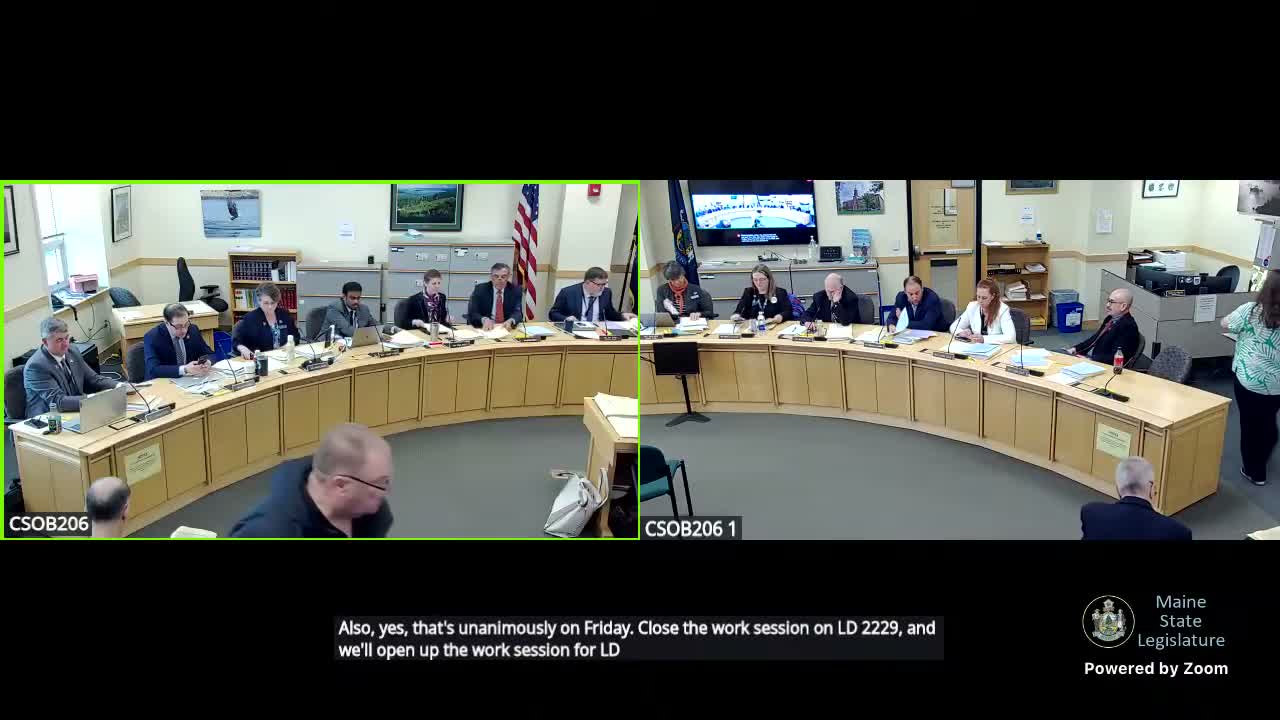
The committee opened the work session on LD 2231, which bundles three related topics: mediation and nondisclosure agreements; minimum-lot and deed provisions; and procedures to convert or cancel motor-vehicle titles so manufactured homes can be treated as real estate.
Lynn (staff drafter) walked members through the latest draft and the changes from the prior meeting. On mediation (page 4), the draft adds language that obtaining a nondisclosure agreement from a homeowner prior to mediation is considered bad faith and can delay a lot-increase taking effect; members emphasized that protecting tenants' ability to meet and seek mediation was a priority. Representative Calamore asked that the nondisclosure provision be preserved if the committee otherwise trimmed the bill; a minority of members later filed a minority report to retain that section.
The committee heard sales- and transfer-tax questions from Maine Revenue Services. Judy Methot, director of the Sales Field and Special Tax Division at Maine Revenue Services, told the panel that a manufactured home is treated as tangible personal property at initial sale because it is not yet attached to realty, so the initial purchase is generally subject to sales tax on the tax base limited to the cost of materials (labor is excluded up to a statutory percentage). Methot noted a separate bill (LD 1419) would raise the materials-exemption base from 50% to 75%.
Kathy Curtis, deputy secretary of state overseeing the Bureau of Motor Vehicles, cautioned that some proposed titling language conflicts with existing law and would make it difficult for the bureau to issue titles as drafted. Curtis recommended following an order-of-operations similar to New York's model (homeowner provides deed-recordation documentation or registry certification; BMV cancels the motor-vehicle title and issues a written cancellation) to avoid administrative problems.
Members debated a prescriptive set of inspections for park purchases (water and sewer system inspections, electrical systems, licensed-arborist hazardous-tree assessments, phase 1 environmental site assessment). Greg Payne, who worked with the drafting group, said the requirements reflect typical bank due diligence; other members pushed back on cost and enforcement concerns and suggested alternatives (for example, if a purchaser did not obtain recommended inspections, then costs uncovered by omitted inspections could not be recovered through tenant fee increases).
A Norway Savings Bank representative explained from a lender's perspective how a chattel loan is paid off and a mortgage and deed are recorded at closing, with cancellation of the motor-vehicle title processed post-closing. Committee members and the BMV agreed the post-closing sequence is workable in practice if closing documents record the intent and lenders follow up to provide cancellation documentation.
After extended discussion, Senator Bailey moved an 'ought to pass as amended' report using the yellow amendment that: removed the provision creating titles where none exist; deleted specified subsections (1.b on page 3 and 2.h on page 3); deleted the underlying language in section 3.a on page 4; clarified that section 9 (minimum-lot sizes) applies only to new parks and expansions; changed two specified 'must' clauses to 'may' (to align with the Short Form Deeds Act being permissive); and deleted all of section 11. Representative Collimore (and other members) offered a minority report that would strike the bill except for the nondisclosure agreement language (section 8).
The clerk called the roll. The committee adopted the majority amended report (ought to pass as amended) and the minority report was entered for the record. Members agreed to continue technical drafting during language review and to coordinate with BMV, lenders, MOCA and other agencies to resolve operational questions.
The committee closed the LD 2231 work session and scheduled language-review work to finalize drafting.
Lynn (staff drafter) walked members through the latest draft and the changes from the prior meeting. On mediation (page 4), the draft adds language that obtaining a nondisclosure agreement from a homeowner prior to mediation is considered bad faith and can delay a lot-increase taking effect; members emphasized that protecting tenants' ability to meet and seek mediation was a priority. Representative Calamore asked that the nondisclosure provision be preserved if the committee otherwise trimmed the bill; a minority of members later filed a minority report to retain that section.
The committee heard sales- and transfer-tax questions from Maine Revenue Services. Judy Methot, director of the Sales Field and Special Tax Division at Maine Revenue Services, told the panel that a manufactured home is treated as tangible personal property at initial sale because it is not yet attached to realty, so the initial purchase is generally subject to sales tax on the tax base limited to the cost of materials (labor is excluded up to a statutory percentage). Methot noted a separate bill (LD 1419) would raise the materials-exemption base from 50% to 75%.
Kathy Curtis, deputy secretary of state overseeing the Bureau of Motor Vehicles, cautioned that some proposed titling language conflicts with existing law and would make it difficult for the bureau to issue titles as drafted. Curtis recommended following an order-of-operations similar to New York's model (homeowner provides deed-recordation documentation or registry certification; BMV cancels the motor-vehicle title and issues a written cancellation) to avoid administrative problems.
Members debated a prescriptive set of inspections for park purchases (water and sewer system inspections, electrical systems, licensed-arborist hazardous-tree assessments, phase 1 environmental site assessment). Greg Payne, who worked with the drafting group, said the requirements reflect typical bank due diligence; other members pushed back on cost and enforcement concerns and suggested alternatives (for example, if a purchaser did not obtain recommended inspections, then costs uncovered by omitted inspections could not be recovered through tenant fee increases).
A Norway Savings Bank representative explained from a lender's perspective how a chattel loan is paid off and a mortgage and deed are recorded at closing, with cancellation of the motor-vehicle title processed post-closing. Committee members and the BMV agreed the post-closing sequence is workable in practice if closing documents record the intent and lenders follow up to provide cancellation documentation.
After extended discussion, Senator Bailey moved an 'ought to pass as amended' report using the yellow amendment that: removed the provision creating titles where none exist; deleted specified subsections (1.b on page 3 and 2.h on page 3); deleted the underlying language in section 3.a on page 4; clarified that section 9 (minimum-lot sizes) applies only to new parks and expansions; changed two specified 'must' clauses to 'may' (to align with the Short Form Deeds Act being permissive); and deleted all of section 11. Representative Collimore (and other members) offered a minority report that would strike the bill except for the nondisclosure agreement language (section 8).
The clerk called the roll. The committee adopted the majority amended report (ought to pass as amended) and the minority report was entered for the record. Members agreed to continue technical drafting during language review and to coordinate with BMV, lenders, MOCA and other agencies to resolve operational questions.
The committee closed the LD 2231 work session and scheduled language-review work to finalize drafting.
Don't Miss a Word: See the Full Meeting!
Go beyond summaries. Unlock every video, transcript, and key insight with a Founder Membership.
✓
Get instant access to full meeting videos
✓
Search and clip any phrase from complete transcripts
✓
Receive AI-powered summaries & custom alerts
✓
Enjoy lifetime, unrestricted access to government data
30-day money-back guarantee
