House advances proposal to let some 3‑year‑olds with special needs enroll in public preschool; bill moves to Senate after close vote
March 18, 2026 | 2026 Legislature ME, Maine
This article was created by AI summarizing key points discussed. AI makes mistakes, so for full details and context, please refer to the video of the full meeting. Please report any errors so we can fix them. Report an error »
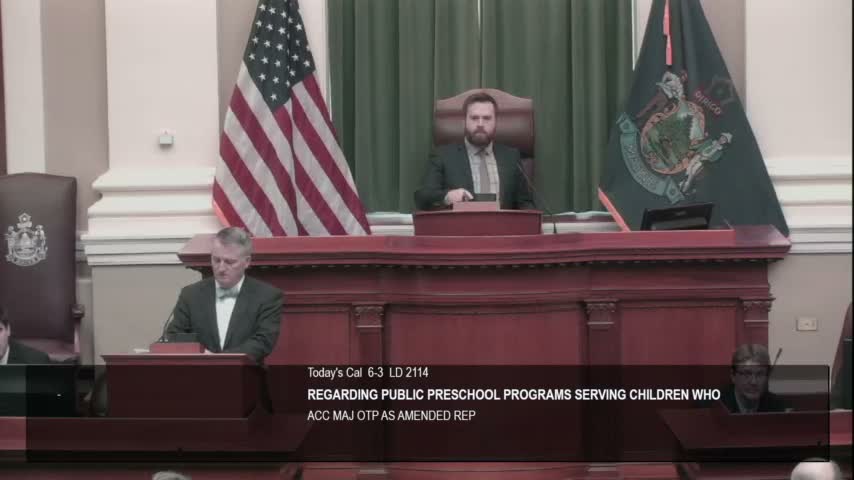
The Maine House on the floor advanced a bill to expand public preschool access so that 3‑year‑olds identified with special education needs may attend state‑funded public pre‑K programs, voting 75–67 to accept the majority 'ought to pass as amended' report and sending the measure on for first reading and referral to the Senate.
The bill, as described on the floor, would require the state to fund placement for 3‑year‑olds who have been identified with special needs while allowing school districts to permit typically developing 3‑year‑olds to attend at the district’s expense to comply with the federal "least restrictive environment" requirement. Opponents repeatedly warned that screening procedures, funding clarity and local fiscal impacts remain unresolved.
"The purpose of this bill is to expand public preschool so that 3 year olds who have been identified as having special needs can attend," said Representative Smith Hagen during floor remarks opposing the immediate acceptance of the majority report, citing a lack of clear answers about how children would be identified and how the program would be governed and funded. "We want to know who is making these determinations and what tools are being used to make that determination."
Supporters pressed the developmental case for early intervention. "The earlier students with special needs receive interventions, the more successful they are in their future as students," Representative Murphy said, urging colleagues to note that the subsidy in the bill applies only to 3‑ and 4‑year‑olds identified with special needs and that districts may contract with private providers to deliver services.
Members from rural districts voiced strong fiscal concerns. "Rural Maine is facing our financial breaking point," Representative Sobolewski said, arguing that allowing districts to add a year of publicly funded care — even when optional — shifts costs to property taxpayers, to transportation and to small local child‑care providers and could imperil existing rural providers. Representative Lyman likewise warned that "3‑year‑old toddlers do not belong in a general education program within a public school," citing concerns about space, age‑appropriate equipment and staffing.
Floor debate centered on three persistent themes: (1) how 3‑year‑old special‑education determinations would be made and by whom; (2) the fiscal effect on cash‑strapped rural districts and local taxpayers if districts choose to enroll non‑funded children; and (3) protections to ensure compliance with federal requirements for least restrictive environments. Several members asked for additional clarity from Child Development Services and the Department of Education; proponents said the bill preserves district choice and state funding for identified children only.
A roll‑call vote to accept the majority 'ought to pass as amended' report carried, 75 in favor to 67 opposed. The clerk recorded the vote and the measure will proceed for further legislative steps in the Senate.
Next procedural steps: first reading has been ordered and the bill will be referred for consideration in the Senate. Further committee review or amendment is possible as the bill moves through the legislative process.
The bill, as described on the floor, would require the state to fund placement for 3‑year‑olds who have been identified with special needs while allowing school districts to permit typically developing 3‑year‑olds to attend at the district’s expense to comply with the federal "least restrictive environment" requirement. Opponents repeatedly warned that screening procedures, funding clarity and local fiscal impacts remain unresolved.
"The purpose of this bill is to expand public preschool so that 3 year olds who have been identified as having special needs can attend," said Representative Smith Hagen during floor remarks opposing the immediate acceptance of the majority report, citing a lack of clear answers about how children would be identified and how the program would be governed and funded. "We want to know who is making these determinations and what tools are being used to make that determination."
Supporters pressed the developmental case for early intervention. "The earlier students with special needs receive interventions, the more successful they are in their future as students," Representative Murphy said, urging colleagues to note that the subsidy in the bill applies only to 3‑ and 4‑year‑olds identified with special needs and that districts may contract with private providers to deliver services.
Members from rural districts voiced strong fiscal concerns. "Rural Maine is facing our financial breaking point," Representative Sobolewski said, arguing that allowing districts to add a year of publicly funded care — even when optional — shifts costs to property taxpayers, to transportation and to small local child‑care providers and could imperil existing rural providers. Representative Lyman likewise warned that "3‑year‑old toddlers do not belong in a general education program within a public school," citing concerns about space, age‑appropriate equipment and staffing.
Floor debate centered on three persistent themes: (1) how 3‑year‑old special‑education determinations would be made and by whom; (2) the fiscal effect on cash‑strapped rural districts and local taxpayers if districts choose to enroll non‑funded children; and (3) protections to ensure compliance with federal requirements for least restrictive environments. Several members asked for additional clarity from Child Development Services and the Department of Education; proponents said the bill preserves district choice and state funding for identified children only.
A roll‑call vote to accept the majority 'ought to pass as amended' report carried, 75 in favor to 67 opposed. The clerk recorded the vote and the measure will proceed for further legislative steps in the Senate.
Next procedural steps: first reading has been ordered and the bill will be referred for consideration in the Senate. Further committee review or amendment is possible as the bill moves through the legislative process.
View the Full Meeting & All Its Details
This article offers just a summary. Unlock complete video, transcripts, and insights as a Founder Member.
✓
Watch full, unedited meeting videos
✓
Search every word spoken in unlimited transcripts
✓
AI summaries & real-time alerts (all government levels)
✓
Permanent access to expanding government content
30-day money-back guarantee
