House approves bill to stop offsets on disability retirement benefits for MainePERS members
March 19, 2026 | 2026 Legislature ME, Maine
This article was created by AI summarizing key points discussed. AI makes mistakes, so for full details and context, please refer to the video of the full meeting. Please report any errors so we can fix them. Report an error »
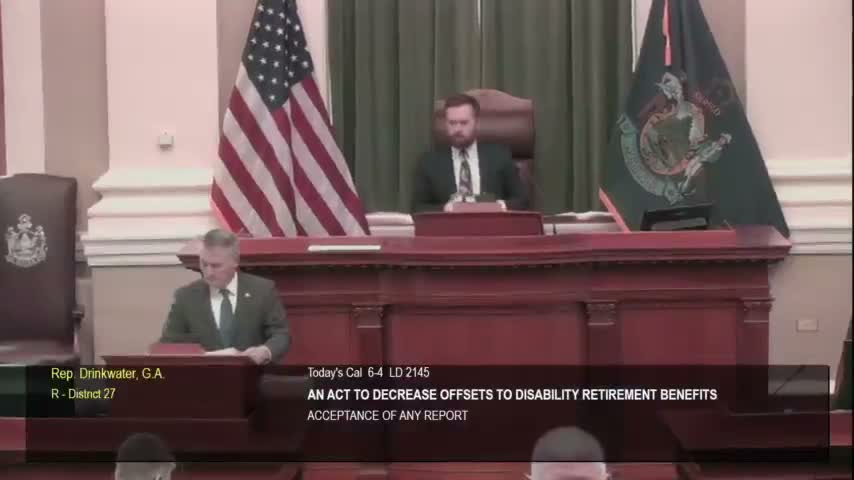
The Maine House of Representatives voted to approve a committee majority report advancing a bill that would change how disability retirement benefits are offset when recipients also receive workers’ compensation.
Representative Rader (the mover on the floor) warned that the change would remove incentives to return to work and carry an immediate fiscal effect: “By moving compensation to a 100% of income, we are removing the very incentive that has long been built into the system,” he said, adding that “Maine PERS estimates it will cost 1,700,000.0.”
Representative Macias, who spoke in favor of the change, framed the debate in human terms: “When they are injured, our responsibility is not to limit them. Our responsibility is to stand with them, to ensure that their well‑being, not cost containment, is at the center of our decisions,” she said, describing the measure as a way to protect workers who have been permanently harmed on the job.
Supporters said the current 80% combined cap left many disabled workers short of basic needs; opponents raised constitutional and funding concerns. Representative Rader cited Article 9, Section 18 of the Maine Constitution in arguing that expanded benefits require funding at enactment.
After debate and a roll‑call vote, the House approved the committee’s amended majority recommendation by a recorded vote of 73 in favor and 66 opposed. The chamber sent the measure forward per the usual legislative process.
Next steps: the House action advances the measure in the legislative process; any further committee or enactment steps were not recorded in the portion of the transcript supplied.
Representative Rader (the mover on the floor) warned that the change would remove incentives to return to work and carry an immediate fiscal effect: “By moving compensation to a 100% of income, we are removing the very incentive that has long been built into the system,” he said, adding that “Maine PERS estimates it will cost 1,700,000.0.”
Representative Macias, who spoke in favor of the change, framed the debate in human terms: “When they are injured, our responsibility is not to limit them. Our responsibility is to stand with them, to ensure that their well‑being, not cost containment, is at the center of our decisions,” she said, describing the measure as a way to protect workers who have been permanently harmed on the job.
Supporters said the current 80% combined cap left many disabled workers short of basic needs; opponents raised constitutional and funding concerns. Representative Rader cited Article 9, Section 18 of the Maine Constitution in arguing that expanded benefits require funding at enactment.
After debate and a roll‑call vote, the House approved the committee’s amended majority recommendation by a recorded vote of 73 in favor and 66 opposed. The chamber sent the measure forward per the usual legislative process.
Next steps: the House action advances the measure in the legislative process; any further committee or enactment steps were not recorded in the portion of the transcript supplied.
View the Full Meeting & All Its Details
This article offers just a summary. Unlock complete video, transcripts, and insights as a Founder Member.
✓
Watch full, unedited meeting videos
✓
Search every word spoken in unlimited transcripts
✓
AI summaries & real-time alerts (all government levels)
✓
Permanent access to expanding government content
30-day money-back guarantee
