Senate committee hears OCM technical fixes on licensing, labeling and data protections; one bill sent to Judiciary
March 18, 2026 | 2026 Legislature MN, Minnesota
This article was created by AI summarizing key points discussed. AI makes mistakes, so for full details and context, please refer to the video of the full meeting. Please report any errors so we can fix them. Report an error »
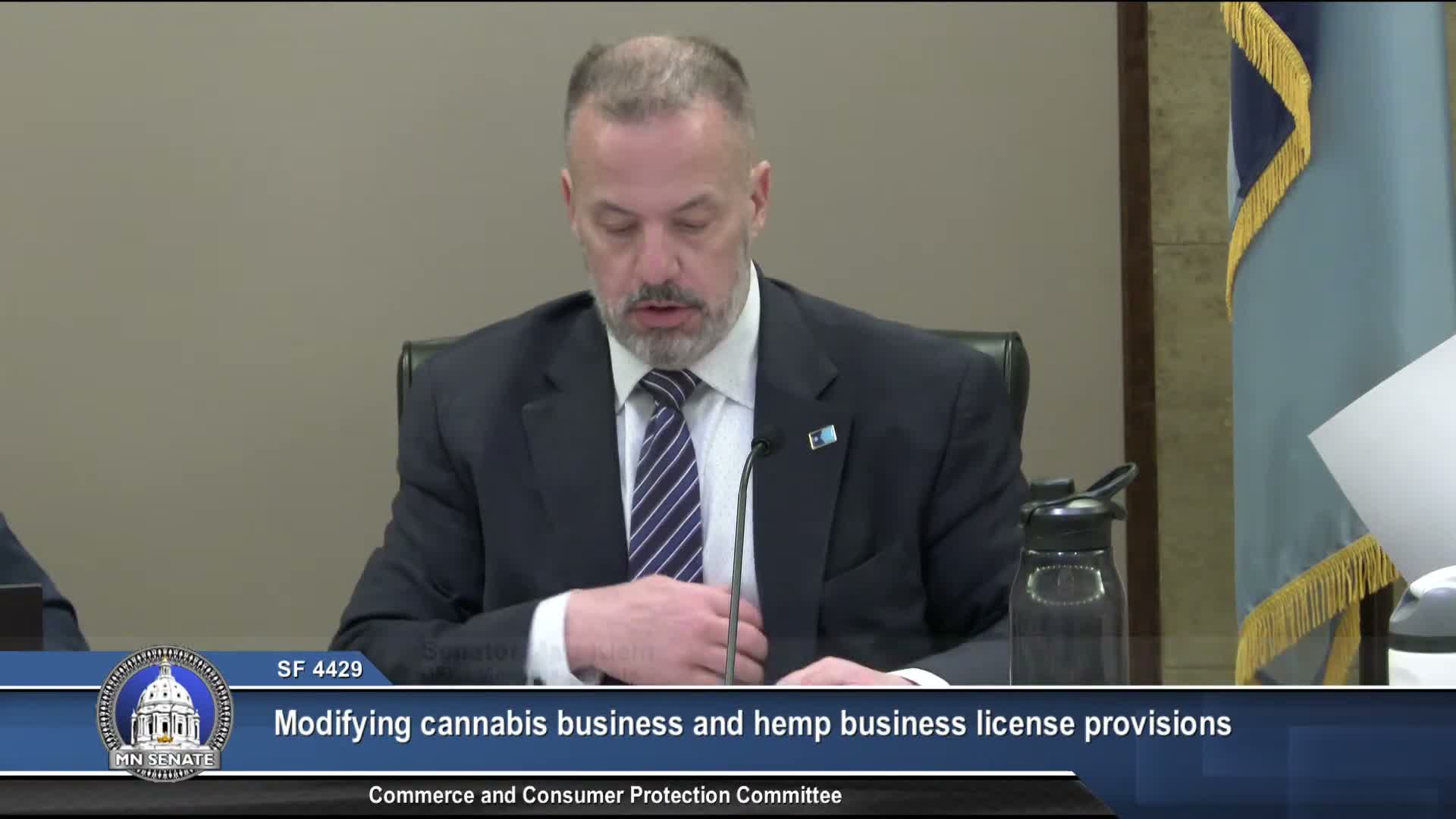
The Minnesota Senate Commerce and Consumer Protection Committee on March 17 heard four technical bills from the Office of Cannabis Management (OCM) designed to adjust licensing, reporting and labeling rules as state cannabis markets mature.
Senator Brian Dibble presented the package on behalf of Senator Port, describing the measures as “technical but important,” meant to remove unintended barriers to market transition while preserving consumer safety. He said SF 4429 would allow a single business to hold both a hemp license and a cannabis business license, ease relabeling burdens, and permit batch‑level supply‑chain details—such as cultivator and manufacturer data—to be provided via QR code to reduce redundant on‑package information.
“Businesses would face costly relabeling requirements if we don’t modernize how we convey batch and supply‑chain information,” Senator Dibble said, adding that the changes aim to “maintain strong regulatory oversight and enhance consumer safety.”
Director Taubel of the OCM, present to answer questions, told the committee the bills reflect lessons from rollout and aim to align state rules with how products are produced and sold. On SF 4401, which reorganizes reporting, Taubel said the goal is to consolidate duplicative statutory reporting into an annual market analysis that includes license counts, market stability, illicit‑market impact and medical‑registry integrity—information useful when calibrating future licensing or enforcement decisions.
Committee members asked about deleted language concerning ensuring sufficient supply and provisions for public education (including pregnancy‑related messaging and impaired driving). Taubel and Senator Dibble said those public‑safety and education functions would remain through coordination with agencies such as the Departments of Health and Public Safety and would be reflected in the reorganized annual report.
SF 4403 would add operational timelines (including a six‑month limit for a qualified applicant to move toward preliminary approval) and align labor‑standards disqualifiers with state agencies. Taubel said the time limits aim to clear “ghost” qualified‑applicant records so OCM can accurately assess market demand before reopening license windows.
On data protections, SF 4402 would classify sensitive seed‑to‑sale monitoring information as nonpublic while making basic application status (submitted, under review, preliminarily approved) visible to improve transparency for communities and applicants. The committee voted by voice to recommend SF 4402 pass and be referred to the Judiciary and Public Safety Committee.
No fiscal impacts were reported in committee testimony; the measures were described repeatedly as policy‑neutral, technical, and designed to improve clarity, reduce duplication, and protect proprietary business and patient information.
The committee laid the remaining OCM bills over for further consideration.
Senator Brian Dibble presented the package on behalf of Senator Port, describing the measures as “technical but important,” meant to remove unintended barriers to market transition while preserving consumer safety. He said SF 4429 would allow a single business to hold both a hemp license and a cannabis business license, ease relabeling burdens, and permit batch‑level supply‑chain details—such as cultivator and manufacturer data—to be provided via QR code to reduce redundant on‑package information.
“Businesses would face costly relabeling requirements if we don’t modernize how we convey batch and supply‑chain information,” Senator Dibble said, adding that the changes aim to “maintain strong regulatory oversight and enhance consumer safety.”
Director Taubel of the OCM, present to answer questions, told the committee the bills reflect lessons from rollout and aim to align state rules with how products are produced and sold. On SF 4401, which reorganizes reporting, Taubel said the goal is to consolidate duplicative statutory reporting into an annual market analysis that includes license counts, market stability, illicit‑market impact and medical‑registry integrity—information useful when calibrating future licensing or enforcement decisions.
Committee members asked about deleted language concerning ensuring sufficient supply and provisions for public education (including pregnancy‑related messaging and impaired driving). Taubel and Senator Dibble said those public‑safety and education functions would remain through coordination with agencies such as the Departments of Health and Public Safety and would be reflected in the reorganized annual report.
SF 4403 would add operational timelines (including a six‑month limit for a qualified applicant to move toward preliminary approval) and align labor‑standards disqualifiers with state agencies. Taubel said the time limits aim to clear “ghost” qualified‑applicant records so OCM can accurately assess market demand before reopening license windows.
On data protections, SF 4402 would classify sensitive seed‑to‑sale monitoring information as nonpublic while making basic application status (submitted, under review, preliminarily approved) visible to improve transparency for communities and applicants. The committee voted by voice to recommend SF 4402 pass and be referred to the Judiciary and Public Safety Committee.
No fiscal impacts were reported in committee testimony; the measures were described repeatedly as policy‑neutral, technical, and designed to improve clarity, reduce duplication, and protect proprietary business and patient information.
The committee laid the remaining OCM bills over for further consideration.
Don't Miss a Word: See the Full Meeting!
Go beyond summaries. Unlock every video, transcript, and key insight with a Founder Membership.
✓
Get instant access to full meeting videos
✓
Search and clip any phrase from complete transcripts
✓
Receive AI-powered summaries & custom alerts
✓
Enjoy lifetime, unrestricted access to government data
30-day money-back guarantee
