Sen. Duckworth advances bill to limit remedial tracking and require clearer student notice
March 18, 2026 | 2026 Legislature MN, Minnesota
This article was created by AI summarizing key points discussed. AI makes mistakes, so for full details and context, please refer to the video of the full meeting. Please report any errors so we can fix them. Report an error »
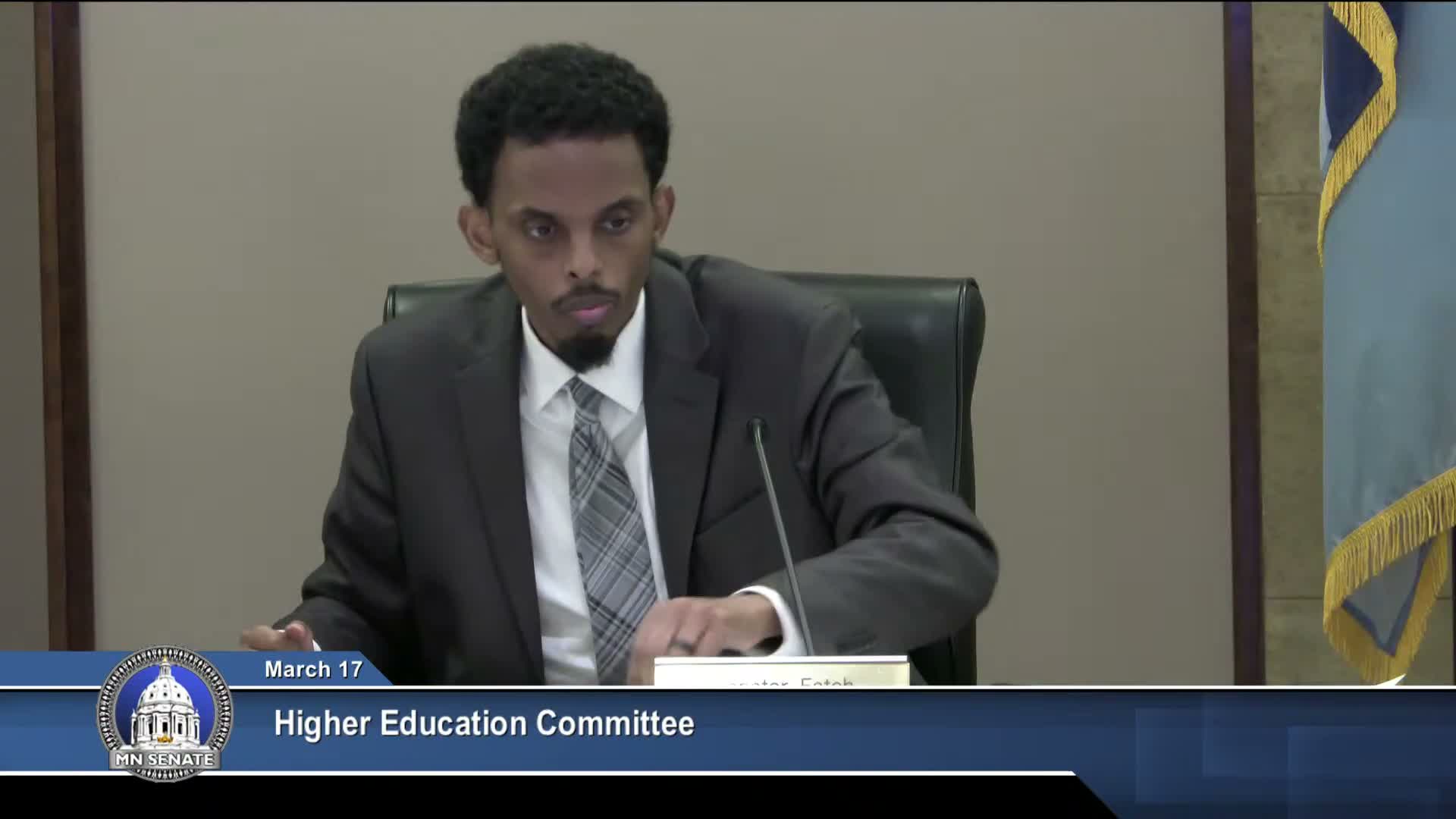
Senator Duckworth presented Senate File 3491 to a legislative committee and, with an A1 amendment adopted by voice vote, the committee laid the bill over for further consideration.
The bill would require public postsecondary institutions that receive state grant funding to explain to students the difference between unaccredited/developmental and credit-bearing courses, develop new credit-bearing English courses to replace traditional developmental courses, and refer students who do not meet minimum requirements for the new course to existing adult basic education programs, the bill text states. The Office of Higher Education (OHE) would be directed to guide implementation and report annually on numbers of students in credited, noncredited and developmental courses and completion rates.
"We have trained and employed over 4,000 clients in health care with over 700 of these graduates reaching their lifelong goal of becoming a nurse," said Jane Grotman, executive director of the International Institute in Minnesota, describing clients who were steered into extended developmental sequences that did not count toward degree completion. Grotman gave one example of a client who "had accumulated 59 credits of developmental education classes and did not understand why she was not moving toward her nursing degree, which is a 40 credit diploma."
A self-identified testifier, Ayan, described being placed into developmental/adult education for five semesters (about 2½ years), running out of financial aid, then receiving scholarship help from the International Institute to continue toward a nursing program. "Instead of paying for those classes, they shall have the chance to continue a free class faster so they can get benefit," Ayan said.
Faculty testimony supported co-requisite models in principle but warned against statutory mandates that would remove institutional flexibility. "Co-requisite is a model we support," said Matt Dempsey, Normandale Community College faculty and vice president of the Minnesota State College faculty union, "but picking one model at the state level can be a difficult situation for us" because many students are part-time and cannot carry additional credits or summer accelerated loads without losing progress.
Andrew Wald, general counsel and director of compliance at the Office of Higher Education, told the committee that OHE currently lacks regulatory authority over Minnesota State Colleges and Universities on these matters and would need to hire one FTE to implement the bill's proposed duties. Wald cited statutory provisions he said limit OHE's purview, listing sections discussed during testimony.
An A1 amendment clarifying which commissioner must report and substituting the term 'office' for 'department' when referring to OHE was moved by Senator Duckworth and adopted by voice vote. The committee chair later announced the bill would be laid over.
What happens next: the bill, as amended, was laid over for further consideration; committee staff or agencies may provide additional technical fixes or a fiscal note is expected given OHE's capacity concerns, testimony indicated.
Clarifying details: 4,000+ clients trained by the International Institute; 700+ graduates reached RN degrees; one client cited with 59 developmental credits versus a 40-credit nursing diploma; testimony referenced an OHE 2024 report documenting a roughly 75% drop in remedial enrollment since 2018 and higher completion rates for students who do not enroll in developmental education, per the quoted report.
Authorities referenced in hearing: statutory citations discussed by OHE counsel included statutory sections described in testimony (e.g., "136A.0.01 subdivision 2", "135A.0.052", "136F.06").
Ending: The committee laid Senate File 3491 over for further consideration after adopting the A1 amendment; no final vote on the bill was recorded at the hearing.
The bill would require public postsecondary institutions that receive state grant funding to explain to students the difference between unaccredited/developmental and credit-bearing courses, develop new credit-bearing English courses to replace traditional developmental courses, and refer students who do not meet minimum requirements for the new course to existing adult basic education programs, the bill text states. The Office of Higher Education (OHE) would be directed to guide implementation and report annually on numbers of students in credited, noncredited and developmental courses and completion rates.
"We have trained and employed over 4,000 clients in health care with over 700 of these graduates reaching their lifelong goal of becoming a nurse," said Jane Grotman, executive director of the International Institute in Minnesota, describing clients who were steered into extended developmental sequences that did not count toward degree completion. Grotman gave one example of a client who "had accumulated 59 credits of developmental education classes and did not understand why she was not moving toward her nursing degree, which is a 40 credit diploma."
A self-identified testifier, Ayan, described being placed into developmental/adult education for five semesters (about 2½ years), running out of financial aid, then receiving scholarship help from the International Institute to continue toward a nursing program. "Instead of paying for those classes, they shall have the chance to continue a free class faster so they can get benefit," Ayan said.
Faculty testimony supported co-requisite models in principle but warned against statutory mandates that would remove institutional flexibility. "Co-requisite is a model we support," said Matt Dempsey, Normandale Community College faculty and vice president of the Minnesota State College faculty union, "but picking one model at the state level can be a difficult situation for us" because many students are part-time and cannot carry additional credits or summer accelerated loads without losing progress.
Andrew Wald, general counsel and director of compliance at the Office of Higher Education, told the committee that OHE currently lacks regulatory authority over Minnesota State Colleges and Universities on these matters and would need to hire one FTE to implement the bill's proposed duties. Wald cited statutory provisions he said limit OHE's purview, listing sections discussed during testimony.
An A1 amendment clarifying which commissioner must report and substituting the term 'office' for 'department' when referring to OHE was moved by Senator Duckworth and adopted by voice vote. The committee chair later announced the bill would be laid over.
What happens next: the bill, as amended, was laid over for further consideration; committee staff or agencies may provide additional technical fixes or a fiscal note is expected given OHE's capacity concerns, testimony indicated.
Clarifying details: 4,000+ clients trained by the International Institute; 700+ graduates reached RN degrees; one client cited with 59 developmental credits versus a 40-credit nursing diploma; testimony referenced an OHE 2024 report documenting a roughly 75% drop in remedial enrollment since 2018 and higher completion rates for students who do not enroll in developmental education, per the quoted report.
Authorities referenced in hearing: statutory citations discussed by OHE counsel included statutory sections described in testimony (e.g., "136A.0.01 subdivision 2", "135A.0.052", "136F.06").
Ending: The committee laid Senate File 3491 over for further consideration after adopting the A1 amendment; no final vote on the bill was recorded at the hearing.
View the Full Meeting & All Its Details
This article offers just a summary. Unlock complete video, transcripts, and insights as a Founder Member.
✓
Watch full, unedited meeting videos
✓
Search every word spoken in unlimited transcripts
✓
AI summaries & real-time alerts (all government levels)
✓
Permanent access to expanding government content
30-day money-back guarantee
