BWSR asks for $5 million in bonding to buy easements and create wetland-replacement credits
March 17, 2026 | 2026 Legislature MN, Minnesota
This article was created by AI summarizing key points discussed. AI makes mistakes, so for full details and context, please refer to the video of the full meeting. Please report any errors so we can fix them. Report an error »
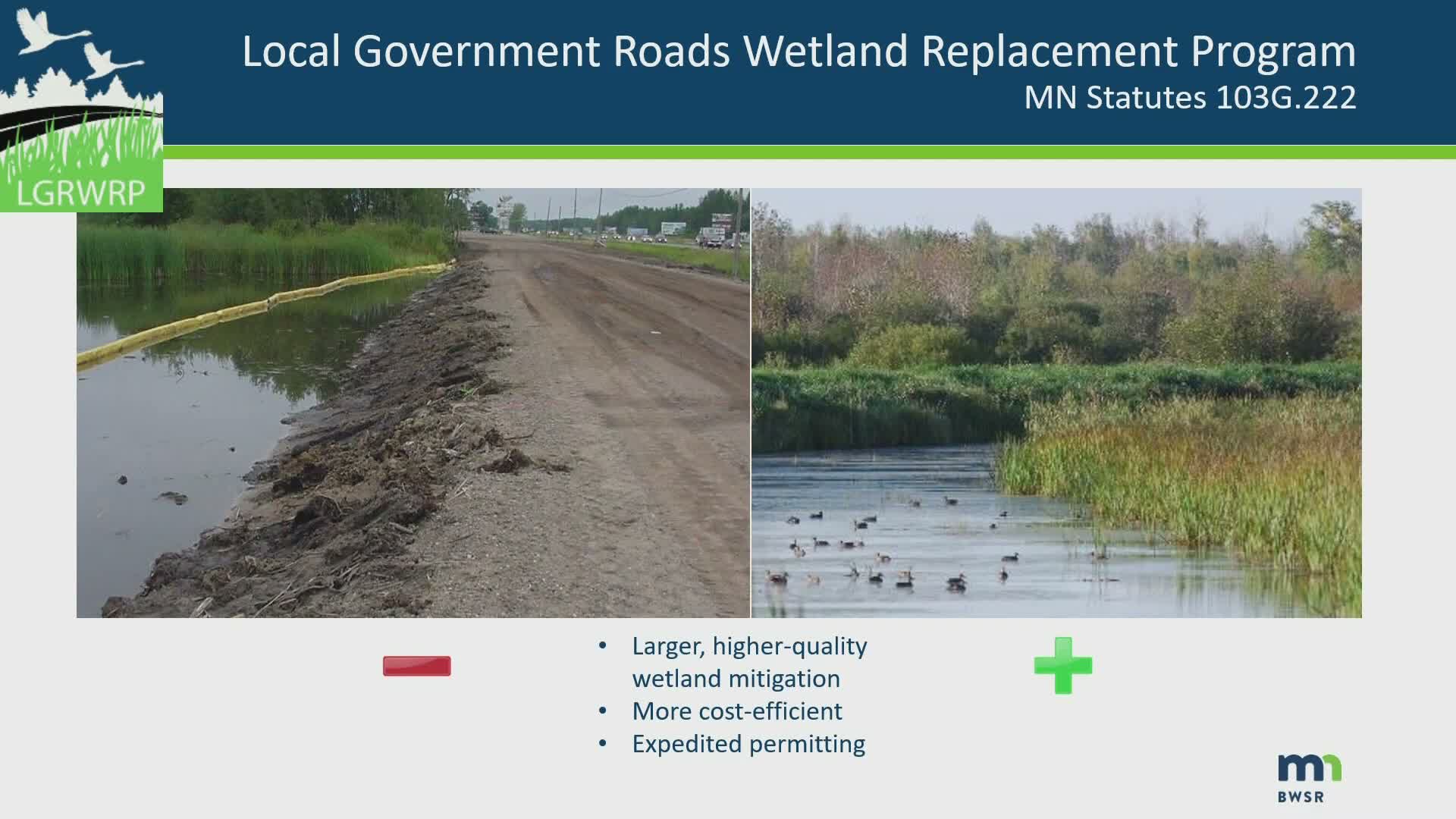
John Jasky, executive director of the Board of Water and Soil Resources, and Andrea Fish, assistant director, presented bonding requests tied to statutory programs that support local governments when road projects negatively affect wetlands.
Fish described the governor’s capital request for $5 million in general-obligation bonds to purchase easements that could restore and protect roughly 100–140 acres and generate up to about 80 wetland-replacement credits. She told members that prior analysis estimated roughly $35 million would be required to address existing demand statewide and about $9.5 million would be needed annually for ongoing demand for wetland credits.
Fish cautioned that creating new wetland-replacement credits is time-consuming — she said it can take 8 to 10 years from appropriation to a final credit release — which is why BWSR supports bonding plus an ongoing funding approach. She also described the agency’s partnership with USDA on the Conservation Reserve Enhancement Program (CREP) and said a working group had recommended a mix of bonding and general-fund cash to ensure predictable credit supply.
Committee members asked about repurposing prior cancellations and about geographic distribution of the program; Jasky said funds are typically repurposed for the originally intended purpose and offered to provide more detail on where different REN/REMIN programs had been used.
No formal committee action on the funding was recorded during the March 17 hearing.
Fish described the governor’s capital request for $5 million in general-obligation bonds to purchase easements that could restore and protect roughly 100–140 acres and generate up to about 80 wetland-replacement credits. She told members that prior analysis estimated roughly $35 million would be required to address existing demand statewide and about $9.5 million would be needed annually for ongoing demand for wetland credits.
Fish cautioned that creating new wetland-replacement credits is time-consuming — she said it can take 8 to 10 years from appropriation to a final credit release — which is why BWSR supports bonding plus an ongoing funding approach. She also described the agency’s partnership with USDA on the Conservation Reserve Enhancement Program (CREP) and said a working group had recommended a mix of bonding and general-fund cash to ensure predictable credit supply.
Committee members asked about repurposing prior cancellations and about geographic distribution of the program; Jasky said funds are typically repurposed for the originally intended purpose and offered to provide more detail on where different REN/REMIN programs had been used.
No formal committee action on the funding was recorded during the March 17 hearing.
View the Full Meeting & All Its Details
This article offers just a summary. Unlock complete video, transcripts, and insights as a Founder Member.
✓
Watch full, unedited meeting videos
✓
Search every word spoken in unlimited transcripts
✓
AI summaries & real-time alerts (all government levels)
✓
Permanent access to expanding government content
30-day money-back guarantee
