MDE outlines authorizer duties, MAPES process in Education Policy Committee briefing
March 17, 2026 | 2026 Legislature MN, Minnesota
This article was created by AI summarizing key points discussed. AI makes mistakes, so for full details and context, please refer to the video of the full meeting. Please report any errors so we can fix them. Report an error »
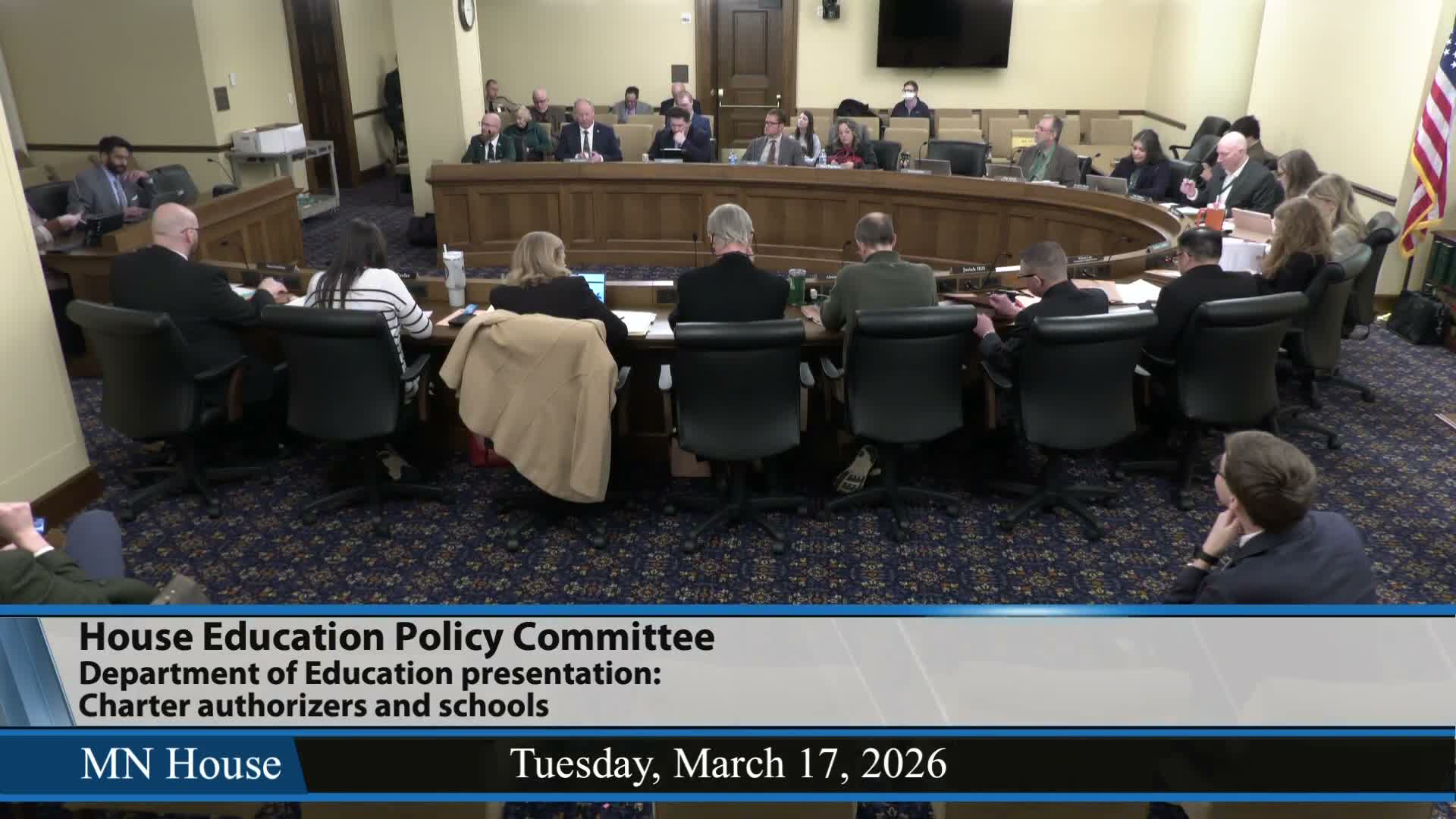
Adosh Unni of the Minnesota Department of Education told the House Education Policy Committee on March 17 that charter-school authorizers must guarantee schools the statutory autonomy granted by law while holding them accountable to contract terms, including academic, operational and financial performance.
Unni, who introduced himself for the record, said authorizers’ core responsibilities include reviewing applications for new schools or expansions, negotiating and executing performance contracts, conducting ongoing monitoring and evaluation, and deciding whether to renew or terminate contracts. He described the commissioner’s statutory timeline for authorizer applications: a 45-business-day decision period after application receipt, with specified cure periods if deficiencies are found.
The department also outlined what must appear in a charter contract: a statement of the school’s primary purpose, program descriptions, admissions policies, governance plans, special-education assurances and performance measures that determine renewal. Initial contracts may run up to five years plus a preoperational planning period; renewals may also be up to five years depending on performance.
Unni described the Minnesota Authorizer Performance Evaluation System, or MAPES, as the statutory framework MDE uses to evaluate authorizer performance. MAPES relies on independent third-party evaluators chosen through a competitive process and generally requires a formal authorizer review every five years, though the commissioner may review more frequently at the commissioner’s initiative or after a request from an interested party.
The presentation also covered procedural protections for charter boards facing nonrenewal or termination: an authorizer must notify the charter board in writing at least 60 business days before proposing nonrenewal or termination, the board may request an informal hearing within 15 business days, and authorizers must preserve hearing recordings for three years.
Committee members asked detailed questions about special education. Unni said charter schools are required to provide the services their students need, consistent with federal and state special-education law, but he deferred to nonpartisan staff for administrative and fiscal mechanics. Nonpartisan staff and fiscal staff explained that charters must offer required services, may have an on‑staff special-education director or contract for services, and that funding for services follows the same front-end formula as districts while certain back-end billing practices differ.
The department closed by describing the Charter Center’s oversight work—reviewing annual reports and financial statements, approving change-of-authorizer requests, providing guidance and training and reviewing complaints about statutory compliance. Unni said MDE uses MAPES to promote “high-quality authorizing practices” and to ensure accountability.
The briefing concluded with committee members requesting additional historical data on the number of authorizers and trends in authorizer withdrawal; MDE staff said they would supply those figures on request.
The committee then moved to business on the agenda, including votes on previously heard bills.
Unni, who introduced himself for the record, said authorizers’ core responsibilities include reviewing applications for new schools or expansions, negotiating and executing performance contracts, conducting ongoing monitoring and evaluation, and deciding whether to renew or terminate contracts. He described the commissioner’s statutory timeline for authorizer applications: a 45-business-day decision period after application receipt, with specified cure periods if deficiencies are found.
The department also outlined what must appear in a charter contract: a statement of the school’s primary purpose, program descriptions, admissions policies, governance plans, special-education assurances and performance measures that determine renewal. Initial contracts may run up to five years plus a preoperational planning period; renewals may also be up to five years depending on performance.
Unni described the Minnesota Authorizer Performance Evaluation System, or MAPES, as the statutory framework MDE uses to evaluate authorizer performance. MAPES relies on independent third-party evaluators chosen through a competitive process and generally requires a formal authorizer review every five years, though the commissioner may review more frequently at the commissioner’s initiative or after a request from an interested party.
The presentation also covered procedural protections for charter boards facing nonrenewal or termination: an authorizer must notify the charter board in writing at least 60 business days before proposing nonrenewal or termination, the board may request an informal hearing within 15 business days, and authorizers must preserve hearing recordings for three years.
Committee members asked detailed questions about special education. Unni said charter schools are required to provide the services their students need, consistent with federal and state special-education law, but he deferred to nonpartisan staff for administrative and fiscal mechanics. Nonpartisan staff and fiscal staff explained that charters must offer required services, may have an on‑staff special-education director or contract for services, and that funding for services follows the same front-end formula as districts while certain back-end billing practices differ.
The department closed by describing the Charter Center’s oversight work—reviewing annual reports and financial statements, approving change-of-authorizer requests, providing guidance and training and reviewing complaints about statutory compliance. Unni said MDE uses MAPES to promote “high-quality authorizing practices” and to ensure accountability.
The briefing concluded with committee members requesting additional historical data on the number of authorizers and trends in authorizer withdrawal; MDE staff said they would supply those figures on request.
The committee then moved to business on the agenda, including votes on previously heard bills.
View the Full Meeting & All Its Details
This article offers just a summary. Unlock complete video, transcripts, and insights as a Founder Member.
✓
Watch full, unedited meeting videos
✓
Search every word spoken in unlimited transcripts
✓
AI summaries & real-time alerts (all government levels)
✓
Permanent access to expanding government content
30-day money-back guarantee
