Committee advances bill aimed at curbing library ebook licensing terms after contested hearing
March 19, 2026 | 2026 Legislature MN, Minnesota
This article was created by AI summarizing key points discussed. AI makes mistakes, so for full details and context, please refer to the video of the full meeting. Please report any errors so we can fix them. Report an error »
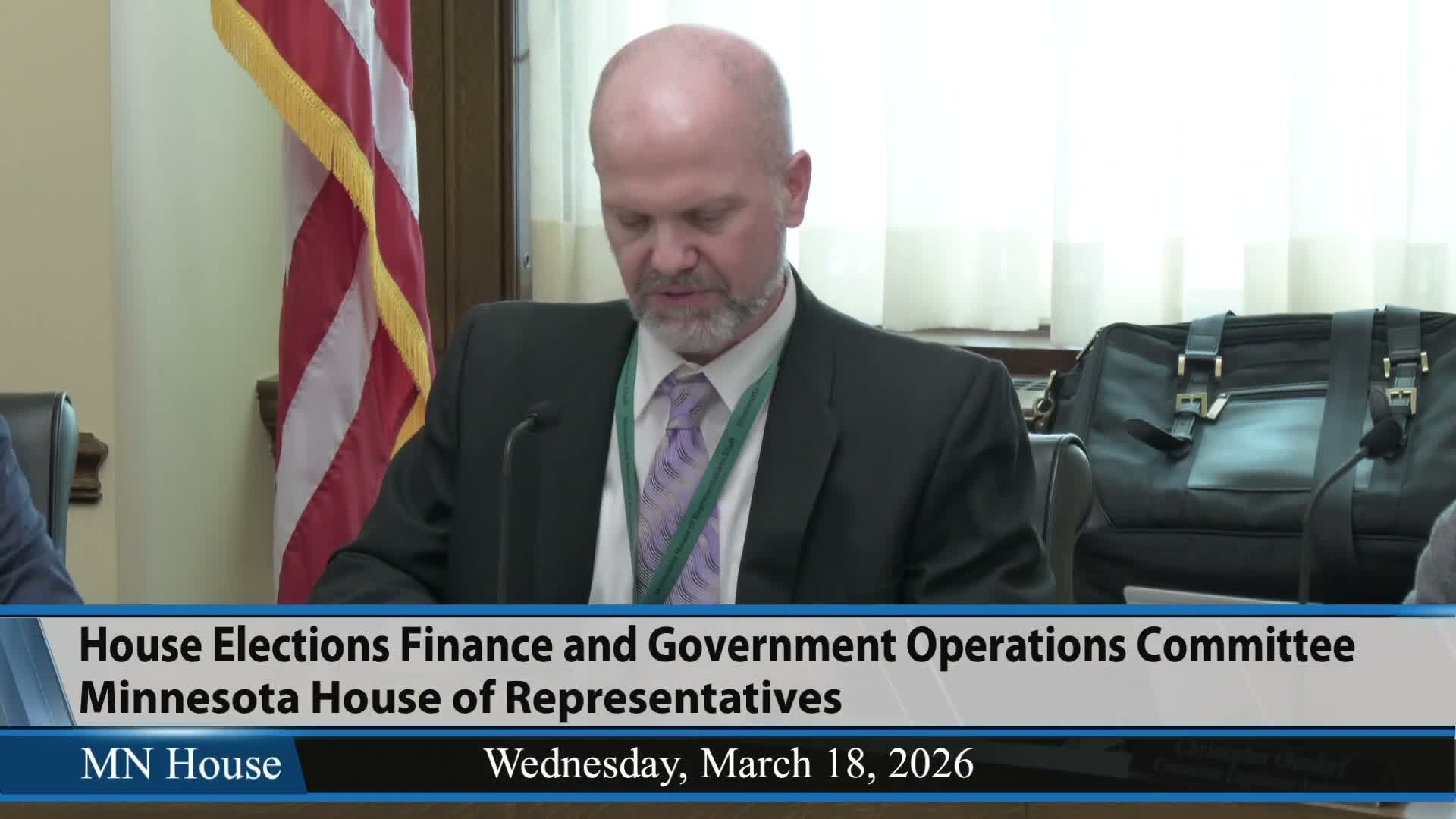
Representative Michael Godfried moved to re‑refer House File 36‑98, a bill he described as setting “common sense parameters” on ebook and audiobook licensing for publicly funded libraries, to the Commerce, Finance and Policy Committee. Proponents said current vendor contracts force libraries to lease digital titles with short expirations and high per‑use costs, straining local budgets and limiting access.
Sarah Hawkins, assistant director at Anoka County Library and legislative chair of the Minnesota Library Association, told the committee that libraries often pay “three to five times” what a consumer pays for an ebook license and that licenses can expire after two years or 20–26 checkouts. Hawkins said the Twin Cities consortium logged about 13,980,000 digital circulations in 2025, that metro libraries spent roughly $6.5 million on digital content in 2025 and still face an unmet need she estimated at over 21,000,000. She offered a concrete example: one set of 835 purchased licenses cost $55,711; Hawkins later confirmed those titles had 11,343 circulations in the most recent year.
Todd Hill of Hill Capital Strategies, testifying on behalf of the Association of American Publishers, said the bill threatens author and publisher rights and could reduce access if publishers refuse to license to Minnesota. Hill argued the per‑use math was misleading: he said the licenses cited convert to many uses and that the effective library cost per reader can be substantially lower when multiple uses are counted.
Committee members pressed proponents and opponents on the data and on potential legal exposure. Several members noted similar measures in other states and asked whether federal copyright law might produce litigation; Hill said some prior state efforts were struck down and litigation risk exists, while proponents said this bill targets public contracting rather than direct regulation of copyright. Representative Greenman and others framed the bill as a response to concentrated market power among a few major publishers; Representative Altendorf and Representative Roach warned of unintended consequences if publishers decline to license to the state.
After discussion, Chair Freiberg moved the committee’s recommendation to re‑refer the bill to Commerce, Finance and Policy. A roll call recorded eight ayes and four nays; the clerk announced the motion carried and HF 36‑98 will be considered next in Commerce, Finance and Policy.
The committee’s action sends the bill to a committee that will examine contract and procurement details, and members signaled they expect further briefing on pricing data and legal contours there.
Sarah Hawkins, assistant director at Anoka County Library and legislative chair of the Minnesota Library Association, told the committee that libraries often pay “three to five times” what a consumer pays for an ebook license and that licenses can expire after two years or 20–26 checkouts. Hawkins said the Twin Cities consortium logged about 13,980,000 digital circulations in 2025, that metro libraries spent roughly $6.5 million on digital content in 2025 and still face an unmet need she estimated at over 21,000,000. She offered a concrete example: one set of 835 purchased licenses cost $55,711; Hawkins later confirmed those titles had 11,343 circulations in the most recent year.
Todd Hill of Hill Capital Strategies, testifying on behalf of the Association of American Publishers, said the bill threatens author and publisher rights and could reduce access if publishers refuse to license to Minnesota. Hill argued the per‑use math was misleading: he said the licenses cited convert to many uses and that the effective library cost per reader can be substantially lower when multiple uses are counted.
Committee members pressed proponents and opponents on the data and on potential legal exposure. Several members noted similar measures in other states and asked whether federal copyright law might produce litigation; Hill said some prior state efforts were struck down and litigation risk exists, while proponents said this bill targets public contracting rather than direct regulation of copyright. Representative Greenman and others framed the bill as a response to concentrated market power among a few major publishers; Representative Altendorf and Representative Roach warned of unintended consequences if publishers decline to license to the state.
After discussion, Chair Freiberg moved the committee’s recommendation to re‑refer the bill to Commerce, Finance and Policy. A roll call recorded eight ayes and four nays; the clerk announced the motion carried and HF 36‑98 will be considered next in Commerce, Finance and Policy.
The committee’s action sends the bill to a committee that will examine contract and procurement details, and members signaled they expect further briefing on pricing data and legal contours there.
View the Full Meeting & All Its Details
This article offers just a summary. Unlock complete video, transcripts, and insights as a Founder Member.
✓
Watch full, unedited meeting videos
✓
Search every word spoken in unlimited transcripts
✓
AI summaries & real-time alerts (all government levels)
✓
Permanent access to expanding government content
30-day money-back guarantee
