Committee adopts amendment and refers dual-enrollment task-force bill to Education Finance
March 19, 2026 | 2026 Legislature MN, Minnesota
This article was created by AI summarizing key points discussed. AI makes mistakes, so for full details and context, please refer to the video of the full meeting. Please report any errors so we can fix them. Report an error »
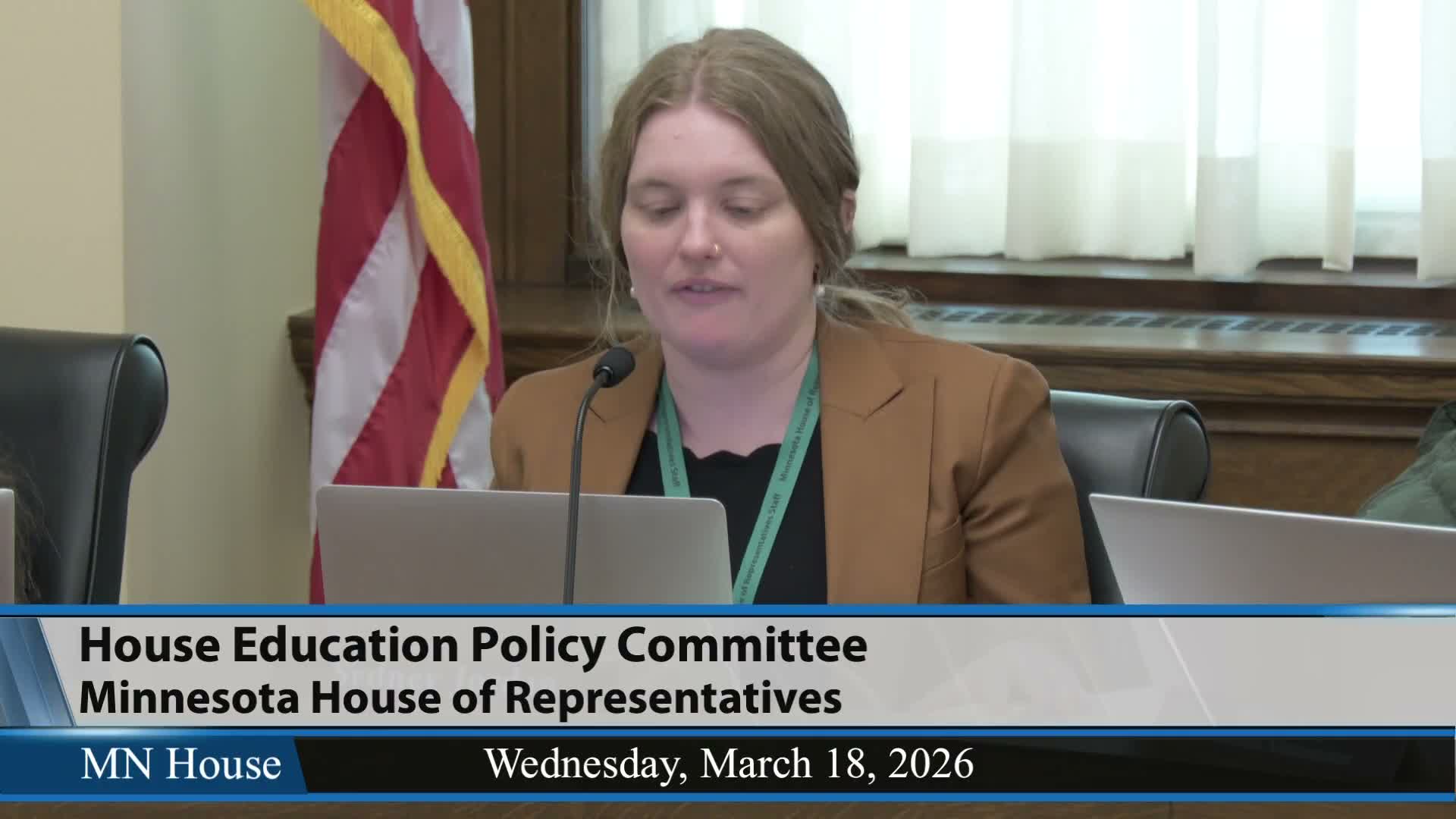
The committee considered House File 25-44, which would establish a time-limited dual-enrollment (including PSEO) task force to review funding formulas, examine cost variations across postsecondary institutions, identify barriers to participation, and recommend metrics and policy changes. Representative Bernig (sponsor) said the task force membership was adjusted in the adopted A3 amendment to add lived-experience voices and to align with changes made in the Senate. The task force would be administratively supported by the Minnesota Department of Education and expire on May 30, 2027, or upon completion of its report.
Beatrice Hanlon, president of People for PSEO, testified the program has existed since 1986, continues to grow, lowers postsecondary costs for students and narrows achievement gaps, but faces gaps in access, transportation and meal access on college campuses. "This task force will begin the work to address gaps in the funding formula and provide solutions that serve all stakeholders without hurting students," Hanlon said.
Khalik Rogers and Mark Grant urged clearer funding transparency and inclusion of higher-education faculty perspectives in the membership. Some members raised concerns about the task force's size (23 members), student representation and Greater Minnesota representation; others suggested outside evaluation by the Office of the Legislative Auditor (OLA) as an alternative or complementary approach. Sponsors said the bill does not change statute now and is intended to produce evidence-based recommendations before statute changes.
The committee adopted the A3 amendment and referred HF25-44 as amended to the Education Finance Committee by voice vote. Members indicated further work on composition and membership would continue in the next committee.
Beatrice Hanlon, president of People for PSEO, testified the program has existed since 1986, continues to grow, lowers postsecondary costs for students and narrows achievement gaps, but faces gaps in access, transportation and meal access on college campuses. "This task force will begin the work to address gaps in the funding formula and provide solutions that serve all stakeholders without hurting students," Hanlon said.
Khalik Rogers and Mark Grant urged clearer funding transparency and inclusion of higher-education faculty perspectives in the membership. Some members raised concerns about the task force's size (23 members), student representation and Greater Minnesota representation; others suggested outside evaluation by the Office of the Legislative Auditor (OLA) as an alternative or complementary approach. Sponsors said the bill does not change statute now and is intended to produce evidence-based recommendations before statute changes.
The committee adopted the A3 amendment and referred HF25-44 as amended to the Education Finance Committee by voice vote. Members indicated further work on composition and membership would continue in the next committee.
View the Full Meeting & All Its Details
This article offers just a summary. Unlock complete video, transcripts, and insights as a Founder Member.
✓
Watch full, unedited meeting videos
✓
Search every word spoken in unlimited transcripts
✓
AI summaries & real-time alerts (all government levels)
✓
Permanent access to expanding government content
30-day money-back guarantee
