Senate committee advances bill allowing optional cameras in special-education classrooms after heated testimony
March 18, 2026 | 2026 Legislature TN, Tennessee
This article was created by AI summarizing key points discussed. AI makes mistakes, so for full details and context, please refer to the video of the full meeting. Please report any errors so we can fix them. Report an error »
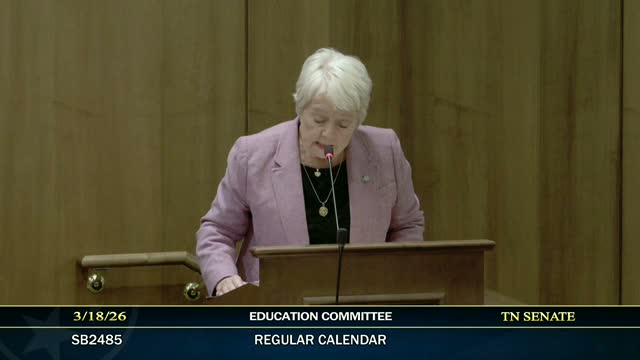
The Tennessee Senate Education Committee on March 23 advanced legislation that would allow school districts to install continuous video monitoring systems in self-contained special-education classrooms if a majority of parents consent.
Supporters, including several parents of nonverbal children, told the committee they want a way to record incidents they say otherwise go undocumented. "When there is no voice, there must be visibility," said Shanika Sherrill, who described her son being returned from school concussed and bruised. Yvonne Johnson, a grandmother and advocate, said the lack of cameras left her granddaughter without a way to corroborate alleged abuse: "This is the gap," she told the committee.
Opponents, who included disability advocates and The Arc Tennessee, warned that video could be misused to discipline students whose behaviors are manifestations of disability. Robbie Faulkner of The Arc Tennessee said behavior plans and other supports—not criminalization—are the proper response to incidents involving students with disabilities.
Sponsor Sen. Janice Boling said the bill is permissive and not punitive, and stressed that federal law limits how footage can be shared: "This bill creates no criminal mechanism whatsoever," she said, noting that the Family Educational Rights and Privacy Act and IDEA restrict disclosure and require manifestation determinations before discipline for students with disabilities.
Legal counsel clarified that while parental consent is required for routine disclosure of footage, a lawfully issued court order could compel production in a judicial proceeding. The committee adopted a legal amendment that added teacher consent language and specified that footage including a nonconsenting student could not be used for discipline, assignment or placement when that student's parent has not consented.
After extended public testimony and questions about retention, who may view footage, teacher access, and consequences for nonconsenting students, the committee voted 7–1 to send the amended bill to the finance committee for further consideration.
What’s next: SB 24-85 moves to the finance committee. The sponsor and witnesses said districts would be expected to craft local policies to govern retention, access and review consistent with federal privacy requirements.
Supporters, including several parents of nonverbal children, told the committee they want a way to record incidents they say otherwise go undocumented. "When there is no voice, there must be visibility," said Shanika Sherrill, who described her son being returned from school concussed and bruised. Yvonne Johnson, a grandmother and advocate, said the lack of cameras left her granddaughter without a way to corroborate alleged abuse: "This is the gap," she told the committee.
Opponents, who included disability advocates and The Arc Tennessee, warned that video could be misused to discipline students whose behaviors are manifestations of disability. Robbie Faulkner of The Arc Tennessee said behavior plans and other supports—not criminalization—are the proper response to incidents involving students with disabilities.
Sponsor Sen. Janice Boling said the bill is permissive and not punitive, and stressed that federal law limits how footage can be shared: "This bill creates no criminal mechanism whatsoever," she said, noting that the Family Educational Rights and Privacy Act and IDEA restrict disclosure and require manifestation determinations before discipline for students with disabilities.
Legal counsel clarified that while parental consent is required for routine disclosure of footage, a lawfully issued court order could compel production in a judicial proceeding. The committee adopted a legal amendment that added teacher consent language and specified that footage including a nonconsenting student could not be used for discipline, assignment or placement when that student's parent has not consented.
After extended public testimony and questions about retention, who may view footage, teacher access, and consequences for nonconsenting students, the committee voted 7–1 to send the amended bill to the finance committee for further consideration.
What’s next: SB 24-85 moves to the finance committee. The sponsor and witnesses said districts would be expected to craft local policies to govern retention, access and review consistent with federal privacy requirements.
View the Full Meeting & All Its Details
This article offers just a summary. Unlock complete video, transcripts, and insights as a Founder Member.
✓
Watch full, unedited meeting videos
✓
Search every word spoken in unlimited transcripts
✓
AI summaries & real-time alerts (all government levels)
✓
Permanent access to expanding government content
30-day money-back guarantee
