Joint committee reviews draft language for LD 1847, focusing on cannabis testing, tracking and small-business supports
March 19, 2026 | 2026 Legislature ME, Maine
This article was created by AI summarizing key points discussed. AI makes mistakes, so for full details and context, please refer to the video of the full meeting. Please report any errors so we can fix them. Report an error »
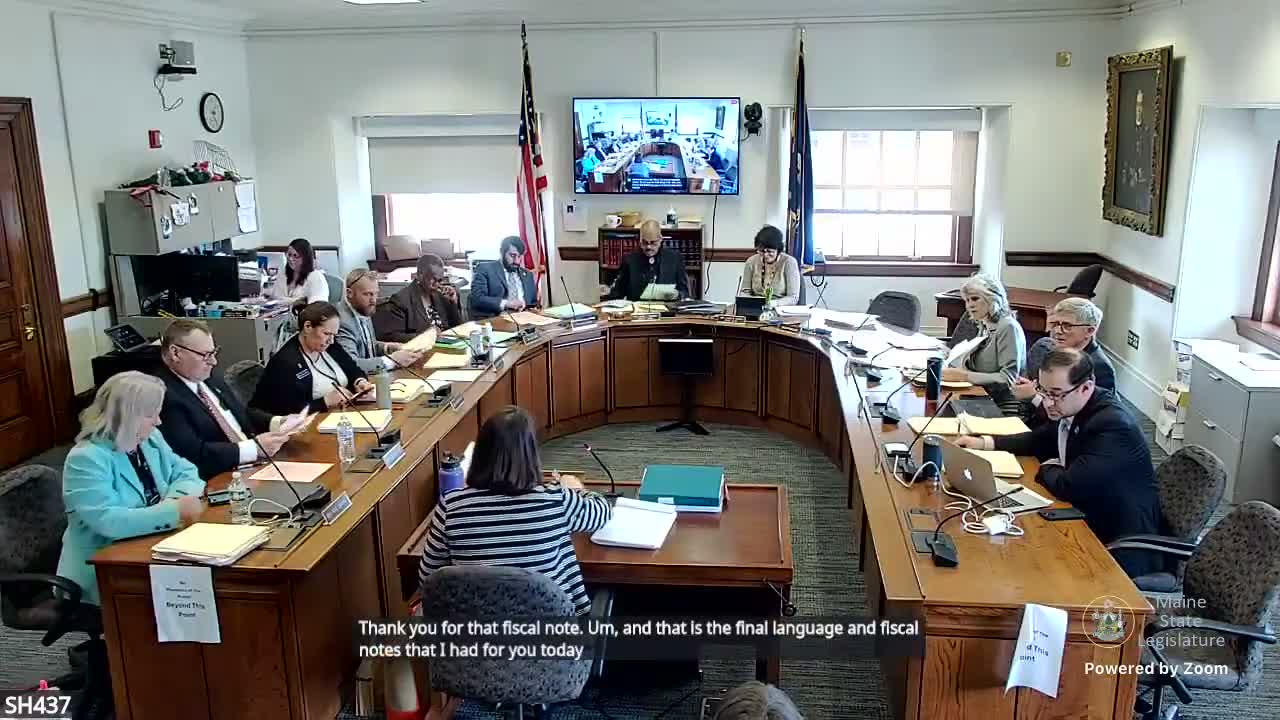
The Joint Standing Committee on Veterans and Legal Affairs on March 23 conducted a detailed preliminary language review of LD 1847, a multipart bill that would revise how Maine regulates testing and inventory tracking in both its medical and adult-use cannabis programs.
Committee analyst Rachel Olsen presented three draft amendments (majority and two minority reports) and walked members through changes to definitions, testing regimes, funding priorities and rulemaking language. Key items under consideration included a clarified definition of "cannabis preroll" intended to guide excise-tax calculation; a new audit-testing program with an escalating penalty ladder for repeated failed tests; a proposed program to pay smaller medical registrants $100 per batch tested when testing costs exceed 10% of gross annual revenue; and a statewide electronic inventory-tracking requirement for larger dispensaries.
Members pressed for specificity about implementation and timing. Part D of the majority report would direct the Office of Cannabis Policy (OCP) to estimate costs and begin a competitive bidding process for an inventory-tracking contract; legislators questioned whether unallocated language should take effect before allocated provisions and whether effective dates should be split so the competitive-bidding work can start ahead of other sections. Representative Mallon said the committee could move some parts into statute or add explicit effective dates; Olsen said she could add an effective date of January 1, 2027, if the committee wanted the unallocated provisions to align with the act's effective date.
Lawmakers also debated the draft D4 support program for small medical registrants (those with gross annual revenue under $125,000). D4 would create eligibility tied to registrant-reported revenues and test-costs: if testing costs exceed 10% of gross revenue, the registrant could receive $100 per batch tested from the medical-use fund. OCP's policy director (identified in the transcript as Gabby Bear / Gabby Bearby Pierce) told the committee the office would follow the model used for municipal reimbursement programs and require applicants to provide documentation sufficient to demonstrate gross revenues and testing costs; committee members sought clarity on whether OCP could cross-check revenue data with Maine Revenue Services and how quickly payments could be delivered to registrants.
The Hickman minority report (butter-yellow) proposes broader changes to records, inventory tracking and the testing framework. It would repeal-and-replace the statute on record-keeping and create an audit-testing program that lays out eligibility, remediation and a violation "ladder": an initial failure could be treated as a minor registration violation but repeated failures could escalate to major registration violations affecting public safety, potentially triggering recalls, additional testing paid by the registrant and investigations. Members asked whether remediation options (for example making concentrates from failed harvests or other permitted remediation practices) are expressly allowed in the audit-testing language; Olsen said the question would be flagged for stakeholders and staff to resolve.
Other contested drafting choices included whether authorized caregivers or in-house manufacturing facilities should be permitted to perform research-and-development testing on behalf of others. The buff amendment under discussion would limit who may conduct research-and-development testing and effectively centralize such work in licensed cannabis testing facilities; OCP said the intention is to ensure consistent testing standards.
The committee also debated how rulemaking for new requirements should proceed. Some sections were proposed as routine-technical rulemaking to accelerate implementation, while other sections would be major-substantive, requiring a longer legislative review. For a subset of changes that would affect large registered dispensaries (defined in draft language as cultivation area of 2,000 square feet or more), the committee discussed making inventory-tracking and certain inspection protocols routine technical so those elements could be implemented more quickly.
Members asked for additional drafting fixes (section numbering and title cleanups), fiscal notes where missing, and clearer timing for effective dates. The chairs directed staff and stakeholders to resolve the outstanding technical and implementation questions and to return answers before reconvening on Friday at 9 a.m. for further consideration.
Next steps: stakeholders and OCP will provide requested clarifications on remediation, eligibility verification methods, the $100-per-batch payment flow, rulemaking classifications, and proposed effective dates; the committee will resume review on Friday.
Committee analyst Rachel Olsen presented three draft amendments (majority and two minority reports) and walked members through changes to definitions, testing regimes, funding priorities and rulemaking language. Key items under consideration included a clarified definition of "cannabis preroll" intended to guide excise-tax calculation; a new audit-testing program with an escalating penalty ladder for repeated failed tests; a proposed program to pay smaller medical registrants $100 per batch tested when testing costs exceed 10% of gross annual revenue; and a statewide electronic inventory-tracking requirement for larger dispensaries.
Members pressed for specificity about implementation and timing. Part D of the majority report would direct the Office of Cannabis Policy (OCP) to estimate costs and begin a competitive bidding process for an inventory-tracking contract; legislators questioned whether unallocated language should take effect before allocated provisions and whether effective dates should be split so the competitive-bidding work can start ahead of other sections. Representative Mallon said the committee could move some parts into statute or add explicit effective dates; Olsen said she could add an effective date of January 1, 2027, if the committee wanted the unallocated provisions to align with the act's effective date.
Lawmakers also debated the draft D4 support program for small medical registrants (those with gross annual revenue under $125,000). D4 would create eligibility tied to registrant-reported revenues and test-costs: if testing costs exceed 10% of gross revenue, the registrant could receive $100 per batch tested from the medical-use fund. OCP's policy director (identified in the transcript as Gabby Bear / Gabby Bearby Pierce) told the committee the office would follow the model used for municipal reimbursement programs and require applicants to provide documentation sufficient to demonstrate gross revenues and testing costs; committee members sought clarity on whether OCP could cross-check revenue data with Maine Revenue Services and how quickly payments could be delivered to registrants.
The Hickman minority report (butter-yellow) proposes broader changes to records, inventory tracking and the testing framework. It would repeal-and-replace the statute on record-keeping and create an audit-testing program that lays out eligibility, remediation and a violation "ladder": an initial failure could be treated as a minor registration violation but repeated failures could escalate to major registration violations affecting public safety, potentially triggering recalls, additional testing paid by the registrant and investigations. Members asked whether remediation options (for example making concentrates from failed harvests or other permitted remediation practices) are expressly allowed in the audit-testing language; Olsen said the question would be flagged for stakeholders and staff to resolve.
Other contested drafting choices included whether authorized caregivers or in-house manufacturing facilities should be permitted to perform research-and-development testing on behalf of others. The buff amendment under discussion would limit who may conduct research-and-development testing and effectively centralize such work in licensed cannabis testing facilities; OCP said the intention is to ensure consistent testing standards.
The committee also debated how rulemaking for new requirements should proceed. Some sections were proposed as routine-technical rulemaking to accelerate implementation, while other sections would be major-substantive, requiring a longer legislative review. For a subset of changes that would affect large registered dispensaries (defined in draft language as cultivation area of 2,000 square feet or more), the committee discussed making inventory-tracking and certain inspection protocols routine technical so those elements could be implemented more quickly.
Members asked for additional drafting fixes (section numbering and title cleanups), fiscal notes where missing, and clearer timing for effective dates. The chairs directed staff and stakeholders to resolve the outstanding technical and implementation questions and to return answers before reconvening on Friday at 9 a.m. for further consideration.
Next steps: stakeholders and OCP will provide requested clarifications on remediation, eligibility verification methods, the $100-per-batch payment flow, rulemaking classifications, and proposed effective dates; the committee will resume review on Friday.
View the Full Meeting & All Its Details
This article offers just a summary. Unlock complete video, transcripts, and insights as a Founder Member.
✓
Watch full, unedited meeting videos
✓
Search every word spoken in unlimited transcripts
✓
AI summaries & real-time alerts (all government levels)
✓
Permanent access to expanding government content
30-day money-back guarantee
